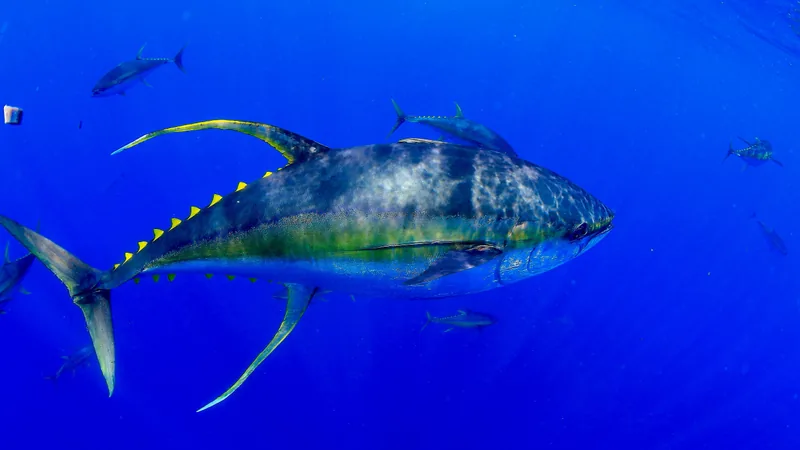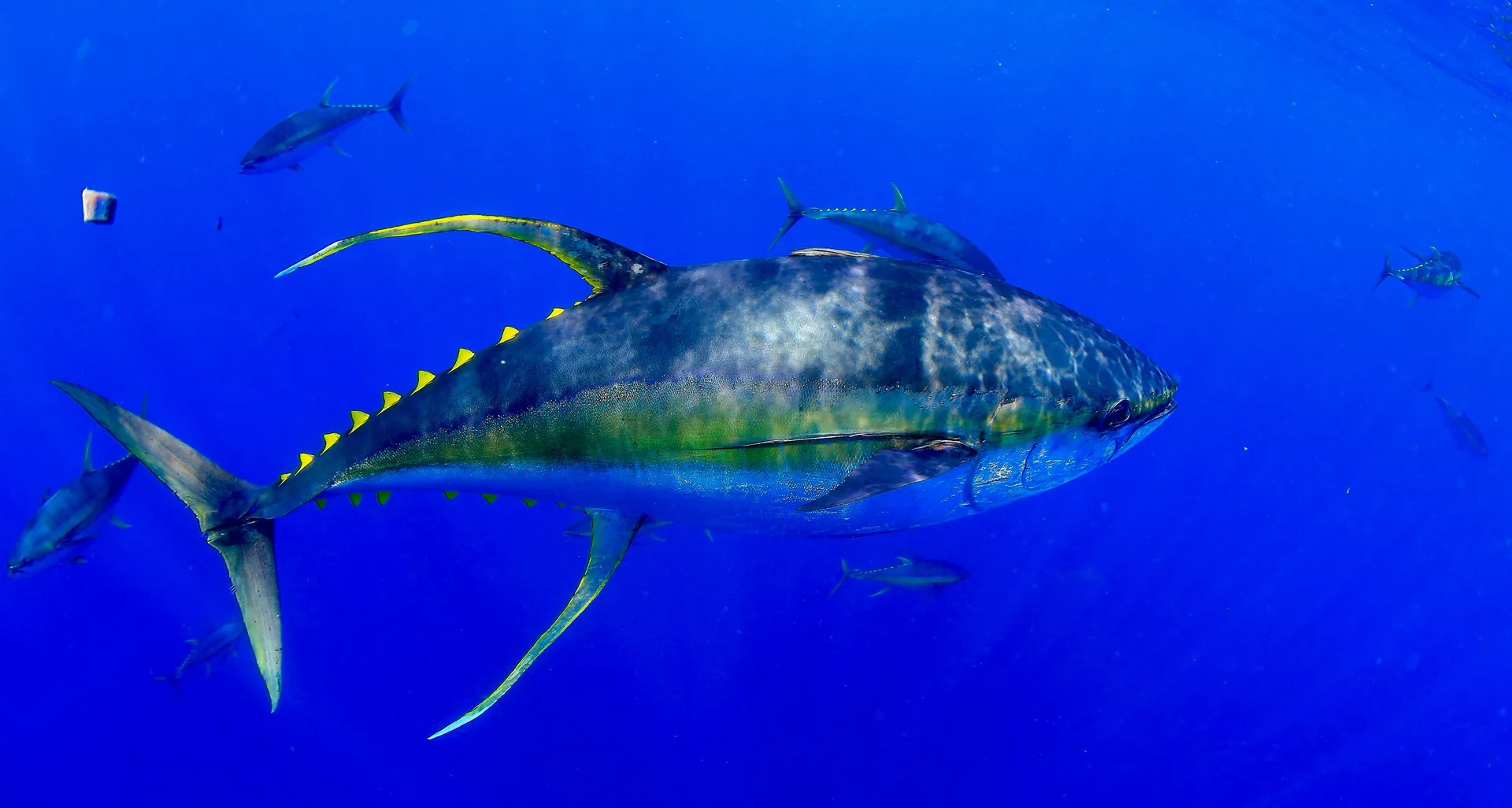
A huge yellowfin tuna Al McGlashan filmed in the Atlantic
Field
notes
A Hot-Rodded Torpedo
The yellowfin tuna runs its engine warm. Its swimming muscle is regionally endothermic: warmed in part by heat the fish makes itself. Researchers testing slow muscle fibres from yellowfin and from bonito (a cooler-running relative) found that a counter-current heat exchanger, a plumbing trick where outgoing and incoming blood trade heat, holding a 10 degrees C difference would typically double the muscle’s maximum power output.
Yellowfin are torpedo-shaped, metallic dark blue on the back, and yellow to silver on the belly, with bright-yellow dorsal and anal fins and finlets. A study of tunas found a hydraulic system in their median fins (the fins along the midline of the body): fin muscles, bones and lymphatic vessels (part of the system that manages body fluid) are involved in controlling them.
Cold plunge Tagged yellowfin in the South Atlantic dived to a maximum depth of 1,014 m and met water as cold as 6.4°C.
Grow Fast, Spawn Often
NOAA Fisheries says yellowfin grow fast, up to 6 feet long and 400 pounds. The same agency gives the Pacific stock a somewhat short life span of 6 to 7 years, though FishBase lists a maximum reported age of 18 years.
NOAA calls them very productive. Most can reproduce by age 2, and females can spawn almost daily, releasing millions of eggs each time.
Cruising the Whole Ocean
Yellowfin live in tropical and subtropical oceans around the world, and FishBase lists them as absent from the Mediterranean. They are highly migratory. Some adults tagged off Kaua’i in Hawaii made rapid dispersals of more than 800 km, and NOAA says yellowfin can swim across an entire ocean.
Their days and nights differ. Tags in the South Atlantic showed fish staying shallow, under 50 m, through the night, then spending more of the day deep, past 100 m. They feed near the top of the food chain on fish, squid and crustaceans, and they are known to gather around floating debris, anchored buoys and dolphins. Marine mammals, billfish and sharks feed on the adults.
Holding Up
The latest Red List assessment rates the species Least Concern. NOAA’s most recent assessments (2023 for the Eastern Pacific stock, 2020 for the Central and Western Pacific) find both stocks neither overfished nor subject to overfishing. In 2024, US commercial landings of Pacific yellowfin totalled 9.8 million pounds.
Published
Traits
Intel
& FAQ
Guess
first
How big is a Yellowfin Tuna, really? Slide, lock in, and see what the sources say. Every answer is a figure from this page, quoted from where it came from.
Sources
- 01Collette et al. (2021). Thunnus albacares. The IUCN Red List of Threatened Species 2021: e.T21857A46624561.
- 02Pacific Yellowfin Tuna. NOAA Fisheries.
- 03Atlantic Yellowfin Tuna. NOAA Fisheries.
- 04Thunnus albacares summary page. FishBase.
- 05Altringham & Block (1997). Why Do Tuna Maintain Elevated Slow Muscle Temperatures? Power Output Of Muscle Isolated From Endothermic And Ectothermic Fish. Journal of Experimental Biology.
- 06Pavlov et al. (2017). Hydraulic control of tuna fins: A role for the lymphatic system in vertebrate locomotion. Science.
- 07Wright et al. (2021). Yellowfin Tuna Behavioural Ecology and Catchability in the South Atlantic: The Right Place at the Right Time (and Depth). Frontiers in Marine Science.
- 08Lam et al. (2020). Complex Dispersal of Adult Yellowfin Tuna From the Main Hawaiian Islands. Frontiers in Marine Science.
What the sources say: 46 claims checked word for word against these sources →