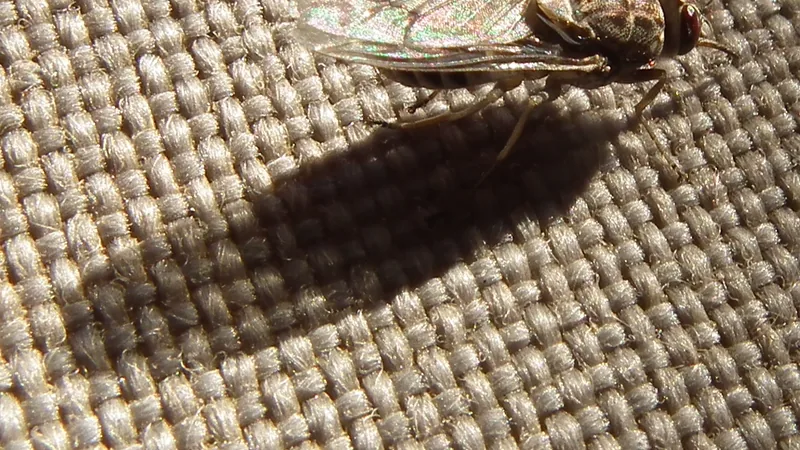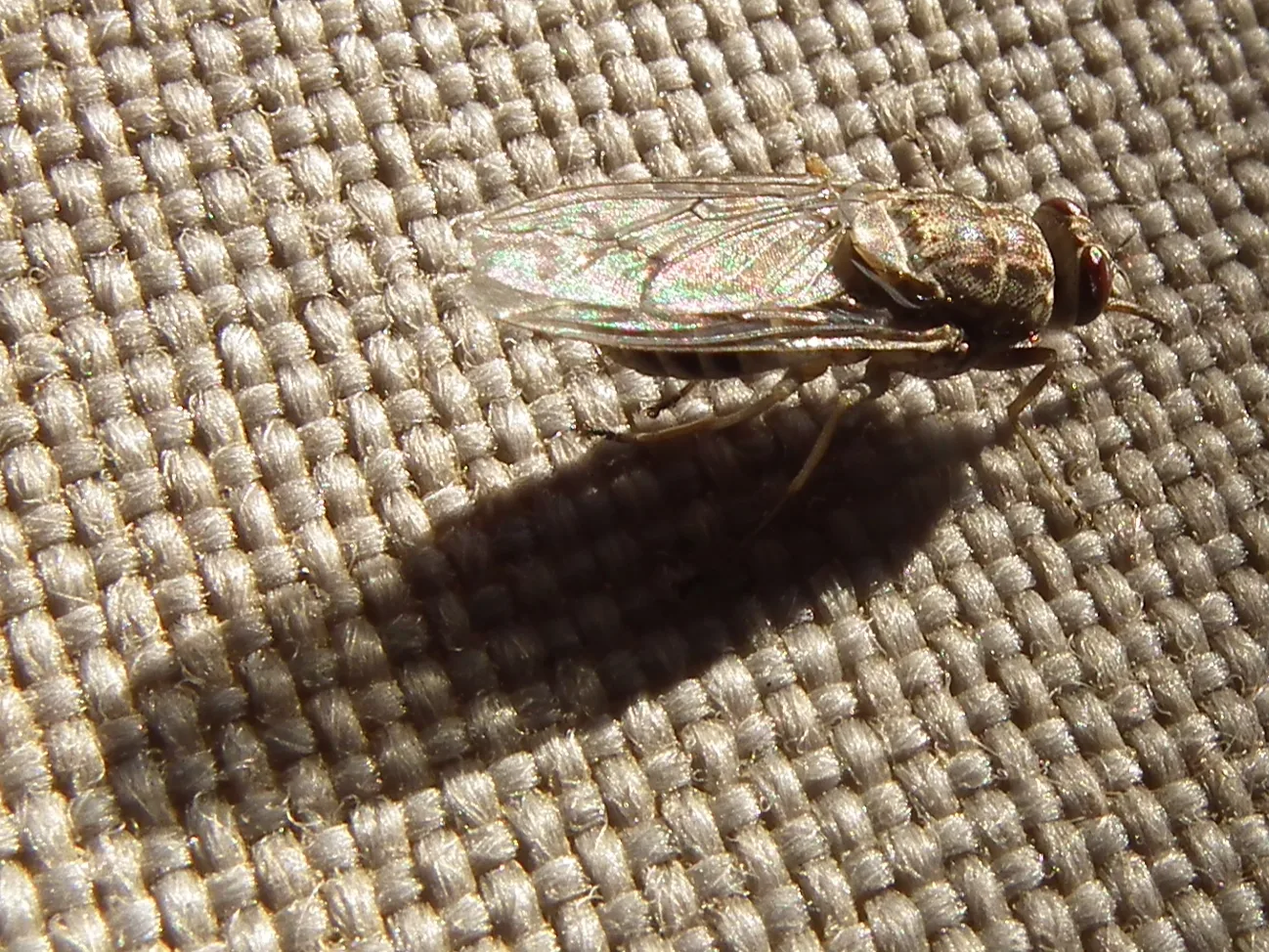
TseTse fly, Glossina_morsitans, vector of sleeping disease, picture taken in Tanzania
Field
notes
A fly that nurses its young
A female Glossina morsitans does not lay eggs. Animal Diversity Web says the embryo stays in her uterus, hatches there and is fed by “milk” glands in her reproductive tract. A study of the milk gland in Glossina morsitans calls it the tissue that passes nutrients and partner bacteria from mother to offspring.
The larva (the young, grub-like stage) is nearly as big as the adult when she drops it onto loose soil. It has about an hour to dig in, then turns black and forms a hard case called a puparium. Pupae stay underground for about a month. The mother must take three blood meals to raise one young.
Those bacteria matter. In lab work on G. morsitans, flies raised without the bacterium Wigglesworthia glossinidia as larvae grew into adults that were sterile and highly susceptible to E. coli infections of the body cavity. Normal adults of the same age resisted them.
Size, weight and lifespan
An adult G. morsitans is 7.5 to 14 millimetres long and brownish grey. In a lab colony of the subspecies G. m. morsitans, one-day-old adults averaged 20.4 milligrams for males and 22.0 for females. At 25 degrees Celsius, males in that colony lived 145.9 days on average, with a range of 9 to 241 days, and females lived 131.1 days, with a range of 4 to 208. Those are lab-reared flies, not wild ones.
Blood and nothing else
Both sexes feed exclusively on blood. They make anticoagulants, chemicals that stop clotting. The fly feeds in the daytime, is drawn to moving objects and reacts to the carbon dioxide animals breathe out. It is active only between 18 and 32 degrees Celsius.
Gulp Scientists who sequenced the tsetse genome report that flies of the genus Glossina take a blood meal almost equivalent to their own weight, and quickly pass out the excess water.
Where it lives, and what it carries
Animal Diversity Web places the species in Africa, in savanna in the wet season and shaded woodland in the dry season, always in the lowlands. In atlases of Zimbabwe and Zambia, the subspecies G. m. morsitans turned up in Zimbabwe’s north and northwest and in south-eastern Zambia.
Tsetse flies pass on the parasites that cause sleeping sickness in people and nagana in livestock. In 2014 the genome team put the number of people at risk of infection in sub-Saharan Africa at an estimated 70 million. In Zambia, researchers call G. morsitans the major vector, or carrier, of both the animal and the human forms of the disease.
Published
Traits
Intel
& FAQ
Guess
first
How big is a Tsetse Fly, really? Slide, lock in, and see what the sources say. Every answer is a figure from this page, quoted from where it came from.
Sources
- 01Fraumann (2003). Glossina morsitans. Animal Diversity Web, University of Michigan.
- 02Chigusa et al. (1997). Relationship between longevity and body weight in Glossina morsitans morsitans. Medical Entomology and Zoology.
- 03International Glossina Genome Initiative et al. (2014). Genome Sequence of the Tsetse Fly ( Glossina morsitans ): Vector of African Trypanosomiasis. Science.
- 04Weiss, Wang & Aksoy (2011). Tsetse Immune System Maturation Requires the Presence of Obligate Symbionts in Larvae. PLoS Biology.
- 05Attardo et al. (2008). Analysis of milk gland structure and function in Glossina morsitans: Milk protein production, symbiont populations and fecundity. Journal of Insect Physiology.
- 06Clausen et al. (1998). Host preferences of tsetse (Diptera: Glossinidae) based on bloodmeal identifications. Medical and Veterinary Entomology.
- 07Muyobela et al. (2025). Developing a national atlas to support the progressive control of tsetse-transmitted animal trypanosomosis in Zambia. Parasites & Vectors.
- 08Shereni et al. (2021). An atlas of tsetse and animal African trypanosomiasis in Zimbabwe. Parasites & Vectors.
What the sources say: 39 claims checked word for word against these sources →