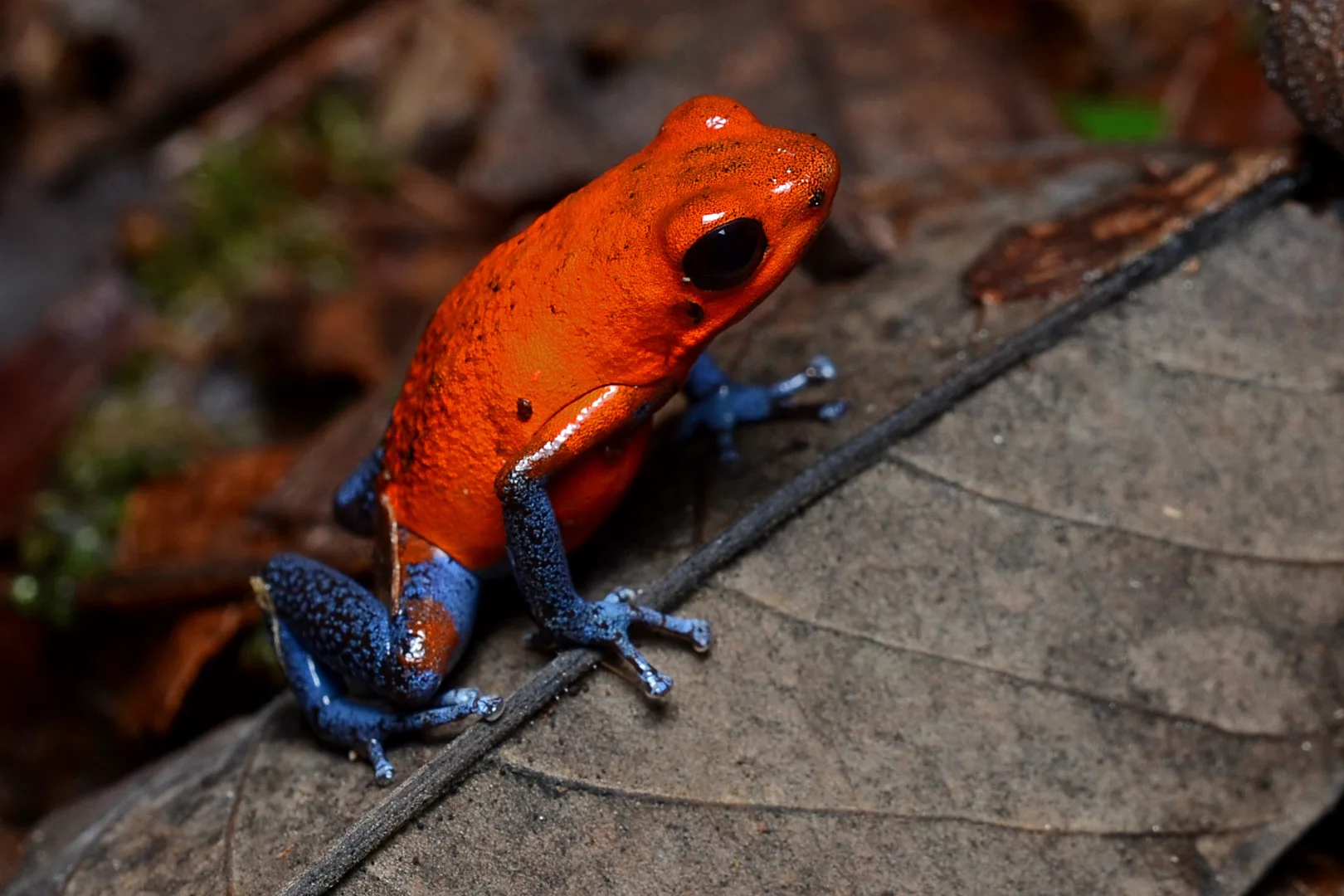
Dendrobatidae: Oophaga pumilio
Field
notes
Poison on loan
Most amphibians make their own defensive chemicals. Poison frogs collect theirs from what they eat. The strawberry poison-dart frog, Oophaga pumilio, is one of them. The chemicals are called alkaloids, and they sit in glands in the frog’s skin.
So where do they come from? Oribatid mites collected in Costa Rica and Panama held about 80 alkaloids, and 41 of them also occur in this frog. Ants are a source too. Formicine ants of two genera carry pumiliotoxins, which are major alkaloids in this frog, and those ants turned up in the stomach contents of the frogs. The frog eats mostly ants, and mites make up a significant part of its diet.
Poisoned baby food After the eggs hatch, a mother carries each tadpole to a watery hollow in the plants. She then returns for about six weeks to feed it unfertilized eggs. Those eggs hold traces of alkaloids, and the researchers suggest this frog may be the first animal known to actively provision its offspring after hatching with chemical defenses.
Tiny, bright and picky about color
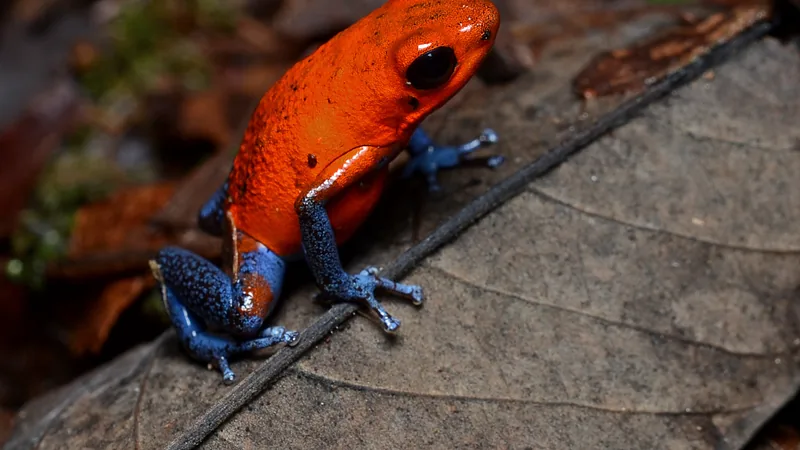
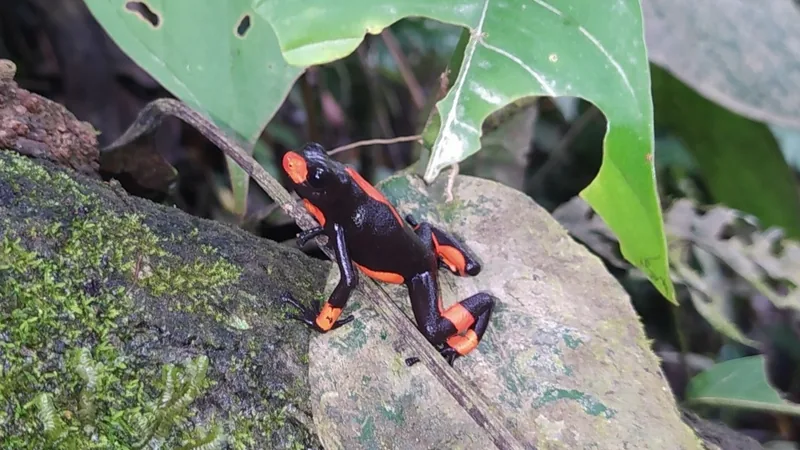
Adults are 17 to 24 mm long and weigh about 2 grams. The typical frog is bright red with blue legs, but the back can also be blue, yellow, white, green, black or orange. The bright colors work as a warning to predators.
The species has more than 15 distinct color morphs, mostly separated by geography. Most of them live on the islands and nearby mainland of the Bocas del Toro Archipelago in Panama.
Color matters to the frogs too. In tests across several populations, the results pointed to a male’s back color as the most important factor in what females preferred.
Wrestling on the forest floor
Males call to mark a territory. If another male answers and approaches, they often wrestle, and a match can last up to 20 minutes. At La Selva Biological Station, studies found males defending territories of 0.24 to 4.78 square metres. These frogs are active by day and usually stay close to the forest floor. They are mostly solitary, and gather to breed.
Where it lives
The frog is found in lowland forests along the Caribbean side of Central America, from Nicaragua to Panama. It typically lives in rainforest and also in cacao groves. The IUCN Red List rates it Least Concern.
Published Updated
Traits
Intel
& FAQ
Guess
first
How big is a Strawberry Poison-Dart Frog, really? Slide, lock in, and see what the sources say. Every answer is a figure from this page, quoted from where it came from.
Sources
- 01Oophaga pumilio. Animal Diversity Web.
- 02Strawberry Poison Dart Frog. Nordens Ark.
- 03Stynoski et al. (2014). Evidence of maternal provisioning of alkaloid-based chemical defenses in the strawberry poison frog Oophaga pumilio. Ecology.
- 04Saporito et al. (2007). Oribatid mites as a major dietary source for alkaloids in poison frogs. Proceedings of the National Academy of Sciences.
- 05Saporito et al. (2004). Formicine ants: An arthropod source for the pumiliotoxin alkaloids of dendrobatid poison frogs. Proceedings of the National Academy of Sciences.
- 06Hovey et al. (2018). Sequestered Alkaloid Defenses in the Dendrobatid Poison Frog Oophaga pumilio Provide Variable Protection from Microbial Pathogens. Journal of Chemical Ecology.
- 07Dreher, Cummings & Pröhl (2015). An Analysis of Predator Selection to Affect Aposematic Coloration in a Poison Frog Species. PLOS ONE.
- 08Maan & Cummings (2008). Female preferences for aposematic signal components in a polymorphic poison frog. Evolution.
- 09Rogers et al.. Genomic takeover by transposable elements in the Strawberry poison frog. Molecular Biology and Evolution.
- 10Oophaga pumilio. The IUCN Red List of Threatened Species 2015: e.T55196A3025630.
What the sources say: 43 claims checked word for word against these sources →