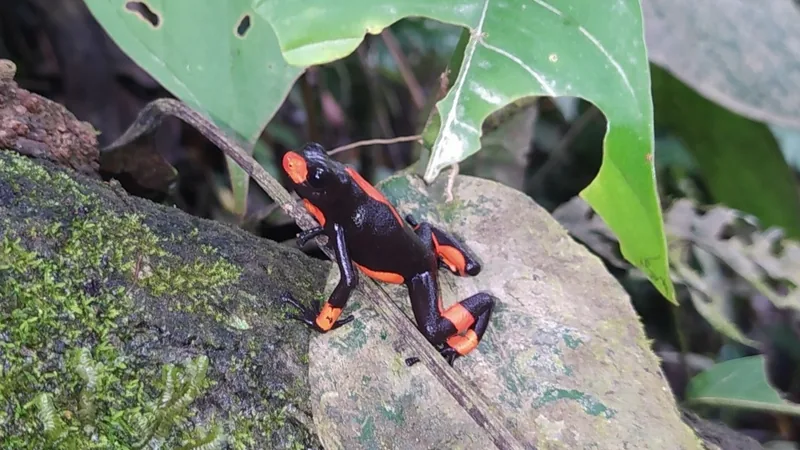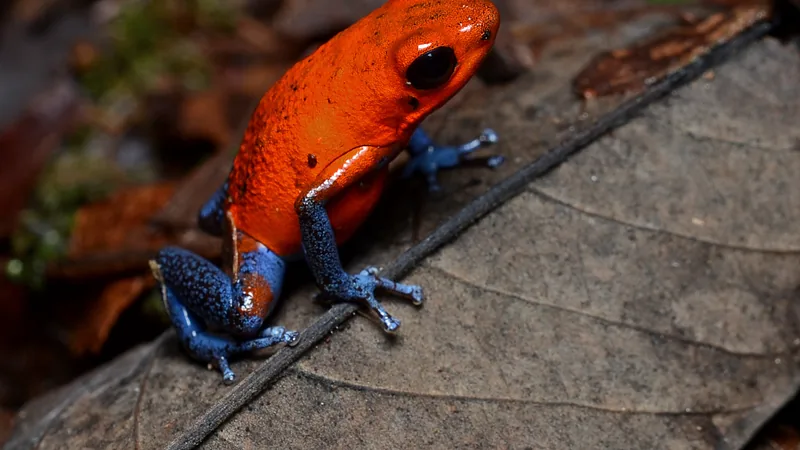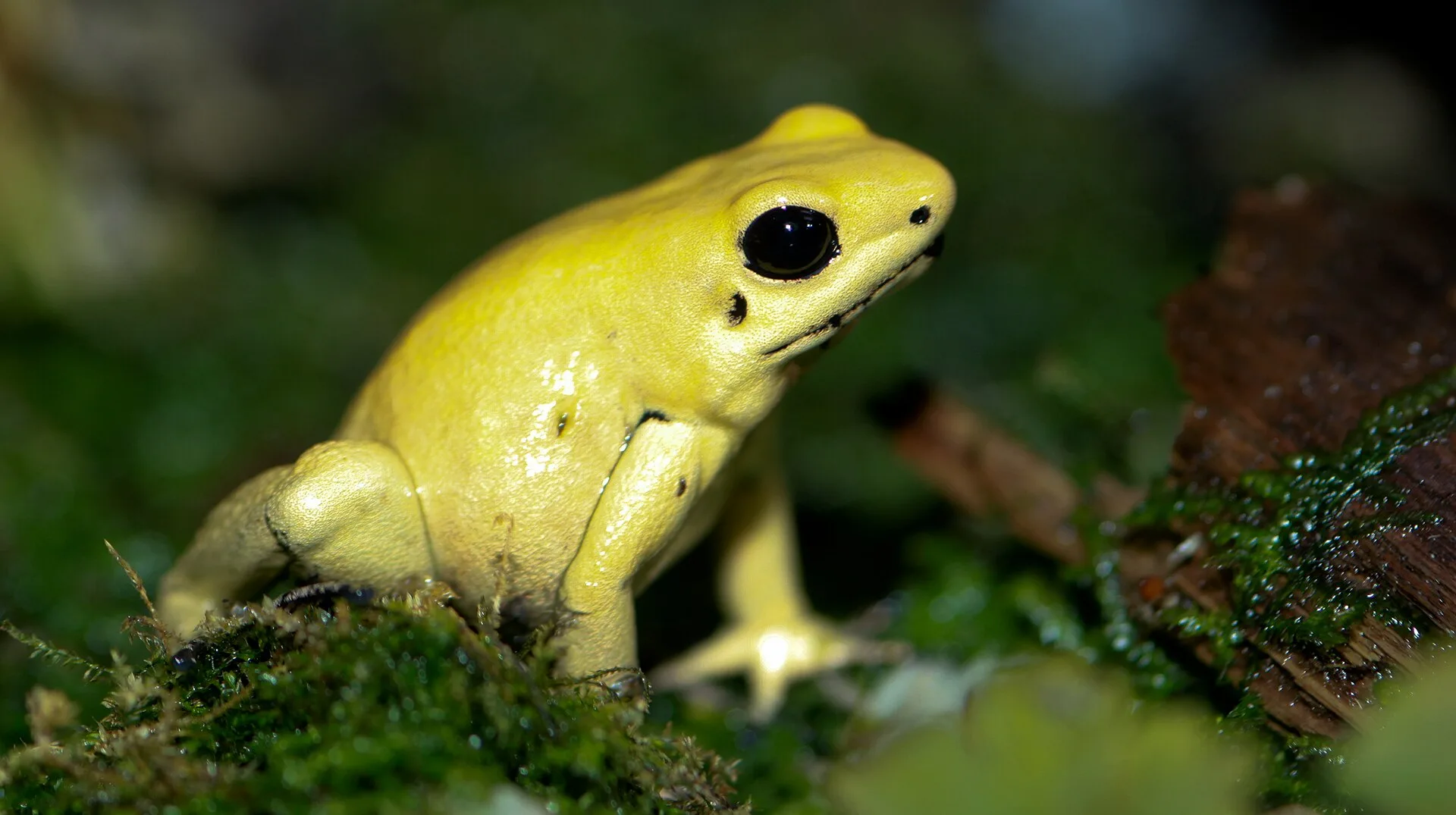
A wild golden poison frog in the Resguardo Indígena Calle Santa Rosa, Colombia.
Field
notes
Small Frog, Enormous Poison
The golden poison frog (Phyllobates terribilis) is no larger than a bottle cap, yet it is considered the most poisonous animal in the world. Large females reach 4.7 cm long and males 4.5 cm, and both weigh less than an ounce. Their life expectancy in a terrarium is 8 to 15 years.
Its skin holds remarkably high amounts of batrachotoxin, one of the strongest toxins in the animal kingdom. The poison of a single frog could kill up to ten people, and the Smithsonian’s National Zoo calls it the most toxic of all frog species. Batrachotoxin acts on the sodium channels of nerve and muscle cells: it keeps the channels open and depolarizes the cells irreversibly, which may lead to arrhythmias, fibrillation and eventually cardiac failure.
A Tiny Corner of Colombia
Golden poison frogs live in a tiny plot of rainforest on Colombia’s Pacific coast: under five small areas of the Cauca department. It is hot, very humid, hilly lowland forest, 30 to 400 metres above sea level, with around 4,000 mm of rain a year, and the known sites lie within an area of only 1,475 square kilometres. Active by day, the frogs live in the leaf litter on the forest floor, hunting mostly ants, along with termites and small beetles.
Poison From Food
The frogs cannot make batrachotoxin on their own. They take in the toxin or its building blocks with the food they eat in the wild, though exactly how is not yet clear. One study has suggested that beetles of the family Melyridae in Colombian rainforests could be the source of the batrachotoxin in the Phyllobates frogs there.
Captivity fades the poison. Without that food in a terrarium, wild-caught frogs gradually lose their toxicity over months, and captive-bred frogs are generally non-toxic to humans. Yet in one study, frogs kept in captivity for up to 6 years were still at least five times more toxic than other Phyllobates species used to poison blowgun darts, and frogs bred and raised to adulthood in captivity had no detectable batrachotoxin.
Darts and Deforestation
The indigenous Emberá people of Colombia have used the frog’s poison for centuries to tip their blowgun darts when hunting, a traditional method now rarely practised. The IUCN lists the golden poison frog as Endangered, and its populations continue to decline. The main threat is the ongoing destruction of its rainforest through deforestation for agriculture, the spread of human settlements and mining. Herbicide pollution from cereal crops grown in its habitat is a threat too.
Published Updated
Traits
Intel
& FAQ
Guess
first
How big is a Golden Poison Frog, really? Slide, lock in, and see what the sources say. Every answer is a figure from this page, quoted from where it came from.
Sources
- 01Basic information and care recommendations for Phyllobates terribilis, Golden Poison Frog. Citizen Conservation, 2024.
- 02Golden Poison Frog. National Geographic.
- 03Poison Frog. San Diego Zoo Wildlife Alliance.
- 04Phyllobates terribilis. Animal Diversity Web, University of Michigan.
- 05Poison frogs. Smithsonian's National Zoo and Conservation Biology Institute.
- 06Phyllobates terribilis. The IUCN Red List of Threatened Species 2017: e.T55264A85887889.
- 07Daly et al. (1980). Levels of Batrachotoxin and Lack of Sensitivity to Its Action in Poison-Dart Frogs (Phyllobates). Science.
- 08Dumbacher et al. (2004). Melyrid beetles (Choresine): A putative source for the batrachotoxin alkaloids found in poison-dart frogs and toxic passerine birds. Proceedings of the National Academy of Sciences.
What the sources say: 52 claims checked word for word against these sources →