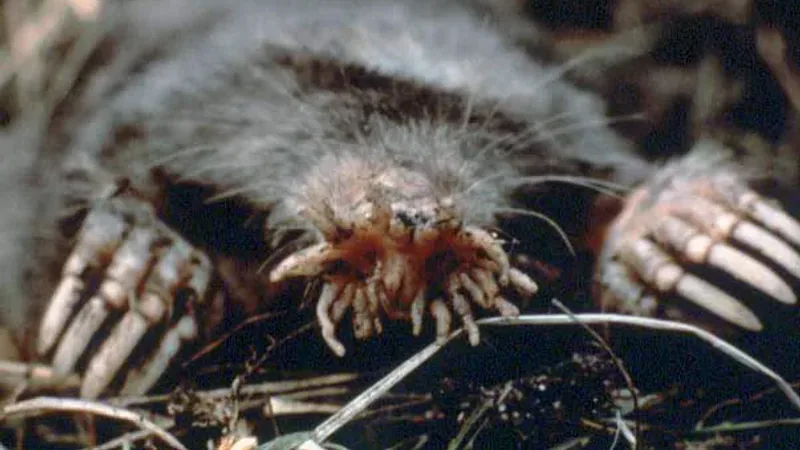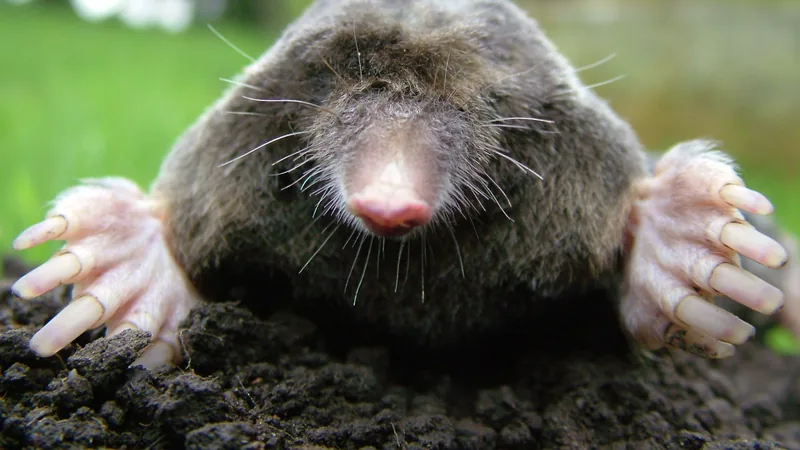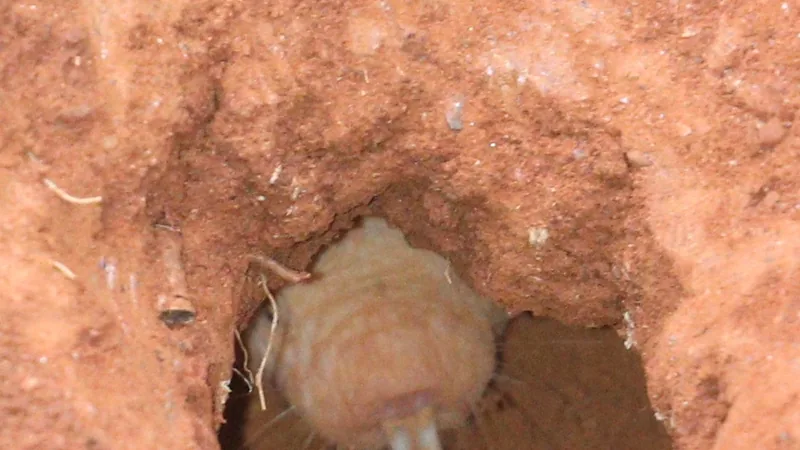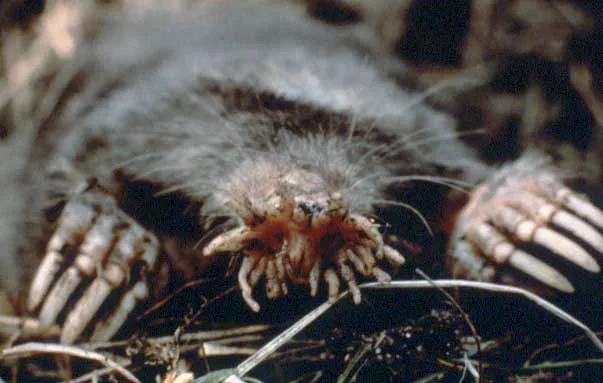
Star-nosed mole with its nasal rays spread
Field
notes
A Mole of Wet Ground
The star-nosed mole (Condylura cristata) is a stout, dark mole native to eastern North America, ranging from Quebec and Newfoundland west to Manitoba and North Dakota, and south along the Appalachians and the Atlantic coast to Georgia. It measures 175 to 205 millimetres from nose to tail-tip and weighs 35 to 75 grams, with a scaly tail that swells to three or four times its normal diameter each winter, when it serves as a fat store. Because a female raises only one litter a year, biologists have speculated the species may live a relatively long 3 to 4 years in the wild for an animal its size; the record in captivity is 2.5 years. It favours marshes, peatlands, wet meadows and poorly drained forest, and lives along the banks of streams, lakes and ponds, venturing into the water for food.
Diet, Diving and Predators
Its diet is mostly invertebrate. Worms make up about half of what it eats, 80 percent of them aquatic species such as leeches, and aquatic insects such as caddisfly and midge larvae add another 30 percent. It also takes the occasional small fish, mollusk or crustacean. It swims with alternating strokes of its front and hind feet in a zigzag motion, diving for about ten seconds at a time, and it stays active through winter, burrowing through snow and swimming beneath the ice of frozen ponds. An alarmed mole can run short distances at 6.4 to 8 kilometres an hour. Owls and hawks hunt it from the air, foxes and weasels take it too, the semi-aquatic mink may hunt it underwater, and bullfrogs and largemouth bass are known aquatic predators.
Twenty-Two Rays Devoted to Touch
Around its nostrils sits a ring of twenty-two fleshy pink rays, eleven to a side. The star is devoted to the sense of touch: each ray is covered in tiny domes called Eimer’s organs, which nearly all other members of the mole family share. Two of the three kinds of touch receptor packed into each Eimer’s organ also show up in the skin of other mammals; the third is unique to this species and is thought to let it identify objects by their microscopic texture.
Less than a square centimetre of skin carries more than 25,000 Eimer’s organs. While foraging, the star touches a new spot about thirteen times a second, and it makes rapid saccades, like an eye’s, to bring its lowest pair of rays onto prey it has touched, at up to around 40 centimetres a second.
The Fastest Known Forager Among Mammals
A star-nosed mole can identify and eat a piece of prey in as little as 120 milliseconds, with a mean of 227 milliseconds, and it is the fastest known forager among mammals. “Double takes” during prey identification suggest it has reached the speed limit for processing touch. It can even smell underwater by re-sniffing bubbles of its own exhaled air.
Published Updated
Traits
Intel
& FAQ
Guess
first
How big is a Star-Nosed Mole, really? Slide, lock in, and see what the sources say. Every answer is a figure from this page, quoted from where it came from.
Sources
- 01Condylura cristata (star-nosed mole). Animal Diversity Web, University of Michigan.
- 02Star-Nosed Mole. SUNY College of Environmental Science and Forestry, Adirondack Ecological Center.
- 03AnAge entry for Condylura cristata. AnAge: The Animal Ageing and Longevity Database, Human Ageing Genomic Resources.
- 04Cassola (2016). Condylura cristata. The IUCN Red List of Threatened Species 2016: e.T41458A115187740.
- 05Catania & Remple (2005). Asymptotic prey profitability drives star-nosed moles to the foraging speed limit. Nature.
- 06Catania (2006). Underwater 'sniffing' by semi-aquatic mammals. Nature.
- 07Catania (2011). The sense of touch in the star-nosed mole: from mechanoreceptors to the brain. Philosophical Transactions of the Royal Society B: Biological Sciences.
- 08Catania (1999). A nose that looks like a hand and acts like an eye: the unusual mechanosensory system of the star-nosed mole. Journal of Comparative Physiology A: Sensory, Neural, and Behavioral Physiology.
- 09Catania & Remple (2003). Tactile Foveation in the Star-Nosed Mole. Brain, Behavior and Evolution.
- 10Catania (2000). Epidermal Sensory Organs of Moles, Shrew Moles, and Desmans: A Study of the Family Talpidae with Comments on the Function and Evolution of Eimer's Organ. Brain, Behavior and Evolution.
What the sources say: 53 claims checked word for word against these sources →