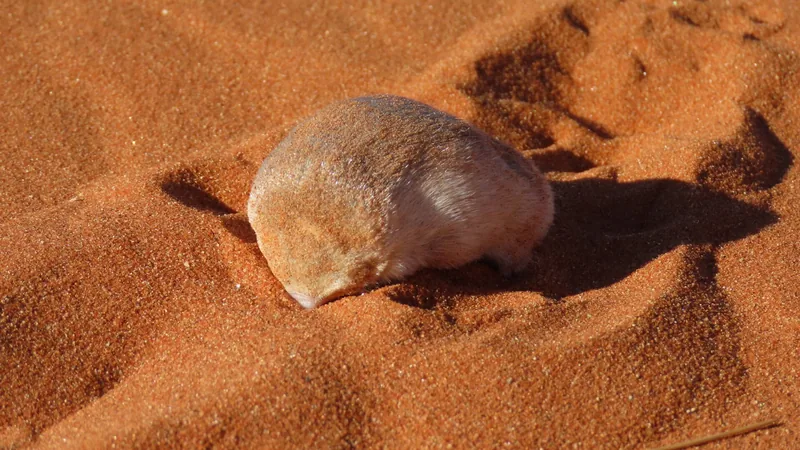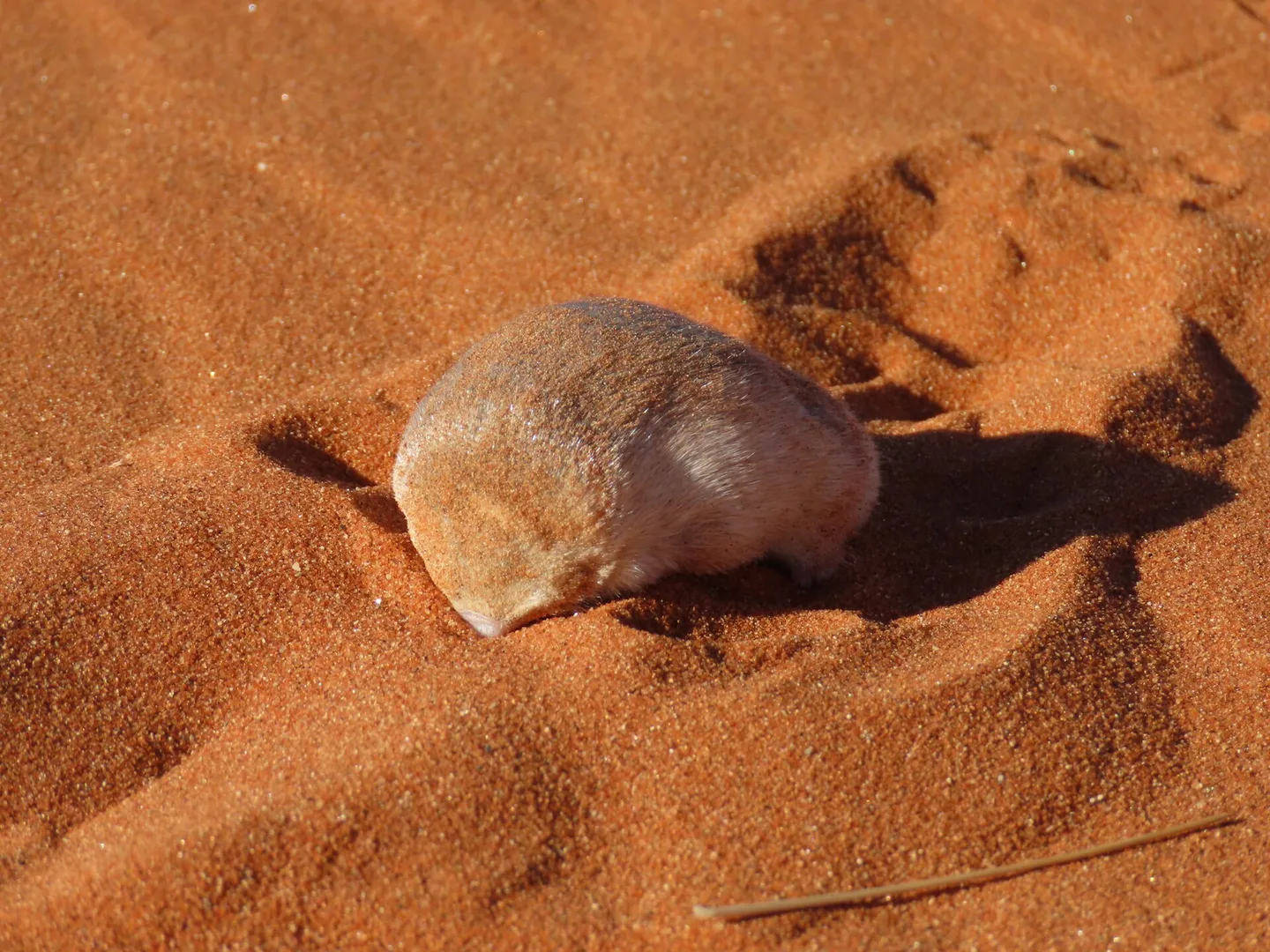
Namib golden mole on a red dune, Namibia
Field
notes
Built for Loose Sand
Grant’s golden mole doesn’t maintain a permanent tunnel, because the sand it burrows through collapses behind it. Many therefore consider it a sand swimmer, one that digs a new burrow each time it moves. It has a head and body length of 70 to 85 mm and a mass of 16 to 32 g, males running larger than females. It has no external eyes: the eyelids fuse at a young age, and the skin covering the eyes then thickens.
Hunting Through Vibration
Functionally blind, the mole hunts by vibration. In the Namib, recordings in the sand suggest it can detect termite colonies and other prey using seismic cues alone. Its malleus, one of the tiny bones inside the middle ear, is hypertrophied, an adaptation for picking up low-frequency signals. Clumps of dune grass, home to its prey, give off low-frequency vibrations that stand out from background noise many meters away, and the mole apparently uses them to orient itself toward the grass. It forages at night, running across the dune surface and periodically dipping beneath it to locate prey by vibration, and some individuals have been known to travel up to 5,800 m while foraging. Termites make up more than half of its diet, topped up with crickets, beetles, ants, moths, spiders, mealybugs, web-footed geckos and legless lizards.
A middle ear built like ballast The mole’s malleus has been measured at 2.44 grams per cubic centimetre, denser than the equivalent bone in any other land mammal on record. The ear bones of other golden mole species are not unusually dense.
Living Without Water
The coastal dunes Grant’s golden mole calls home, stretching from South Africa’s southwestern Cape and Little Namaqualand north into the Namib Desert of Namibia, are one of the driest habitats in the world. In the Namib it can survive on an insect diet without drinking water: efficient kidneys make that possible, and low energy use and torpor cut how much water it needs. By day it burrows 50 cm down into the sand and enters torpor, lowering its metabolism to reduce its energy demands. Its nightly surface foraging often exposes it to predators, including spotted eagle-owls, barn owls, and domestic cats and dogs. The IUCN currently lists the species as Least Concern.
Published Updated
Traits
Intel
& FAQ
Guess
first
How big is a Golden Mole, really? Slide, lock in, and see what the sources say. Every answer is a figure from this page, quoted from where it came from.
Sources
- 01Eremitalpa granti (Grant's golden mole). Animal Diversity Web, University of Michigan.
- 02Maree (2015). Eremitalpa granti. The IUCN Red List of Threatened Species 2015: e.T7994A21283661.
- 03Narins et al. (1997). The Use of Seismic Signals by Fossorial Southern African Mammals: A Neuroethological Gold Mine. Brain Research Bulletin.
- 04Mason & Narins (2002). Seismic sensitivity in the desert golden mole (Eremitalpa granti): A review. Journal of Comparative Psychology.
- 05Mason et al. (2006). Ossicular density in golden moles (Chrysochloridae). Journal of Comparative Physiology A.
- 06Fielden, Perrin & Hickman (1990). Water metabolism in the Namib Desert Golden Mole, Eremitalpa granti namibensis (Chrysochloridae). Comparative Biochemistry and Physiology Part A: Physiology.
What the sources say: 32 claims checked word for word against these sources →