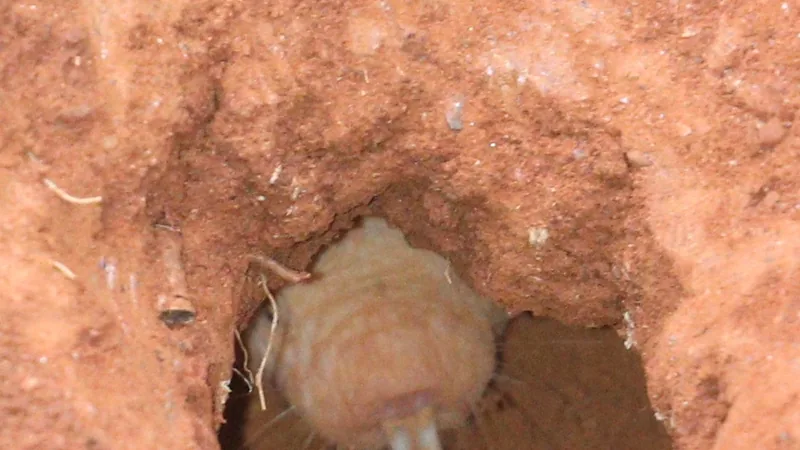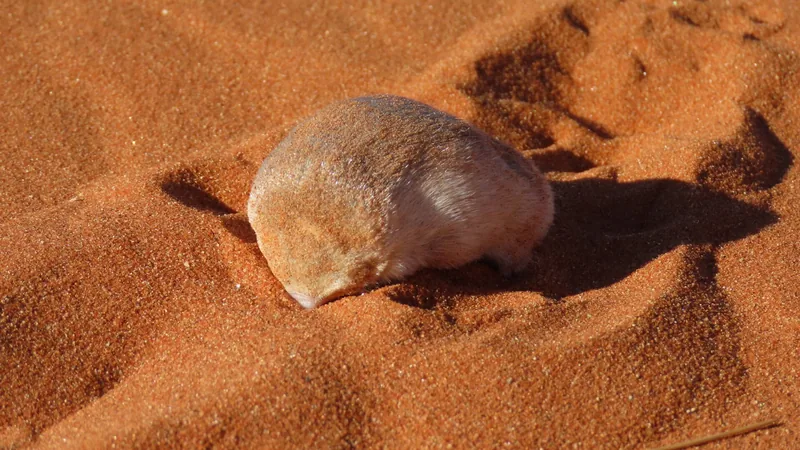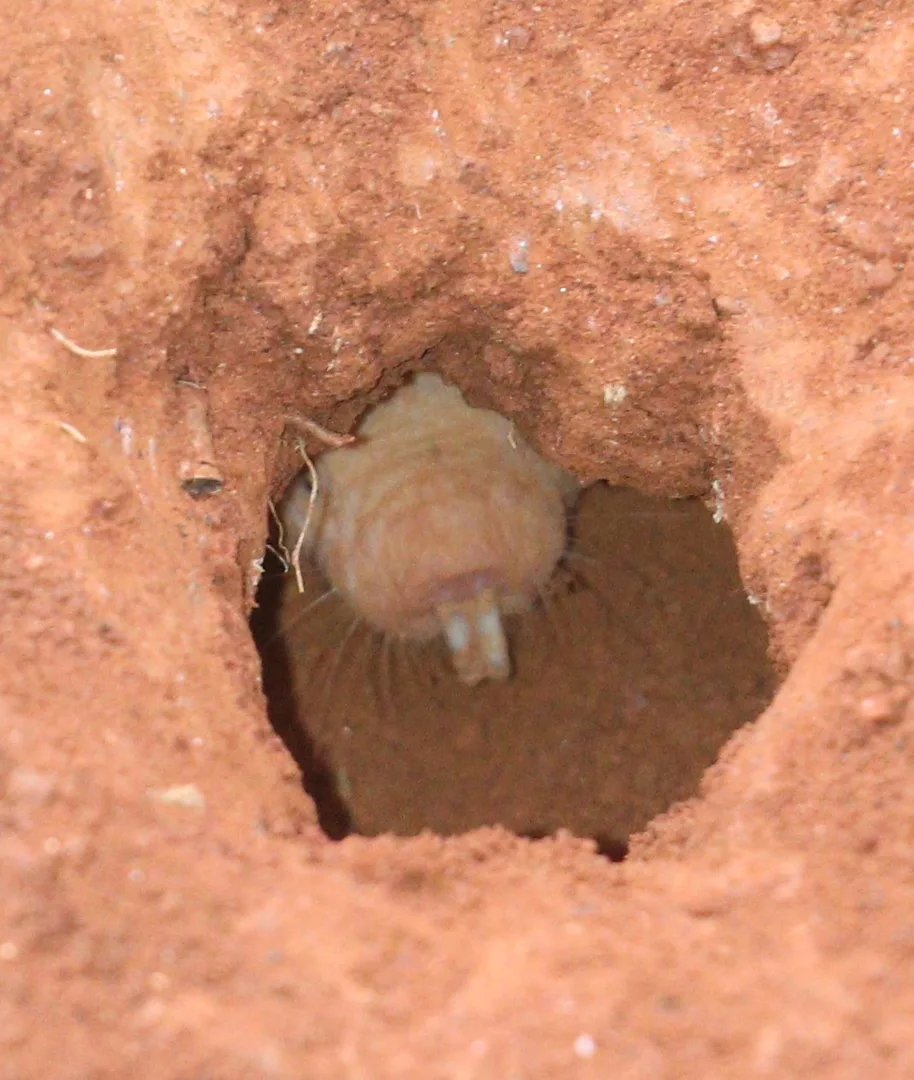
A naked mole-rat at a burrow opening in Meru National Park, Kenya.
Field
notes
Chopstick Teeth and a Beehive Underground
A naked mole-rat tunnels with its front teeth, which can move independently of each other, spreading apart and coming back together like a pair of chopsticks. Its lips close behind them, so it can dig without getting dirt in its mouth, and about a quarter of its muscle mass is in its jaws.
Naked mole-rats are eusocial, living much the way bees and ants do: one breeding female, called the queen, is the mother of almost all the others, while most colony members spend their whole lives working for the colony. A colony averages around 70 mole-rats, though colonies of up to 295 have been seen, and its tunnels can total up to 4 kilometers, some running 2 meters deep. If the queen dies, a few females may fight to the death to take her place, and the winner’s spine stretches to get ready to have pups. The main predators are snakes, especially the rufous beaked snake, and snakes move easily through the tunnels; a mole-rat that meets one runs back chirping a warning, and several soldiers may pile on top of each other to block the way.
Built to Outlast Every Other Rodent
A naked mole-rat is tiny: about 8 to 10 centimeters long and 30 to 50 grams, though soldiers can weigh up to 57 grams and the queen up to 71. It eats underground roots and tubers, some more than a foot across, and gets all the water it needs from that food without drinking. It lives in the semi-arid grasslands of Ethiopia, Kenya, Djibouti and Somalia. What sets it apart is how long it keeps living: a naked mole-rat can live past 30, the longest reported lifespan of any rodent. Researchers who analyzed records of more than 3,000 captive naked mole-rats found that, unlike every other mammal studied so far, their risk of dying did not rise with age, even at 25 times their age at reproductive maturity.
A built-in cancer brake Naked mole-rat cells release a form of a molecule called hyaluronan more than five times larger than the human version, and it builds up in their tissues. It triggers early contact inhibition, which stops cells dividing at a much lower density than mouse cells, a powerful defense against cancer. Cancer in naked mole-rats is rare.
Acid, Chili and Thin Air
The nerves in a naked mole-rat’s skin lack a pain-related chemical messenger called substance P, and acid and the capsaicin in chili peppers barely trigger any pain-related behavior. Its tunnels run thin on air, too: the air in its burrows holds around 8 percent oxygen and more than 20 percent carbon dioxide. A naked mole-rat can survive days breathing air that thin, and hours at just 3 percent oxygen. In lab tests with no oxygen at all, it switches to an oxygen-free way of making energy, fueled by a sugar called fructose that builds up in its brain, and survives 18 minutes without apparent injury.
Published Updated
Traits
Intel
& FAQ
Sources
- 01Naked Mole-Rat. San Diego Zoo Wildlife Alliance.
- 02Naked mole-rat. Smithsonian's National Zoo and Conservation Biology Institute.
- 03Heterocephalus glaber (naked mole rat). Animal Diversity Web, University of Michigan.
- 04Maree & Faulkes (2016). Heterocephalus glaber. The IUCN Red List of Threatened Species 2016: e.T9987A115095455.
- 05Tian et al. (2013). High-molecular-mass hyaluronan mediates the cancer resistance of the naked mole rat. Nature.
- 06Kim et al. (2011). Genome sequencing reveals insights into physiology and longevity of the naked mole rat. Nature.
- 07Ruby, Smith & Buffenstein (2018). Naked mole-rat mortality rates defy Gompertzian laws by not increasing with age. eLife.
- 08Park et al. (2008). Selective Inflammatory Pain Insensitivity in the African Naked Mole-Rat (Heterocephalus glaber). PLoS Biology.
- 09Park et al. (2017). Fructose-driven glycolysis supports anoxia resistance in the naked mole-rat. Science.
- 10Lashani et al. (2025). Naked mole-rats employ a normoxic escape behaviour that is altered by social interaction. Biology Letters.