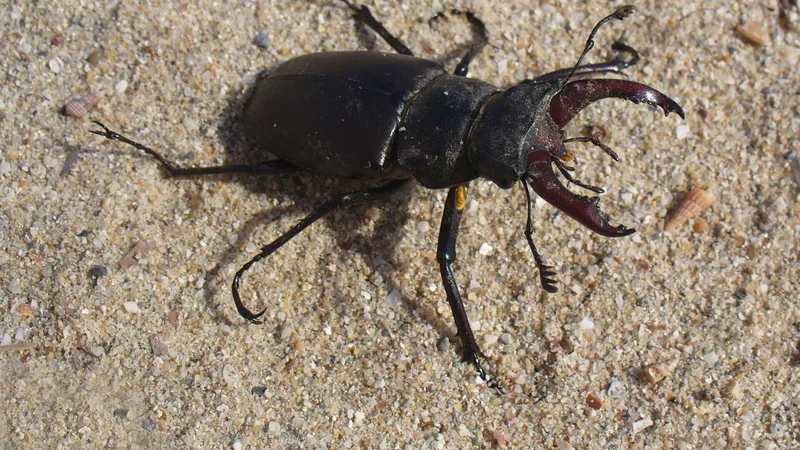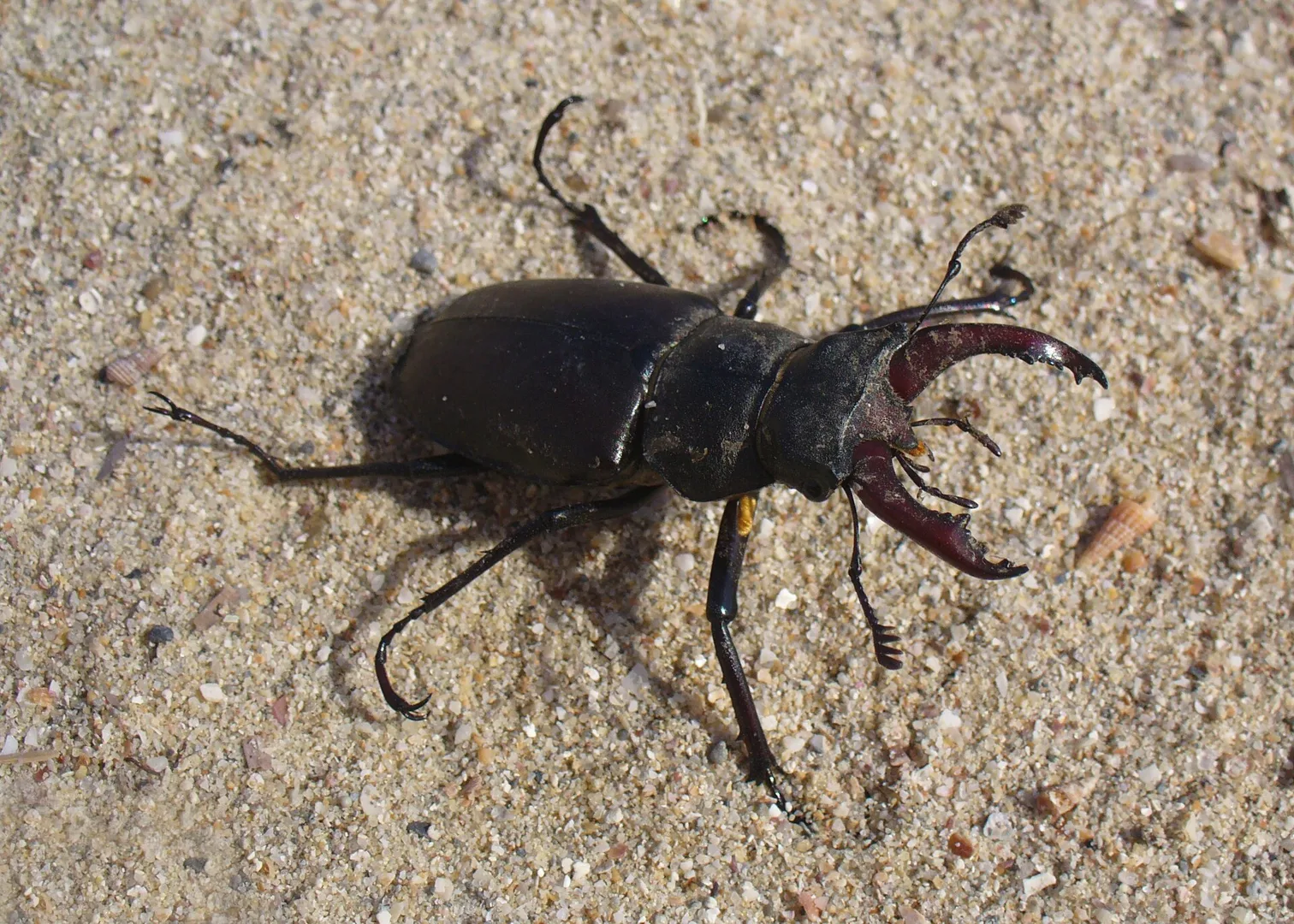
Lucanus cervus male. Ukraine, Crimea
Field
notes
Living Antlers
A male stag beetle can measure up to 7.5 centimeters long, jaws included, making it the largest beetle in the UK and in Europe. Males run 35 to 75 millimeters and females 30 to 50 millimeters, and adults weigh 2 to 6 grams. Size varies across Europe: beetles from Spain, Germany and the Netherlands are larger than those from Belgium or the UK. In the UK, most individuals are relatively small.
Males use those oversized jaws to battle each other for access to females. A male raises them as a warning to rivals. In a fight, each beetle tries to pry the other loose from where it clings, and the more similar their jaw size, the longer the battle lasts.
Skilled wrestlers. A male can even stand up on his hind legs to throw an opponent, and the largest beetle almost always wins.
In one study, the bigger-jawed “major” males survived at a lower rate than “minor” males, and body fragments left by corvids showed the two forms faced different predation pressure. Mating success depends on a male’s size relative to the female’s, and very large males are less successful at it.
Years Underground, Weeks Above Ground
A stag beetle typically lives three to seven years, and spends most of that time as a larva underground. Females lay 15 to 36 eggs in a single clutch, 24 on average, and an egg hatches after about three weeks. The larva then spends three to five years underground, often up to a meter deep, feeding on decaying wood, most often oak. A larva can grow to around 11 centimeters, longer than the adults.
After about six weeks as a pupa, the adult stays underground until the following May or June, usually digging its way out after warm summer rains, when the ground is softer. An adult doesn’t eat solid food: it drinks sweet fluids such as tree sap and the juice of rotting fruit, and mostly relies on energy stored as a larva. It has only a few weeks left to find a mate before it dies, usually by August. Stag beetles are sedentary: dispersal distances seem to range from a few hundred meters up to a maximum of five kilometers.
A Beetle in Trouble
Stag beetles rely on dead wood, and losing it is the main reason the species is struggling, as woodland, parks and gardens are tidied up and broadleaf woodland becomes farmland, plantations and towns. The stag beetle is found widely across Europe, and throughout its range it has shown pronounced declines. The IUCN Red List records it as extinct in Estonia and Lithuania and reintroduced to Denmark. It’s been protected under the European Union’s Habitats Directive since 1992, and the Red List currently classifies it as Near Threatened.
Despite their intimidating appearance, stag beetles are harmless to people. A male can give a bit of a pinch, but only if you encourage him; a female’s jaws are a bit stronger and can bite, but females aren’t aggressive. Stag beetles break down dead wood and return its nutrients to the soil. They also provide food for birds, and in towns they face a lot of predation from cats, foxes, crows and magpies.
Published Updated
Traits
Intel
& FAQ
Guess
first
How big is a Stag Beetle, really? Slide, lock in, and see what the sources say. Every answer is a figure from this page, quoted from where it came from.
Sources
- 01Stag beetles: Facts about the UK's largest beetle and where to see it. Natural History Museum, London.
- 02Telnov (2025). Lucanus cervus. The IUCN Red List of Threatened Species 2025: e.T239951016A213072777.
- 03Harvey et al. (2011). Bionomics and distribution of the stag beetle, Lucanus cervus (L.) across Europe*. Insect Conservation and Diversity.
- 04Tini et al. (2017). Detection of stag beetle oviposition sites by combining telemetry and emergence traps. Nature Conservation.
- 05Harvey & Gange (2006). Size variation and mating success in the stag beetle, Lucanus cervus. Physiological Entomology.
- 06Romiti et al. (2015). Exaggerated allometric structures in relation to demographic and ecological parameters in Lucanus cervus (Coleoptera: Lucanidae). Journal of Morphology.
- 07Cox et al. (2019). Phylogeographic structure and ecological niche modelling reveal signals of isolation and postglacial colonisation in the European stag beetle. PLOS ONE.
What the sources say: 44 claims checked word for word against these sources →