Satanic Leaf-Tailed Gecko displaying extreme leaf mimicry
Field
notes
Dressed as a Dead Leaf
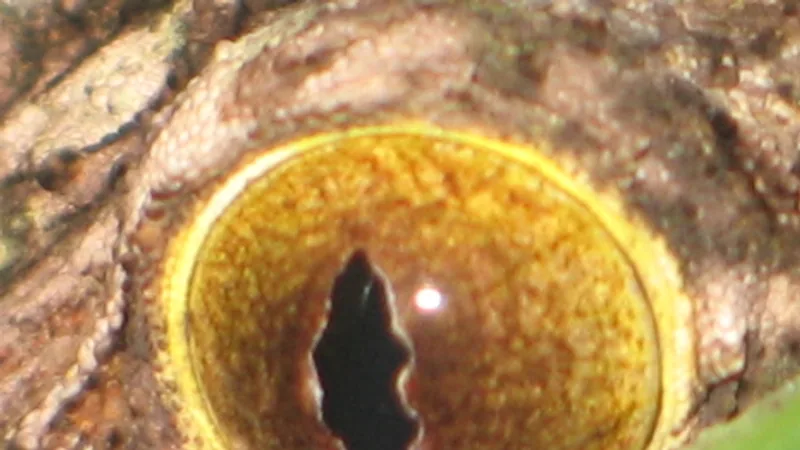
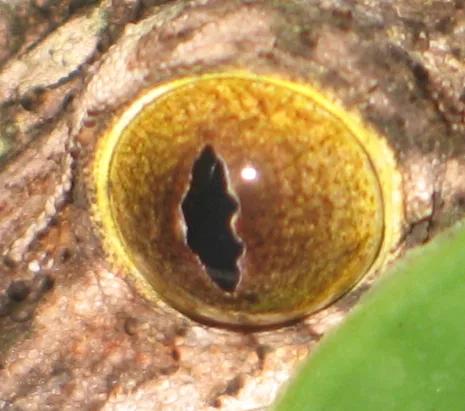
The satanic leaf-tailed gecko (Uroplatus phantasticus) is a lizard in dead-leaf disguise. It comes in mottled shades of brown, grey or rust to match different kinds of dead leaves, and its flattened tail closely resembles a dead leaf, complete with apparent decay and missing pieces. Its camouflage includes patches that resemble lichen, ridges that look like leaf veins, and missing chunks that mimic bits of a dead leaf that have broken off. It has large eyes with vertical pupils, and above each eye, pointy scales resemble horns. It is also called the phantastic leaf-tailed gecko.
One of the Smallest Leaf-Tailed Geckos
Uroplatus phantasticus is one of the smallest of Madagascar’s leaf-tailed geckos, a genus found nowhere else on Earth. It is usually around 9 centimetres (3.5 inches) long, and its body alone measures 55 to 70 millimetres from snout to vent. Individuals in human care can live up to 15 years. It spends its days asleep and its nights active, keeping to the trees and shrubs of Madagascar’s eastern rainforests and rarely climbing more than about 10 feet (3 meters) off the ground.
A Loud, Red-Mouthed Bluff
When confronted, this gecko opens wide. Faced with a bird or snake that might eat it, it gapes to flash a bright red tongue and mouth and lets out a loud cry, hoping to scare the predator off.
Scientists know little about what this gecko eats in the wild. In human care it eats crickets, moths and other small invertebrates. Scientists also know very little about how this species communicates.
Eggs in the Leaf Litter
Females lay clutches of two round eggs in the leaf litter of the forest floor at the start of the rainy season, which begins around November in Madagascar. At a captive-breeding colony in Kyiv, 119 measured gaps between one clutch and the next averaged 34 days, and eggs took an average of 94 days to hatch. In that colony, all 43 recorded matings took place within two hours of the room lights being switched off. The species is rated Least Concern by the IUCN, though it was once threatened by the international pet trade. Export is now illegal, and its future hinges on the continued protection of its rainforest habitat in eastern Madagascar.
Published Updated
Traits
Intel
& FAQ
Sources
- 01Phantastic leaf-tailed gecko. Smithsonian's National Zoo and Conservation Biology Institute.
- 02Marushchak, O. Yu., Tkachev, D. O., Nekrasova, O. D. & Marushchak, A. D. (2022). The Data on the Reproductive Biology of the Satanic Leaf-Tailed Geko, Uroplatus phantasticus (Squamata, Gekkonidae), at the BION Terrarium Center as a Contribution to ex situ Offspring Programs. Zoodiversity.
- 03Ratsoavina et al. (2020). Uroplatus phantasticus. The IUCN Red List of Threatened Species 2020: e.T172906A177285160.