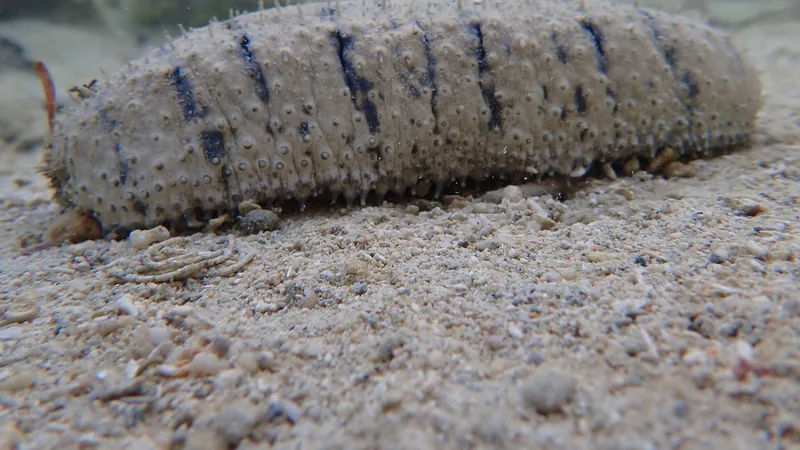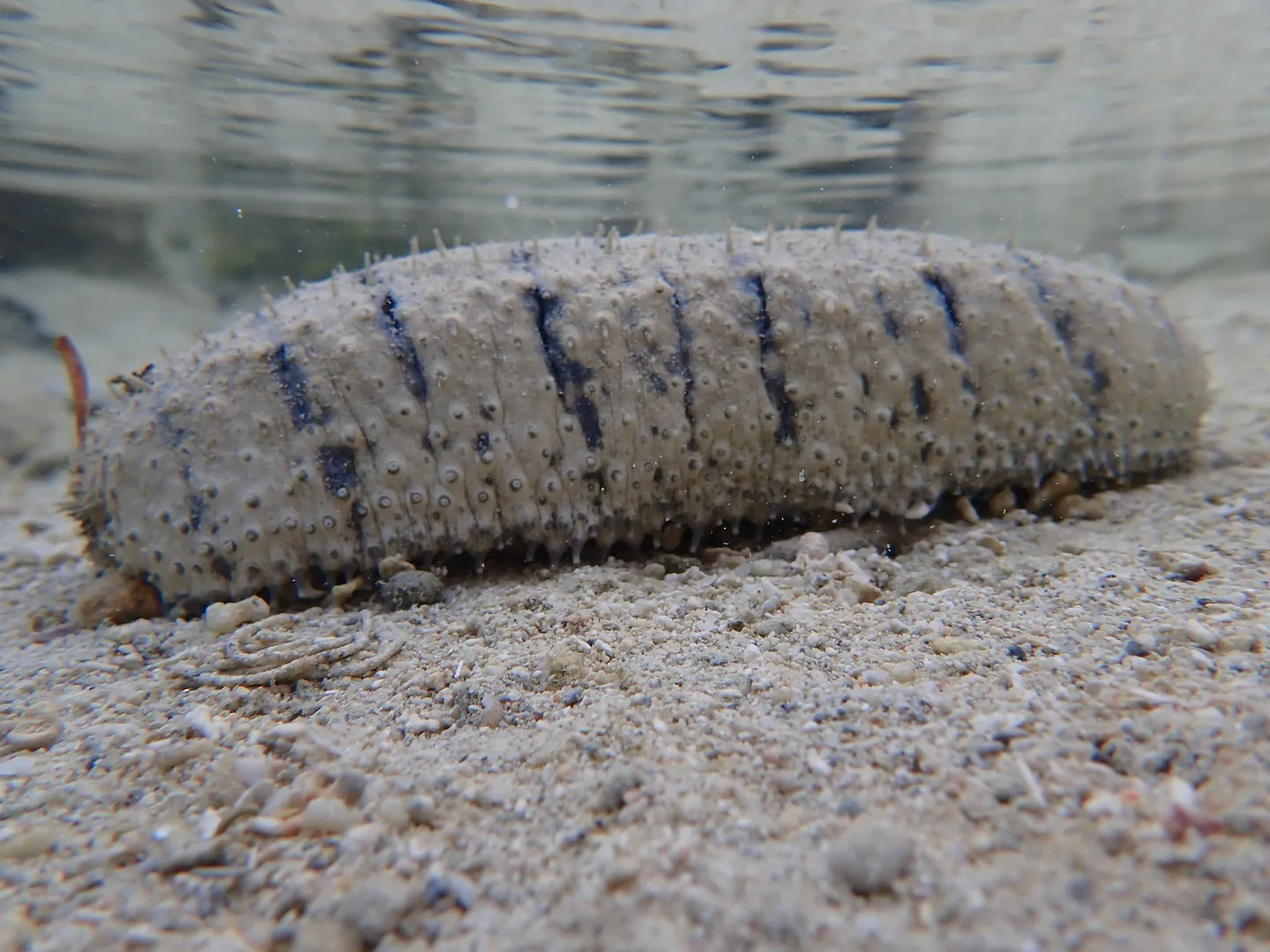
Holothuria scabra (sandfish sea cucumber), a living animal on sand, observed in Cakaudrove, Fiji.
Field
notes
Eating the sea floor
The sandfish, Holothuria scabra, is a sea cucumber that ingests a considerable amount of sediment while it feeds. In Fiji, researchers counted what came out the other end: each animal produced an average of 26 sediment pellets an hour, and each pellet weighed about 0.36 g.
The sandfish there fed for about 10 hours a day, in daylight, and sat inactive for the other 14. At low tide they generally stayed buried. Add it all up and the researchers estimated the local population could rework the top 5 mm of sediment about two and a half times a year.
Size and range
In the Fiji study area, the most common length was about 15 cm, which works out to about 200 g.
Sandfish are widely distributed across the Indo-Pacific, in shallow soft-bottom habitats. They generally live in low-energy environments behind fringing reefs or in protected bays and shores. A 2012 paper reported some specimens collected by snorkellers at a depth of 5 m at Qeshm Island, the first record of the species in the Persian Gulf.
A sandfish’s day job
Sandfish removal test In Fiji, the depth oxygen reached into the sediment fell by 63% after a 6 °C rise in water temperature over two months in pens with no sandfish. In pens with high sandfish densities, no such change was observed.
Sandfish are closely associated with seagrass beds. In two caging experiments, seagrass grew 5% less in one year and 12% less in the next where the sandfish were kept out.
In laboratory trials, newly settled juveniles stayed on seagrass leaves for 4 to 5 weeks, then migrated to sand at around 6 mm long. In a Madagascar hatchery, buried juveniles exposed their posterior end to breathe.
The dried-seafood trade
Sandfish are one of the highest-valued species in the bêche-de-mer trade. Bêche-de-mer is sea cucumber that has been gutted, cooked, salted and dried. A 2014 study found sandfish and golden sandfish to be the most valuable tropical sea cucumbers in dried seafood markets in China, with one Hong Kong store selling very large sandfish for US$1,668 a kilogram.
The same 2012 paper called it the most exploited sea cucumber species in Iran. A 2022 review reports declines in wild stocks over the entire distribution range. The IUCN Red List lists it as Vulnerable.
Published
Traits
Intel
& FAQ
Guess
first
How big is a Sandfish Sea Cucumber, really? Slide, lock in, and see what the sources say. Every answer is a figure from this page, quoted from where it came from.
Sources
- 01Purcell, Hamel & Mercier (2026). Holothuria scabra. The IUCN Red List of Threatened Species 2026: e.T180257A272668462.
- 02Lee et al. (2018). Effects of sandfish (Holothuria scabra) removal on shallow-water sediments in Fiji. PeerJ.
- 03Global knowledge on the commercial sea cucumber Holothuria scabra. Advances in Marine Biology, 2022.
- 04Wolkenhauer et al. (2009). The ecological role of Holothuria scabra (Echinodermata: Holothuroidea) within subtropical seagrass beds. Journal of the Marine Biological Association of the United Kingdom.
- 05Dabbagh et al. (2012). Holothuria scabra (Holothuroidea: Aspidochirotida): first record of a highly valued sea cucumber, in the Persian Gulf, Iran. Marine Biodiversity Records.
- 06Mercier, Battaglene & Hamel (2000). Settlement preferences and early migration of the tropical sea cucumber Holothuria scabra. Journal of Experimental Marine Biology and Ecology.
- 07Purcell (2014). Value, market preferences and trade of beche-de-mer from Pacific Island sea cucumbers. PLoS ONE.
- 08Becker et al. (2004). The skin ulceration disease in cultivated juveniles of Holothuria scabra (Holothuroidea, Echinodermata). Aquaculture.
What the sources say: 38 claims checked word for word against these sources →