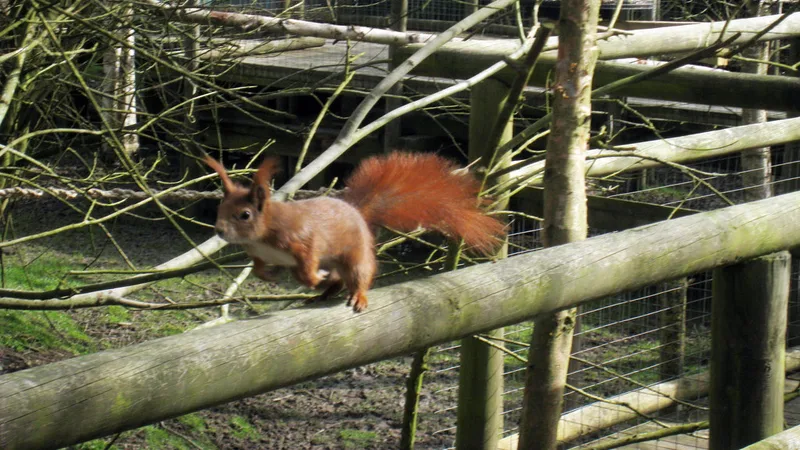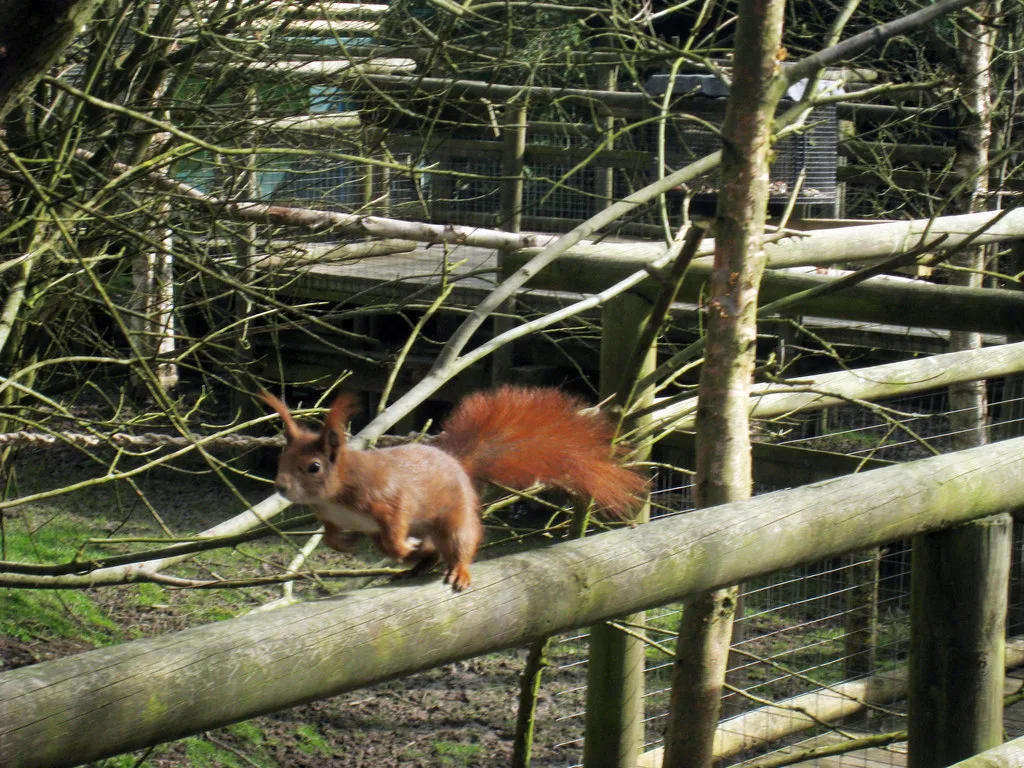
Red squirrel in Royal Łazienki Park, Warsaw, Poland
Field
notes
A Small Body and a Big Tail
The red squirrel lives throughout the forests of Europe and northern Asia. In Britain it weighs around 300g against a grey squirrel’s roughly 540g, and its body runs under 25cm long, with a bushy tail almost as long again. Coat colour varies more in this species than in almost any other Palearctic mammal, running from light red to black, though in some places a whole population shares one colour: in Britain only red-coated animals live, and in the Sila region of southern Italy only black ones. Wild red squirrels may live up to 12 years; one in captivity lived over 14.8 years.
Seeds, Nuts and a Few Seconds
In Britain pine seeds are a particular favourite, along with hazelnuts and the seeds of larch and spruce, plus fruit, tree shoots, bark, lichen and fungi. It has a specialised way of opening a nut, using the power of its lower incisors, and with practice can crack one in just a few seconds. It eats the most in spring, about 80g a day, and the least in winter, about 35g a day. It buries food in the ground or hides it in tree bark, and forgotten caches may sprout into new trees.
Built for the Canopy
A red squirrel can jump more than two metres, and double-jointed ankles let it move up and down trees with ease. On an inclined branch it flexes and retracts its limbs to bring its centre of mass close to the branch, placing its forelimbs to the side and underneath while its hindlimbs stay roughly on top. Its nests, called dreys, sit high in the trees, built from twigs and lined with moss and leaves.
An Unexpected Reservoir Leprosy was considered a disease of humans, with the exception of the armadillo, so finding it in red squirrels in 2016 was highly unexpected. Researchers found leprosy bacteria in squirrels from England, Ireland and Scotland, some with leprosy-like lesions on the head and limbs, others seemingly healthy. The strain from Brownsea Island is closest to one that circulated in medieval England. Red squirrels are a reservoir for leprosy in the British Isles.
Pox and the Grey Invasion
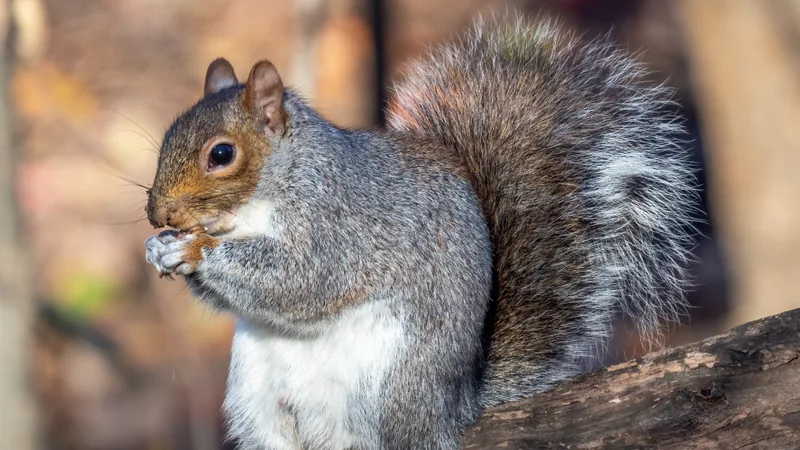
In Britain the grey squirrel, a North American species introduced in the early 20th century, is an immune carrier of the squirrelpox virus, which is fatal to reds. A study of red squirrels found dead between 1993 and 2005 found the disease only in areas of England also inhabited by grey squirrels, supporting a role for the grey as a reservoir host of the virus. There was a delay between greys settling an area and disease showing up in reds, implying the greys must reach a threshold number or density before passing the virus on. Largely because of the greys, which also outcompete them, reds have now disappeared from most of England and Wales. An estimated 287,000 remain in Britain against 2.7 million greys, confined to Scotland, pockets of northern England and Wales, and small islands off England’s south coast. They are still found across much of Ireland, though the range is shrinking there too. In Britain, foxes, stoats, pine martens and birds of prey hunt them as well.
Published Updated
Traits
Intel
& FAQ
Guess
first
How big is a Red Squirrel, really? Slide, lock in, and see what the sources say. Every answer is a figure from this page, quoted from where it came from.
Sources
- 01Sciurus vulgaris (Eurasian red squirrel). Animal Diversity Web, University of Michigan.
- 02Red squirrel (Sciurus vulgaris). Woodland Trust.
- 03Sciurus vulgaris (Eurasian red squirrel). AnAge: The Animal Ageing and Longevity Database, Build 15.
- 04Gazzard (2024). Sciurus vulgaris. The IUCN Red List of Threatened Species 2024: e.T221730864A221731815.
- 05Avanzi et al. (2016). Red squirrels in the British Isles are infected with leprosy bacilli. Science.
- 06Ploemacher et al. (2020). Reservoirs and transmission routes of leprosy; A systematic review. PLOS Neglected Tropical Diseases.
- 08Schmidt & Fischer (2011). The kinematic consequences of locomotion on sloped arboreal substrates in a generalized (Rattus norvegicus) and a specialized (Sciurus vulgaris) rodent. Journal of Experimental Biology.
What the sources say: 43 claims checked word for word against these sources →