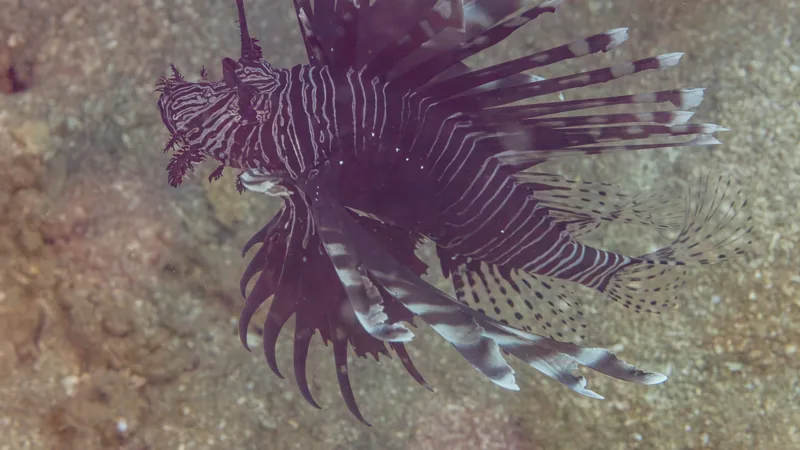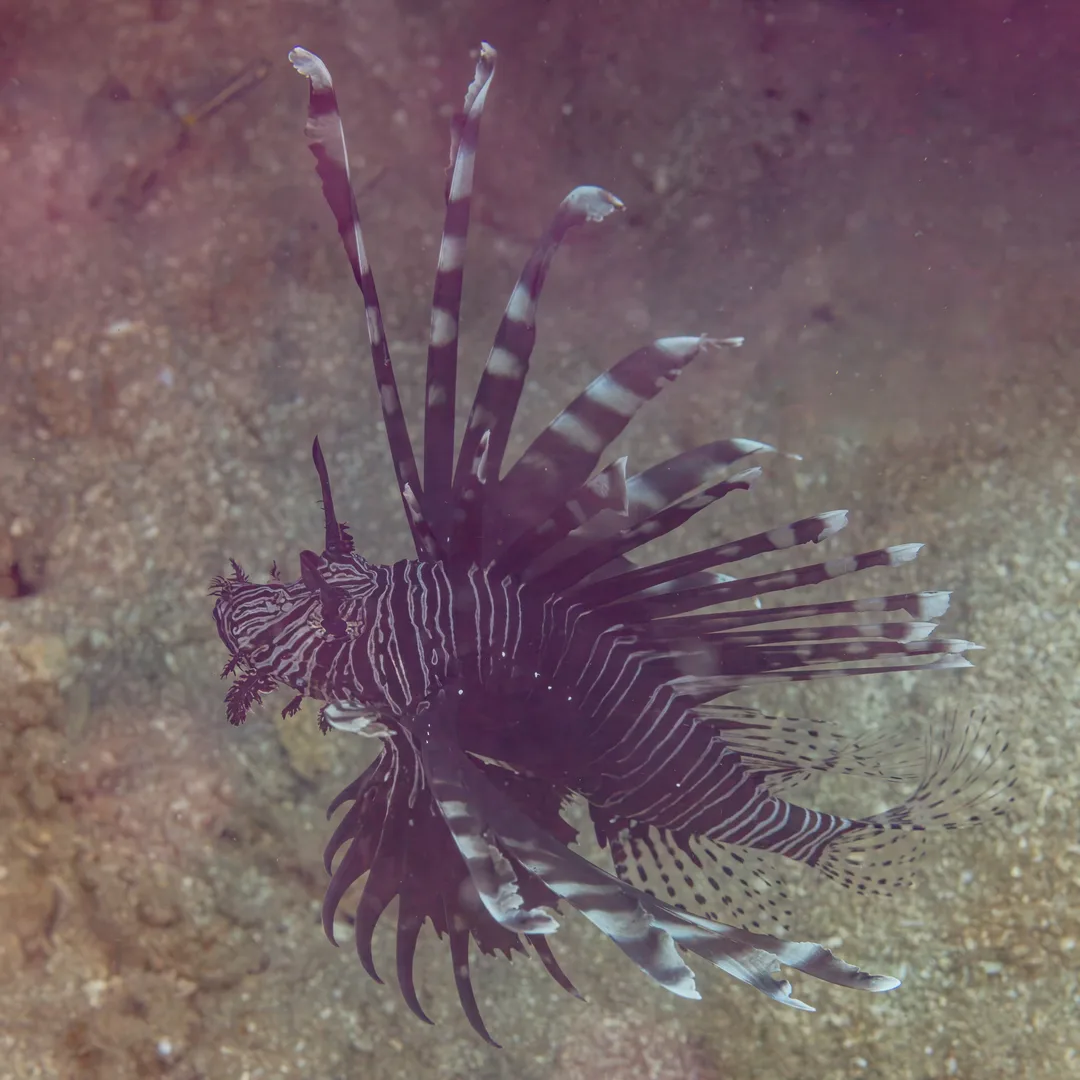
Red lionfish ( Pterois volitans ), Anilao, Philippines
Field
notes
Slower than its dinner, and it wins anyway
Biologists were unsure how a predator in plain sight could catch prey faster than itself. In a laboratory study, red lionfish chased a faster prey fish, Chromis viridis, while swimming about half as fast, and still captured it in 61% of experiments. Part of the trick is steady motion. The lionfish kept heading for where the prey was, not where it was going, and kept moving without a break. The prey swam in fits and starts, slowing down at times, and those slow spells let the lionfish close in. Once it was less than 9 cm away it fired a suction-feeding strike, and 74% of those strikes worked. The researchers named the trick the persistent-predation strategy.
Out on the reef it also uses its wide pectoral fins to trap prey in a corner, then swallows it in one sweep. It eats small fishes, shrimps and crabs.
A pin cushion with a stripe job
The red lionfish varies a lot in appearance, but it is basically zebra-banded in red and white, and NOAA says lionfish rely on their unusual colours and fins to put off predators. It carries 13 dorsal spines, and venom glands sit at the base of certain fin spines. A stab from one can inject the toxins, and the venom is known to cause a severe reaction in humans.
Venom delivery Spines on the dorsal, anal and pelvic fins can deliver the venom.
The maximum published length is 45.7 cm total length (snout to the tip of the tail), the maximum published weight is 1.4 kg, and the maximum reported age is 10 years.
From Pacific reefs to the Atlantic
Its home range runs from Western Australia and the Cocos-Keeling Islands east to the Marquesas, and north to southern Japan and southern Korea. It lives on reefs from 2 to 55 m deep. By day it hides in unexposed spots, often head down and almost motionless, and it hunts at night.
NOAA says lionfish, popular aquarium fish, were possibly released into the Atlantic on purpose, and they were first reported off southeast Florida in the 1980s. Two Indo-Pacific lionfish, P. volitans and P. miles, have spread across the western Atlantic, the Caribbean and the Gulf of Mexico, and the Atlantic figures here cover both. On nine Bahamas reefs, as lionfish multiplied, the fish species they ate lost 65% of their combined biomass in two years. NOAA adds that a mature female lionfish sheds about two million eggs each year.
Published
Traits
Intel
& FAQ
Guess
first
How big is a Red Lionfish, really? Slide, lock in, and see what the sources say. Every answer is a figure from this page, quoted from where it came from.
Sources
- 01Motomura & Matsuura (2016). Pterois volitans. The IUCN Red List of Threatened Species 2016: e.T190468A78940195.
- 02Peterson & McHenry (2022). The persistent-predation strategy of the red lionfish ( Pterois volitans ). Proceedings of the Royal Society B: Biological Sciences.
- 03Green et al. (2012). Invasive Lionfish Drive Atlantic Coral Reef Fish Declines. PLoS ONE.
- 04Pterois volitans summary page. FishBase.
- 05Red Lionfish (Pterois volitans). Florida Museum of Natural History, Discover Fishes.
- 06What is a lionfish? NOAA National Ocean Service.
What the sources say: 45 claims checked word for word against these sources →