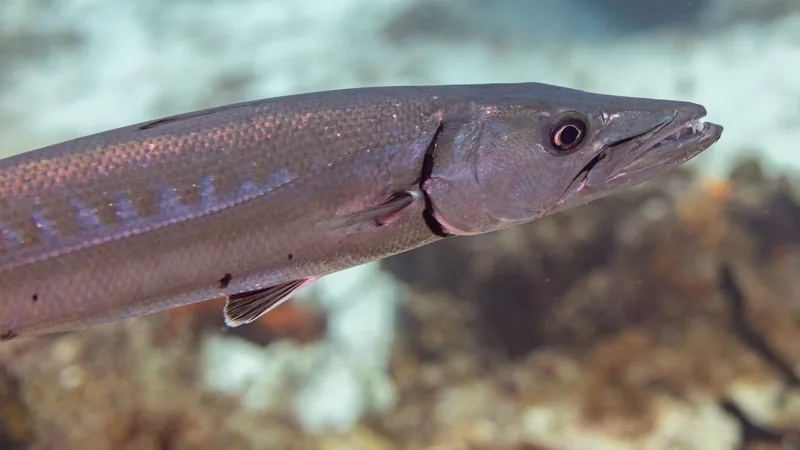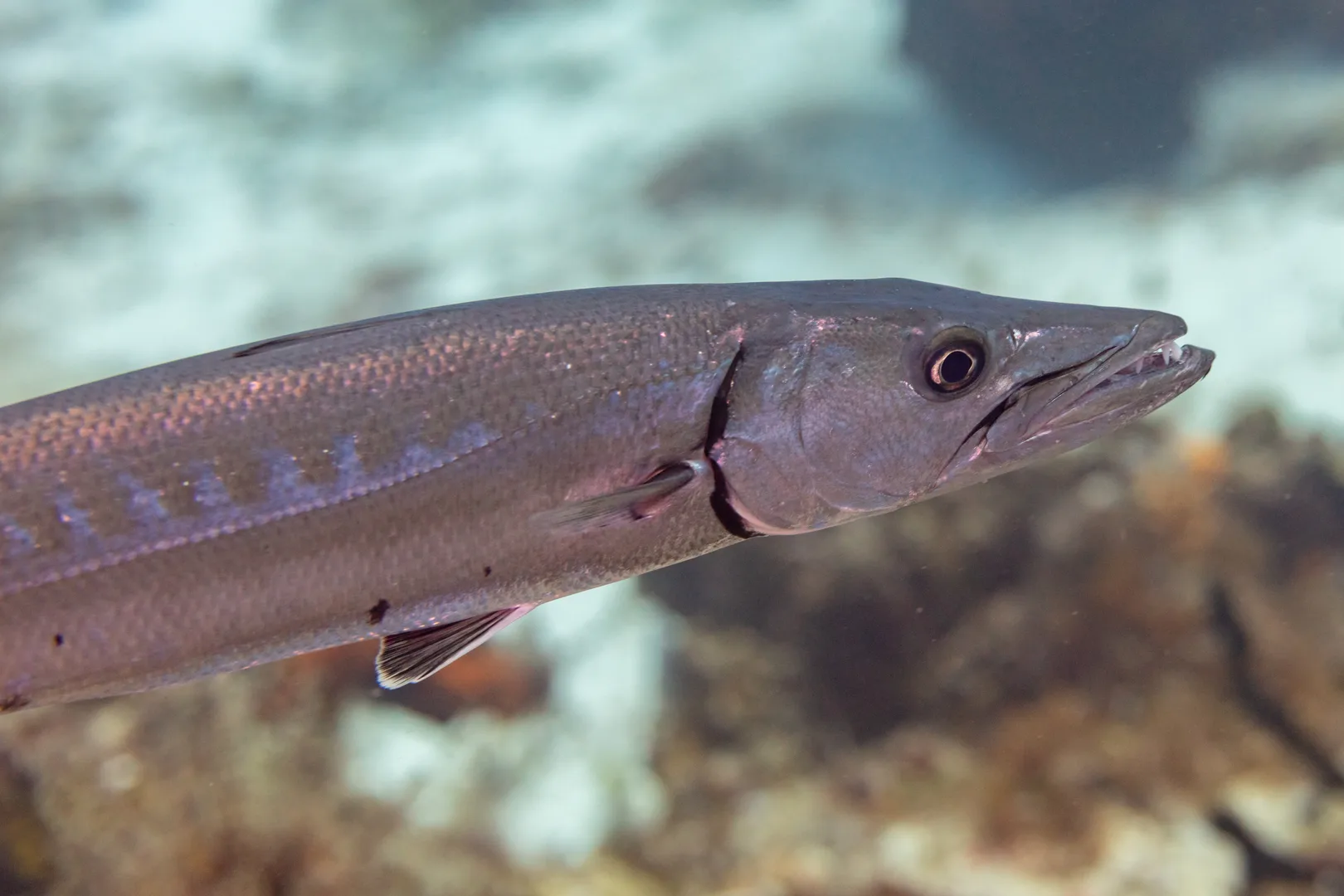
Great barracuda ( Sphyraena barracuda ), Cozumel, Mexico
Field
notes
Scissors with fins
The great barracuda is a long, tube-shaped fish with a pointed snout filled with two rows of teeth. It has two sets of teeth: a row of small razor-sharp ones along the outside of the jaw, and a larger set of dagger-like teeth inside them. Larger prey is cut into pieces to be swallowed separately. In a study that filmed barracuda biting, the fish hit prey at the corner of the mouth, and quick repeated bites with short head shakes cut the prey in two. Large teeth on a bone at the back of the jaw work against the lower jaw like the blades of scissors, and predicted bite force at the corner of the mouth reached as high as 58 newtons in large fish.
Built for speed The great barracuda’s body plan is designed for speed, and the top speed of the species is estimated at up to 36 mph (58 km/h).
A sight hunter
Barracuda are generally active by day and find prey largely by sight. They are opportunistic, feeding at any depth in the water. The menu includes jacks, grunts, groupers, snappers, small tunas and mullets, and a large gape and very sharp teeth let them feed on big fish by chopping them in half. They tend to be solitary, though small groups sometimes gather over reefs and sandy bottoms. Young fish grow up among mangroves and seagrass, then move to deeper reefs in their second year.
Up to two meters long
The Florida Museum gives the hook-and-line record as a fish 1.7 meters (5.5 feet) long and 44 kg (103 lb), and says the species is reported to reach 2 meters and 50 kg. FishBase lists a maximum of 200 cm total length and calls 140 cm common. Scale analysis of large specimens shows they live at least 14 years. Great barracuda live in nearshore tropical and subtropical seas worldwide: the western Atlantic from Massachusetts to Brazil, the Gulf of Mexico and Caribbean, the eastern Atlantic, the Indo-Pacific and the Red Sea. The IUCN rates the species Least Concern.
Poison on the menu
Ciguatera is an illness linked to toxins made by tiny marine dinoflagellates that grow attached to marine algae. Plant-eating fish may swallow them by accident, and large fish-eating reef fish at the top of the food chain become reservoirs for the highest amounts of toxin. The Florida Museum says the great barracuda has been tied to ciguatera cases in parts of its range, while FishBase notes it has not been reported as poisonous in the eastern Atlantic.
Published
Traits
Intel
& FAQ
Guess
first
How big is a Great Barracuda, really? Slide, lock in, and see what the sources say. Every answer is a figure from this page, quoted from where it came from.
Sources
- 01Great Barracuda. Florida Museum of Natural History, Discover Fishes.
- 02Sphyraena barracuda summary page. FishBase.
- 03Grubich, Rice & Westneat (2008). Functional morphology of bite mechanics in the great barracuda (Sphyraena barracuda). Zoology.
- 04Aiken et al. (2015). Sphyraena barracuda. The IUCN Red List of Threatened Species 2015: e.T190399A115319634.
What the sources say: 39 claims checked word for word against these sources →