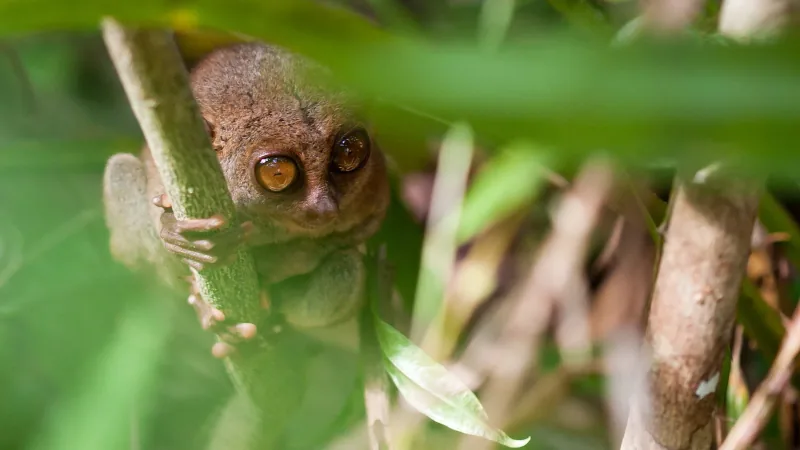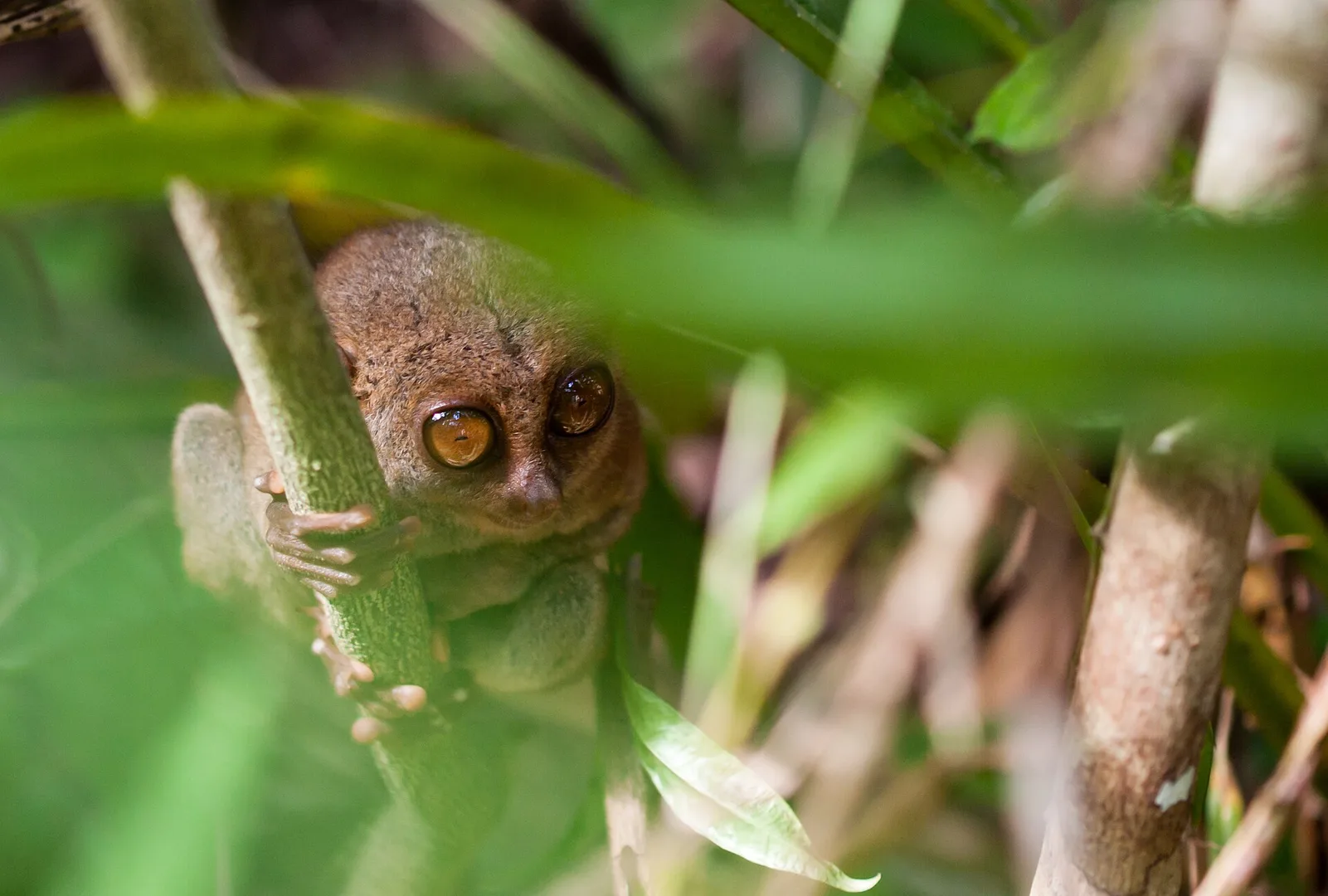
A Philippine tarsier resting in a bush by day, shielding its eyes from the sun.
Field
notes
Imagine a hunter about the size of a young child’s hand, working the night shift, with the largest eyes for its body of any mammal. Meet the Philippine tarsier (Carlito syrichta).
A head like a periscope
Its body is roughly 85 to 160 millimeters long, and it weighs between 80 and 165 grams. It has a tufted tail 25 centimeters long. Its eyes are huge, and its ears are big and bat-like. Sharp sight and hearing together make it a highly successful night hunter.
Then there is the neck. A tarsier’s head can rotate 180 degrees.
Named for its feet Tarsiers were named for two greatly elongated bones in their feet. These long bones give tarsiers added leverage for jumping.
A leaper that hunts at night
The tarsier does not usually move on all four limbs. It has developed excellent leaping skills, and pads on its fingers and toes help it cling to branches. By day it hides in dense vegetation and sleeps in trees. At night it hunts insects, spiders, lizards and small vertebrates such as birds. When it seizes prey, it carries the meal in its mouth and uses both hands.
It lives in the rainforests of the Philippines and is most commonly found on Samar, Leyte, Bohol and Mindanao. Tarsiers appear to have home ranges of 1 to 2 hectares.
Babies start fast. A single young is born after about six months, well furred and with its eyes open. It can climb after two days and jump after four, and by about 45 days it can catch its own prey.
This tarsier may also have a hidden channel. In one study, the Philippine tarsier’s hearing reached about 91 kHz, and researchers recorded a call at 70 kHz. Few mammals can send and receive calls in pure ultrasound, above 20 kHz, and these values are among the highest recorded for any land mammal. The researchers suggest ultrasonic calls might be a private channel that subverts detection by predators, prey and competitors.
Captive records, wild threats
The lifespan figures come from captivity. AnAge gives a maximum of 16 years, based on a male that reportedly lived more than 10 years in captivity. Wild tarsiers likely do not live as long as captive ones.
Hunters and trappers have hurt the species by shaking tarsiers out of their trees or chopping down the branches they live in, and deforestation has hit the species significantly too. The IUCN Red List rates the Philippine tarsier Near Threatened.
Published Updated
Traits
Intel
& FAQ
Guess
first
How big is a Philippine Tarsier, really? Slide, lock in, and see what the sources say. Every answer is a figure from this page, quoted from where it came from.
Sources
- 01Tarsius syrichta (Philippine tarsier). Animal Diversity Web, University of Michigan.
- 02AnAge entry for Carlito syrichta. AnAge: The Animal Ageing and Longevity Database, Human Ageing Genomic Resources.
- 03Shekelle (2020). Carlito syrichta. The IUCN Red List of Threatened Species 2020: e.T21492A17978520.
- 04Ramsier et al. (2012). Primate communication in the pure ultrasound. Biology Letters.
What the sources say: 49 claims checked word for word against these sources →