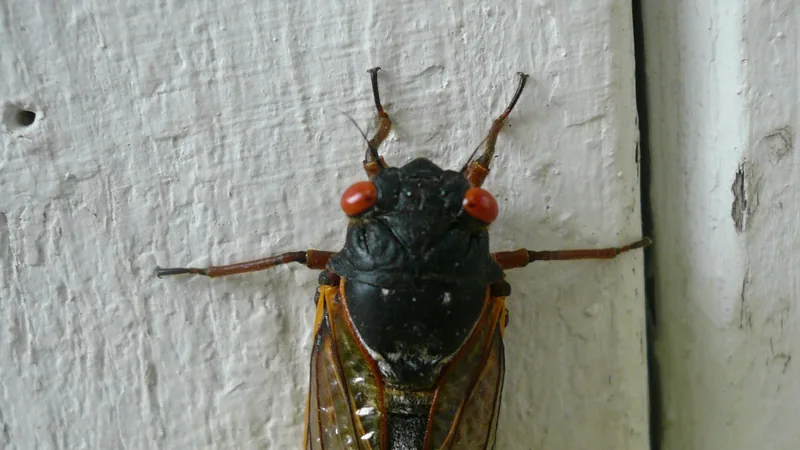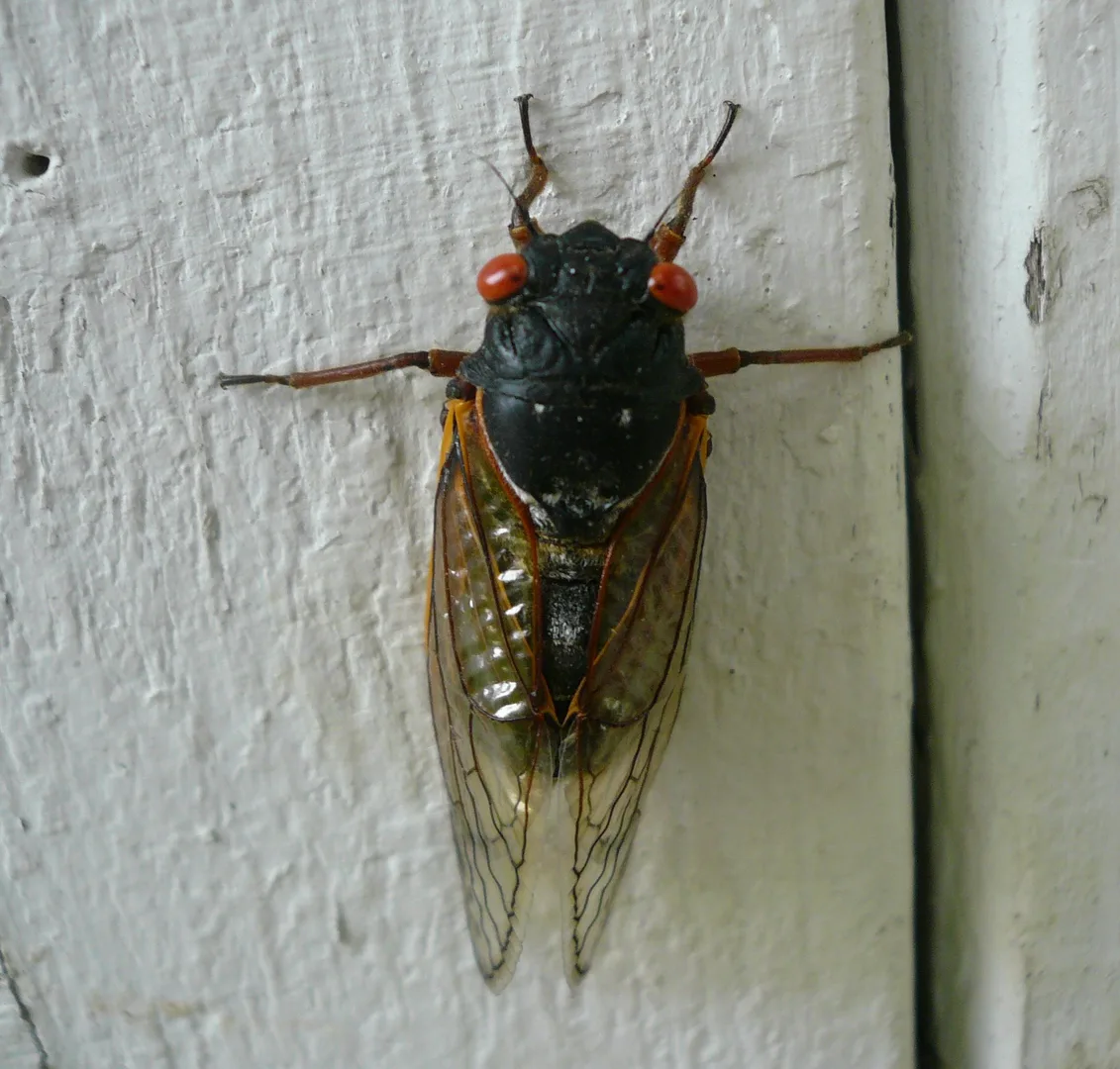
Brood XIII Magicicada septendecim 17 year cicada, from the south suburbs of Chicago.
Field
notes
Seventeen years in the dark
The periodical cicada (Magicicada septendecim) hatches in a twig, drops to the ground and burrows in. Periodical cicada nymphs usually live within 60 cm of the surface, most often 20 to 45 cm down. The new nymph, the young stage, is about 2.5 mm long. It feeds by sucking juices from plant roots, especially those of deciduous trees, which lose their leaves each year, and it goes through several juvenile stages. Nymphs need 17 years to finish their development.
Whole-brood emergence Periodical cicadas live in broods, populations in different areas. A single M. septendecim brood emerges once every 17 years, and an entire brood sometimes emerges during one night.
Up the bark, into a chorus
In the spring of the 17th year, nymphs build exit tunnels and generally emerge in May. Each one attaches itself to the bark of a nearby tree and goes through one final molt, a change of skin, to become an adult. The adult is black, with eyes that are generally reddish-orange and clear wings with orange veins. It is 40 mm in length, the largest of the periodically emerging cicada species.
Within four or five days, the males form singing choruses. Only males sing, and they do it with a pair of rigid membranes called tymbals near the abdomen. The calling song of this species is said to sound like the word “Pharaoh”. A chorus can become remarkably loud.
A short, crowded adult life
Why come out all at once? It is generally accepted that brooding behavior exists mainly to overwhelm predators. The logic is that with so many cicadas in a small area, even if many are eaten, enough survive to reproduce.
Both sexes generally mate with several partners. A female then uses her needle-like ovipositor, an egg-laying tool, to cut slits in twigs. A single female can lay up to 500 eggs, and afterward she drops to the ground and dies. Neither males nor females live past early July.
Where they live, and what they cost
This species is widely distributed in the eastern United States. Its genus is found only in the United States, east of the Great Plains, and M. septendecim is primarily located in the northern midwestern and eastern parts of that area. The eggs go into more than 70 kinds of trees and other plants.
The only significant injury the insect causes comes from the egg slits. Twigs may split, wither and die, which is called flagging. It is not serious for mature trees, but it can greatly harm young trees. The IUCN Red List rates the species Lower Risk/near threatened, the 1996 equivalent of Near Threatened, in an assessment made in 1996 that the Red List itself marks as needing an update.
Published Updated
Traits
Intel
& FAQ
Guess
first
How big is a Periodical Cicada, really? Slide, lock in, and see what the sources say. Every answer is a figure from this page, quoted from where it came from.
Sources
- 01Magicicada septendecim (Linnaeus' 17-year cicada). Animal Diversity Web, University of Michigan.
- 02Periodical cicada, Magicicada septendecim L. (Hemiptera: Cicadidae). Forest Pest Insects in North America: a Photographic Guide.
- 03Magicicada septendecim (L. 1758). Periodical Cicada Information Pages, University of Connecticut.
- 04Magicicada septendecim. The IUCN Red List of Threatened Species 1996: e.T12691A3373584.
- 05Brumfield et al. (2022). Gut microbiome insights from 16S rRNA analysis of 17-year periodical cicadas (Hemiptera: Magicicada spp.) Broods II, VI, and X. Scientific Reports.
- 06Sota (2022). Life-cycle control of 13- and 17-year periodical cicadas: A hypothesis and its implication in the evolutionary process. Ecological Research.
What the sources say: 54 claims checked word for word against these sources →