Peacock Spider (Maratus volans), Tuan Forest QLD 4650, Australia
Field
notes
The Fan Hidden on His Back
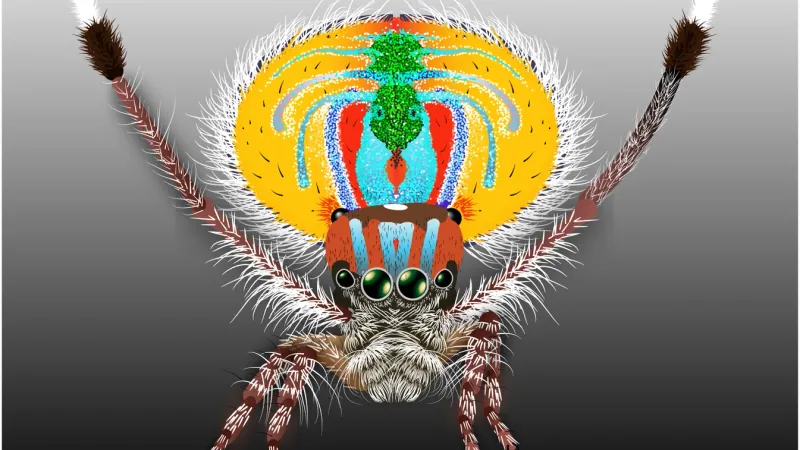
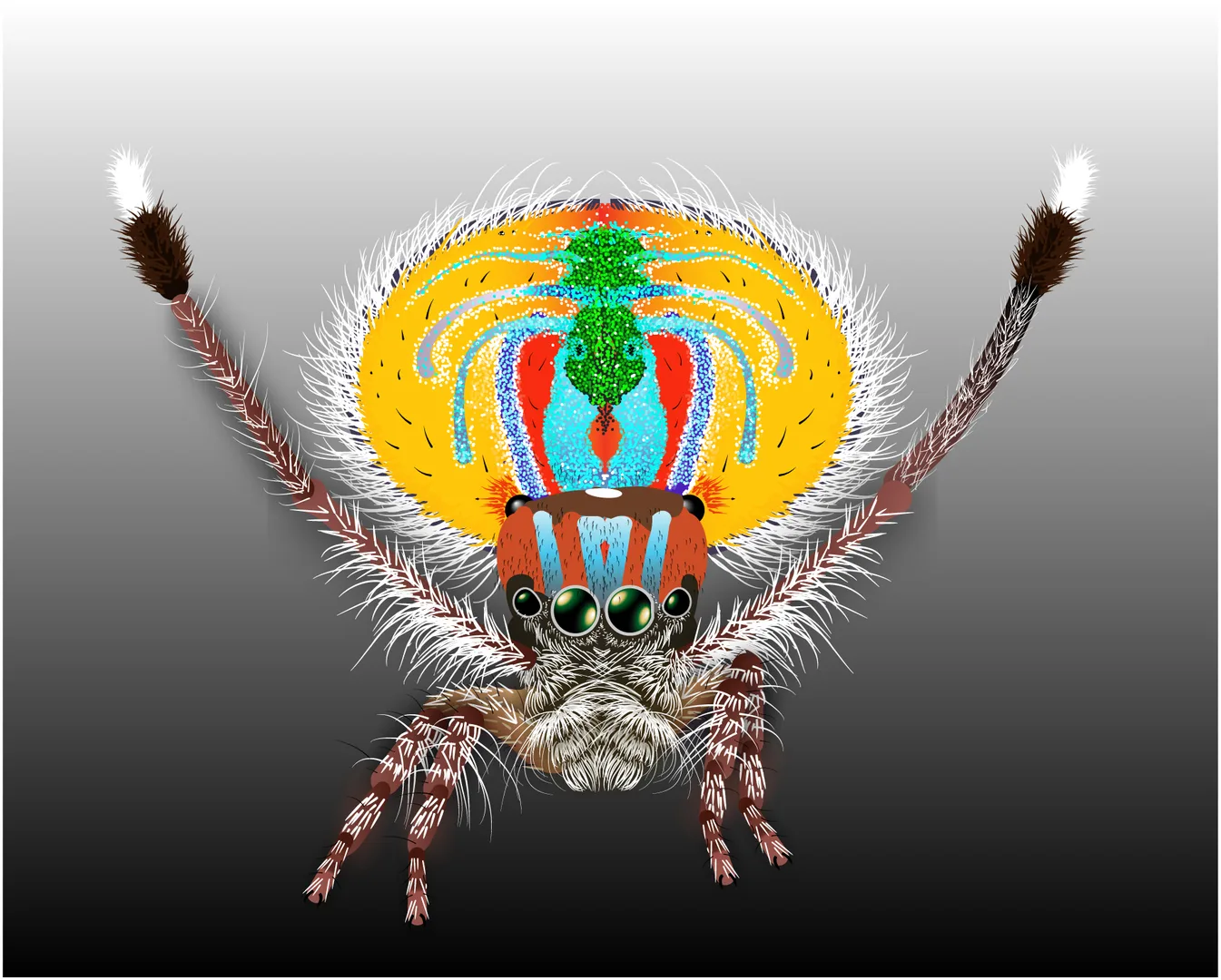
A male peacock spider carries a secret, usually tucked around his abdomen. During courtship he unfurls brightly colored flaps into a fan that looks like a peacock’s tail, and waves it at a female. This is Maratus volans, a jumping spider native to Australia and found most often near the coast of New South Wales. The animals in one study came from around Sydney, New South Wales. One male that researchers measured was 4.5 millimeters long. Queensland Museum records also list the species from southeastern and central Queensland. Many male jumping spiders are more ornamented than their female counterparts, but the study’s authors call this species an exceptional example.
In male Maratus spiders, the color patterns come from specialised short hairs that cover the back of the abdomen and parts of the carapace. Those hairs reflect different colors depending on the angle they are seen from.
A Dance With a Metronome
The legs are part of the act too. The male’s third pair is elongated and ornamented, with a dense black tuft on one segment and a thick white clump on another. He throws them up, swings them down and flicks them back up, about 3.2 times a second.
The fan swings side to side like a metronome, most often in time with the leg waves. Sometimes, when he pauses, he slowly flutters the edge of the fan. In several cases that made the female turn back toward him.
Signals Through the Ground
The show is also a concert. The male sends vibrations through whatever he is standing on, and every one of them comes with a bob of his abdomen. The most common are “rumble-rumps”, each lasting about 2.4 seconds. He seems to start them as soon as he detects a female, even from far away. Up close, he adds the leg waving and the fan dance.
Near the end comes the pre-mount display, with signals the researchers named crunch-rolls and grind-revs. Then he tries to mount.
A tough crowd The study’s authors note that a female’s response, receptive or aggressive, was often seen when live males and females were paired. They say it shapes how a male carries on courting.
Lab Meals and Ground Dwellers
Maratus spiders are mostly ground dwellers, and peacock spiders belong to the jumping spiders, a family of visual specialists. In the lab, the spiders were fed fruit flies weekly and crickets on occasion.
Published Updated
Traits
Intel
& FAQ
Guess
first
How big is a Peacock Spider, really? Slide, lock in, and see what the sources say. Every answer is a figure from this page, quoted from where it came from.
Sources
- 01Girard, Kasumovic & Elias (2011). Multi-Modal Courtship in the Peacock Spider, Maratus volans (O.P.-Cambridge, 1874). PLoS ONE.
- 02Girard, Elias & Kasumovic (2015). Female preference for multi-modal courtship: multiple signals are important for male mating success in peacock spiders. Proceedings of the Royal Society B: Biological Sciences.
- 03Waldock (2013). A review of the peacock spiders of the Maratus mungaich species-group (Araneae: Salticidae), with descriptions of four new species. Records of the Western Australian Museum.
- 04Otto & Hill (2011). An illustrated review of the known peacock spiders of the genus Maratus from Australia, with description of a new species. Peckhamia.
What the sources say: 39 claims checked word for word against these sources →