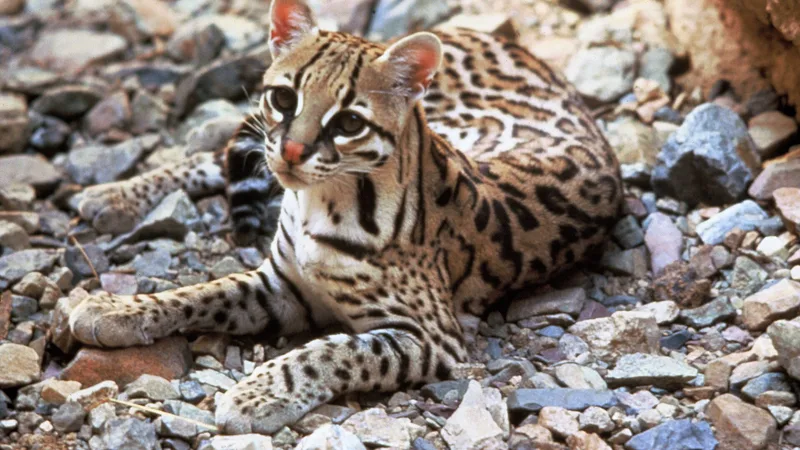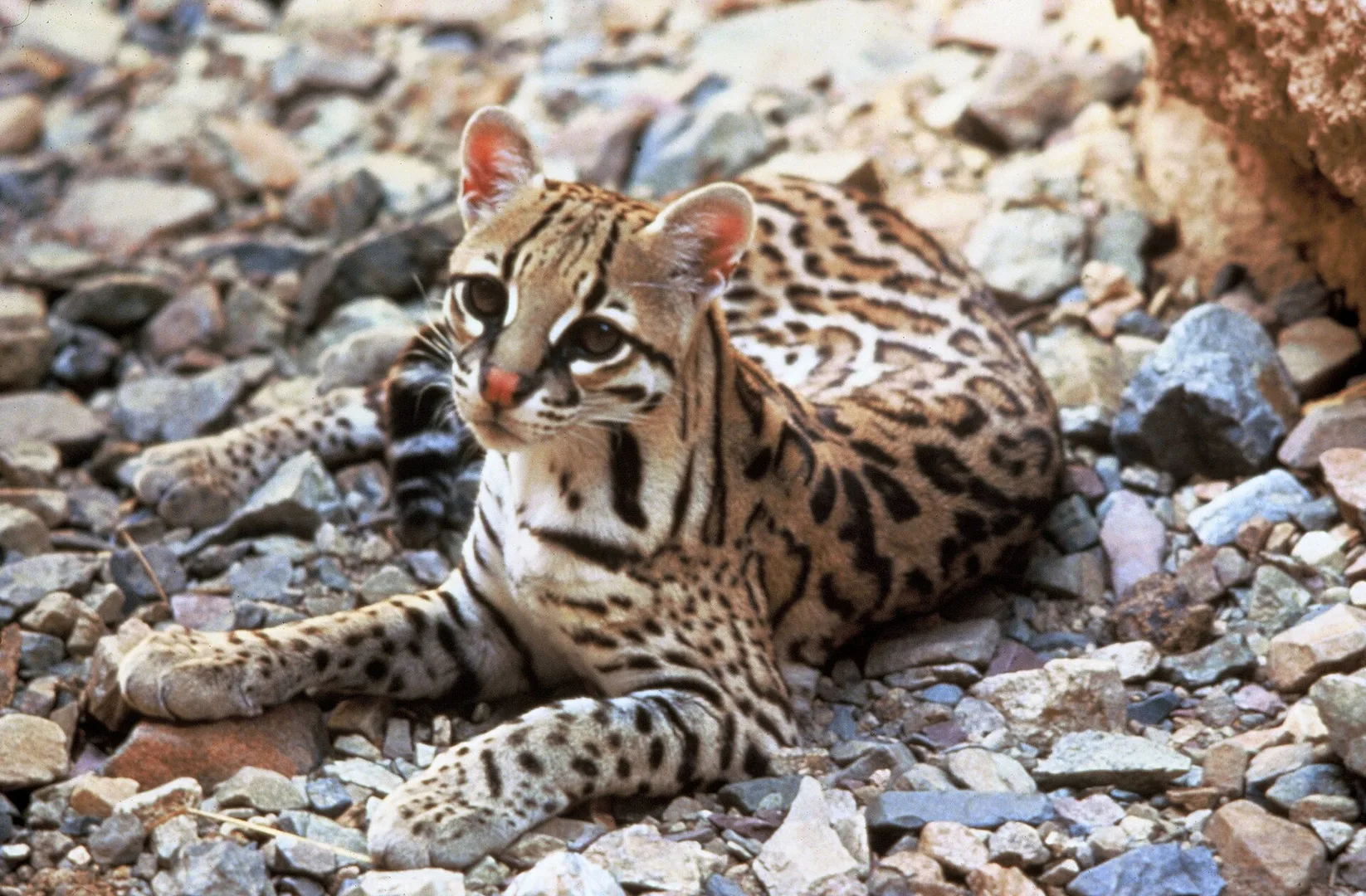
A wild ocelot (Leopardus pardalis) in Parque Estadual Encontro das Águas, Brazil.
Field
notes
A Cat With Built-In Night Vision
Ocelots are active mainly at night, especially at dawn and dusk. Their eyes have a layer that reflects light, so they see much better in the dark than we can. San Diego Zoo Wildlife Alliance puts it simply: walking around at night is as easy for an ocelot as walking around during the day is for you. Their sense of smell is a lot better than ours, though not as keen as a dog’s.
Ocelots are small cats. San Diego Zoo Wildlife Alliance gives their length as 73 to 100 centimeters, with males longer than females, and a tail of 26 to 41 centimeters. Females weigh 6.6 to 11.3 kilograms and males 7 to 15.5. They are the second-largest spotted cats in South America, after jaguars. Their paws are large for their body size, which is why one of their Spanish names, “manigordo,” means big feet. In human care, an ocelot’s median life expectancy is 15.7 years.
Mostly Small Prey
Larger cats such as pumas and jaguars may share an ocelot’s habitat, but each cat targets different prey. A 2019 study of camera-trap records from eight Neotropical forest sites describes ocelots as eating small to medium-bodied prey, and jaguars and pumas as mostly eating medium to large-bodied prey. Across those sites, ocelots were mainly active at dawn, dusk and night, with more than 60 percent of their activity between 6 p.m. and 6 a.m.; at one site they were active by day as well as by night.
Ocelots track prey by following odor trails, and may also sit and wait for prey to appear. They prey mainly on small rodents, but sometimes eat birds, snakes, iguanas and other lizards, young deer, and even fish and crabs. If a carcass can’t be eaten in one feeding, the ocelot covers it and returns the next night to finish its meal.
Very Rare in the United States
The IUCN lists the ocelot as Least Concern, but San Diego Zoo Wildlife Alliance says its populations are declining. In the United States, ocelots were once found throughout Texas and east to Arkansas and Louisiana, and hunting and habitat loss have made them very rare. In 2019, ocelot researcher Michael Tewes wrote that the ocelot was at a high risk of extinction there, with fewer than 80 believed to remain in two small groups. The smaller, typically about 7 to 14 cats, lived mainly on and around Laguna Atascosa National Wildlife Refuge, hemmed in by farmland, roads and growing towns. The larger lived on ranchland, mainly in and around Willacy County, and held more than 80 percent of the U.S. population.
People hunted ocelots for their fur. One coat could take as many as 25 ocelots, and from the early 1960s to the mid-1980s a coat of ocelot fur could sell for $40,000 in western Germany. Bringing ocelots or their skins into the US and other countries became illegal in 1972, and very few people buy the skins now.
A Coat With No Repeats Each ocelot has a different coat pattern, and even the patterns and color on one cat’s right and left sides are not the same.
Their facial patterns are very distinct too, so individual ocelots are easy to recognize.
Published Updated
Traits
Intel
& FAQ
Guess
first
How big is a Ocelot, really? Slide, lock in, and see what the sources say. Every answer is a figure from this page, quoted from where it came from.
Sources
- 01Leopardus pardalis (ocelot). Animal Diversity Web, University of Michigan.
- 02Ocelot. San Diego Zoo Wildlife Alliance.
- 03Santos et al. (2019). Prey availability and temporal partitioning modulate felid coexistence in Neotropical forests. PLOS ONE.
- 04Tewes, M.E. (2019). Conservation Status of the Endangered Ocelot in the United States - A 35-Year Perspective. 37th Annual Faculty Lecture, Texas A&M University-Kingsville.
- 05Paviolo et al. (2015). Leopardus pardalis. The IUCN Red List of Threatened Species 2015: e.T11509A97212355.
What the sources say: 70 claims checked word for word against these sources →