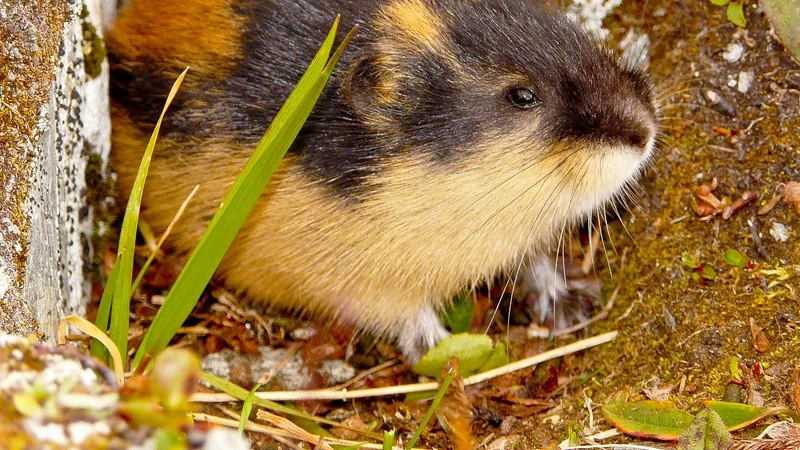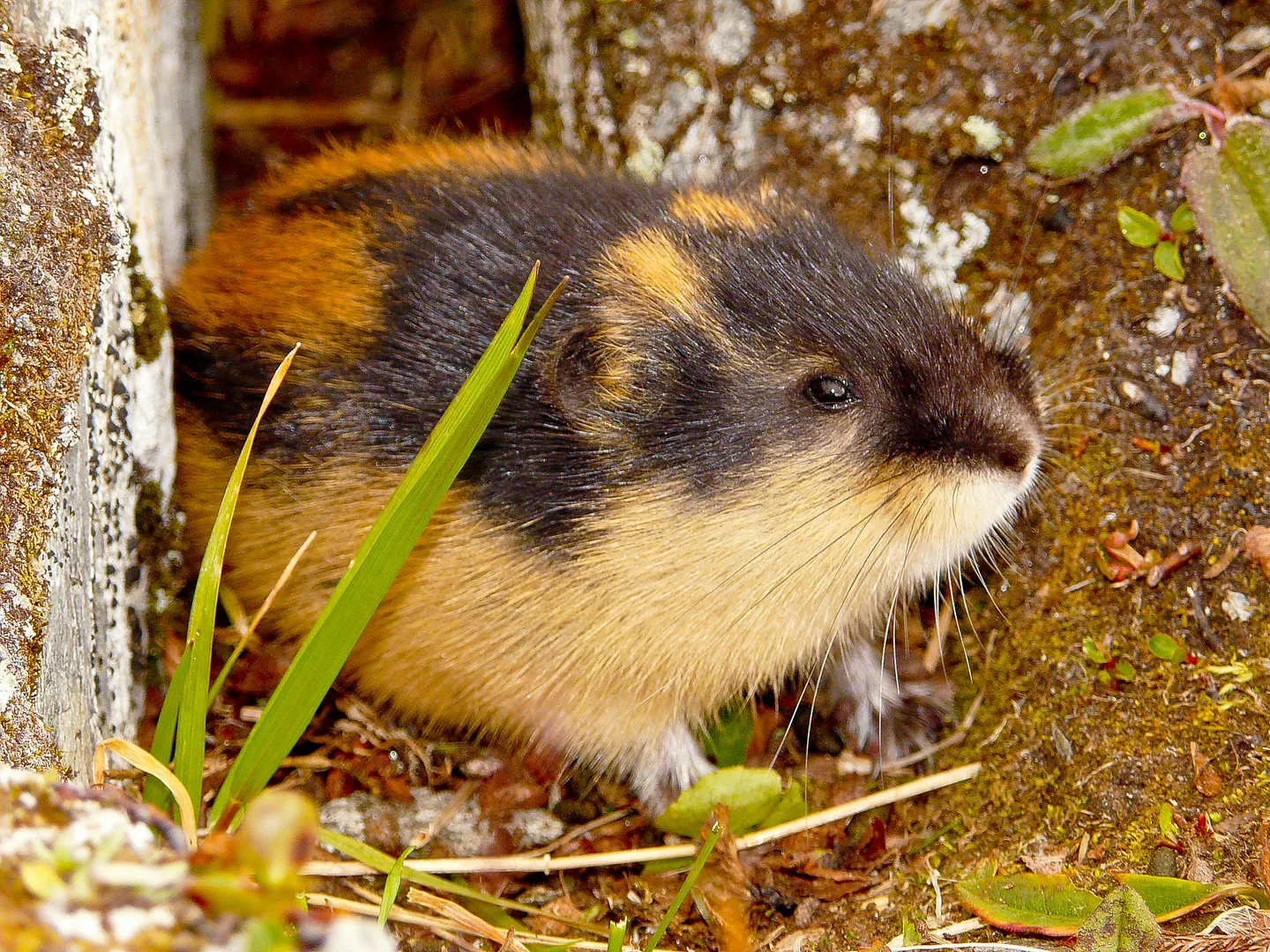
Berglemming im Padjelanta Nationalpark, Nordschweden
Field
notes
Warning colors on a rodent
The Norway lemming, Lemmus lemmus, lives in the mountain tundra of Fennoscandia. That region takes in the Scandinavian Peninsula, Finland and the Kola Peninsula. The lemming has black and brown fur with some golden-yellow streaks. Researchers describe the species as having a number of aposematic traits in coloration and behavior. Aposematic means “warning”. It was thought to be the only mammal found nowhere but Fennoscandia until 2021, when researchers described a distinct lineage from Novaya Zemlya in Arctic Russia as a new subspecies. That island lemming has cryptic coloration, the camouflaging kind, instead.
Small and built for snow
A Norway lemming weighs between 20 and 130 grams, and its body is 8 to 17.5 centimeters long. Males and females are generally similar in size. The oldest one on record lived at least 3.3 years, and that was in captivity.
The first claw on each paw is larger and flatter than the rest. That change helps lemmings tunnel through snow. In winter they live in insulated spaces under the snow, which gives them warmth, shelter, access to food and protection from predators. They mainly eat mosses, lichens, bark and some grasses.
Red foxes, Arctic foxes, ermines, weasels, snowy owls and ravens are common predators, and Arctic foxes specialize in hunting lemmings. A lemming’s main defense is its burrow. Lemmings can also be feisty. They may turn aggressive toward each other when too many are close together, and males have been observed boxing and wrestling.
Booms, busts and a Disney myth
Rodent population cycles in the north have puzzled people for centuries. One study followed an alpine Norwegian habitat from 1970 to 1997. It found that winter weather and snow conditions, together with density dependence, accounted for the ups and downs of a rodent community dominated by Norway lemmings. It also predicted the lack of peak years after 1994. When numbers peak, lemmings disperse beyond their normal range and may even move into forests.
The suicide myth Lemmings do not commit mass suicide, says Alaska’s wildlife agency, which calls it a myth. A 1983 investigation reported that the lemming scenes in Disney’s 1958 film White Wilderness were faked.
Real lemmings can swim and will cross water, and sometimes they drown. An expert on small mammals described the Scandinavian mountains as a classic place where this has been seen: lemmings stop at a body of water, build up along the shore, and eventually swim across.
The IUCN Red List rates the Norway lemming Least Concern.
Published
Traits
Intel
& FAQ
Guess
first
How big is a Norway Lemming, really? Slide, lock in, and see what the sources say. Every answer is a figure from this page, quoted from where it came from.
Sources
- 01Lemmus lemmus. Animal Diversity Web, University of Michigan.
- 02AnAge entry for Lemmus lemmus. AnAge: The Animal Ageing and Longevity Database, Build 15, Human Ageing Genomic Resources.
- 03Woodford (2003). Lemming Suicide Myth: Disney Film Faked Bogus Behavior. Alaska Fish & Wildlife News, Alaska Department of Fish and Game.
- 04Kausrud et al. (2008). Linking climate change to lemming cycles. Nature.
- 05Spitsyn et al. (2021). A new Norwegian Lemming subspecies from Novaya Zemlya, Arctic Russia. Ecologica Montenegrina.
- 06Lagerholm et al. (2014). On the origin of the Norwegian lemming. Molecular Ecology.
- 07Amori (2024). Lemmus lemmus. The IUCN Red List of Threatened Species 2024: e.T11481A221786418.
What the sources say: 45 claims checked word for word against these sources →