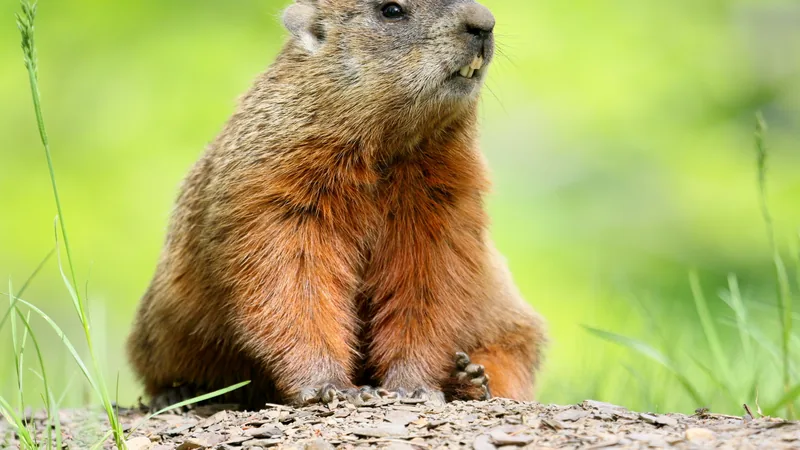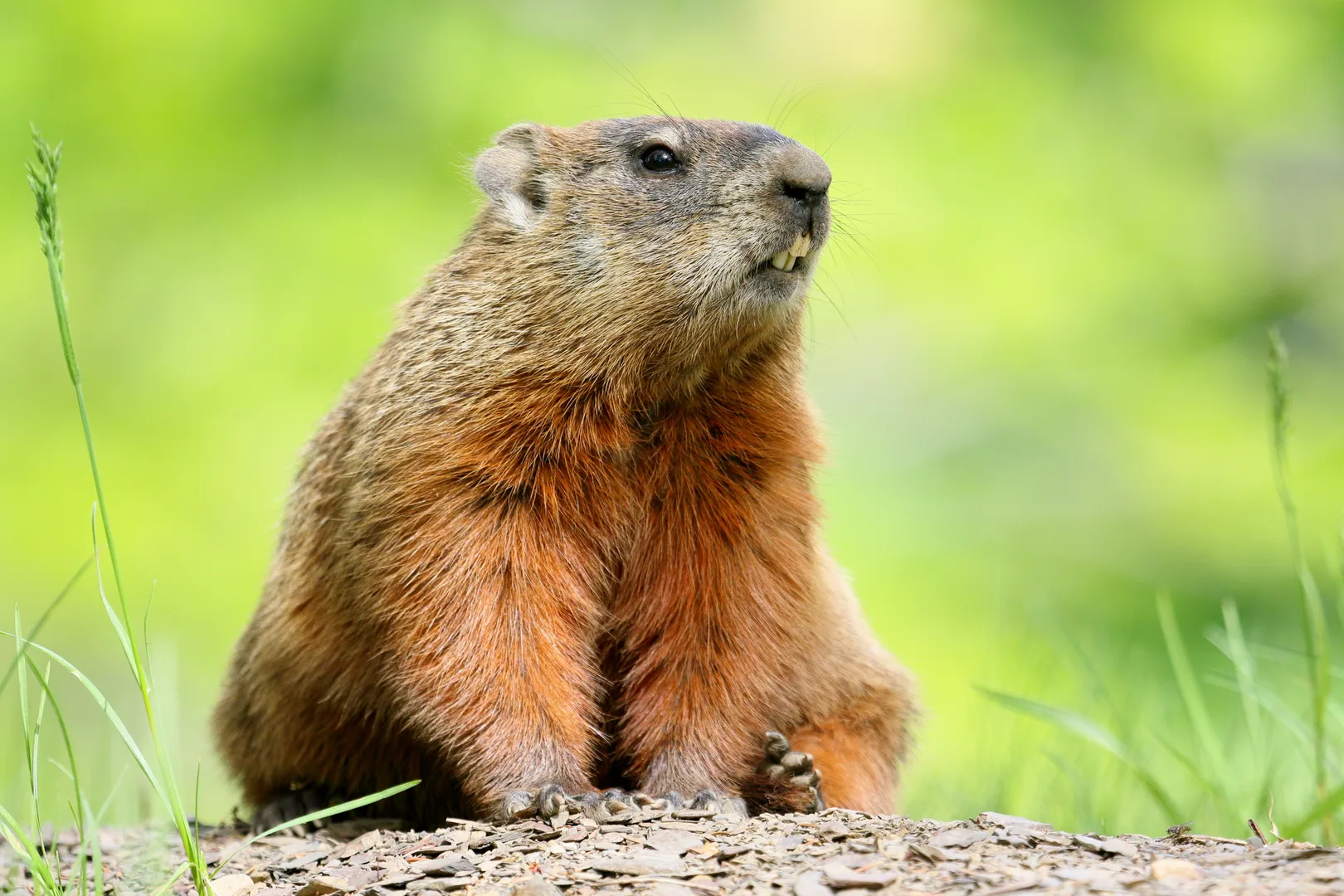
Sitting up to watch for danger in a meadow in Connecticut.
Field
notes
Built to dig
The groundhog is the largest marmot in its range. It weighs 5 to 15 pounds and measures 16 to 26 inches long. It belongs to the squirrel family, and you can find it across much of Canada and the eastern United States.
Its tools are long, curved claws and strong limbs. With them it digs tunnel networks that can reach 4 to 5 feet down and up to 30 feet in length. A burrow often has several entrances and separate chambers for hibernation, which is deep winter sleep. Once abandoned, these burrows give shelter and breeding space to many other animals, including rabbits, raccoons, foxes, river otters and snakes.
Like all rodents, it has big front teeth, called incisors, that grow continuously. Grazing and gnawing through roots wear them down.
Tidy tunnels Groundhogs are surprisingly sanitary, even dedicating separate chambers for defecation.
Eat now, sleep later
In summer, a groundhog can eat up to 1.5 pounds of plants a day. That adds 11.5 to 20 grams of body weight daily, depending on sex and age. In spring it favours clover, and later in the growing season it seeks out berries, corn, tomatoes, alfalfa and apples from fields and gardens. It will occasionally eat bird eggs, beetles, snails and grasshoppers.
Hibernation starts in October or November. Both sexes wake briefly in February, when males claim territories and look for females. They go back to sleep and finally emerge in March. A female has one litter of 2 to 6 young a year. The kits are born blind and hairless. After about 2 months of care they leave to find their own territories.
The whistle pig
A threatened groundhog often defends itself with its teeth and gives a shrill whistle. The whistle also warns other groundhogs, especially juveniles. To avoid predators it climbs trees and stops to look up while feeding. Groundhogs are prey for coyotes, bobcats, eagles, hawks, owls and weasels.
In the wild a groundhog lives 4 to 6 years on average. The Red List rates it Least Concern.
A lab partner
Groundhogs are the best non-human model for studying hepatitis B, a virus that damages the human liver. They can be infected with a similar disease called woodchuck hepatitis virus. Studying infected groundhogs helps researchers understand the virus and develop new treatments for people with hepatitis B.
Published Updated
Traits
Intel
& FAQ
Guess
first
How big is a Groundhog, really? Slide, lock in, and see what the sources say. Every answer is a figure from this page, quoted from where it came from.
Sources
- 01Cassola (2016). Marmota monax. The IUCN Red List of Threatened Species 2016: e.T42458A115189992.
- 02Kerwin & Maslo. Ecology and Management of the Groundhog (Marmota monax). Rutgers New Jersey Agricultural Experiment Station.
- 03Tobias. Marmota monax (woodchuck). Animal Diversity Web.
What the sources say: 42 claims checked word for word against these sources →