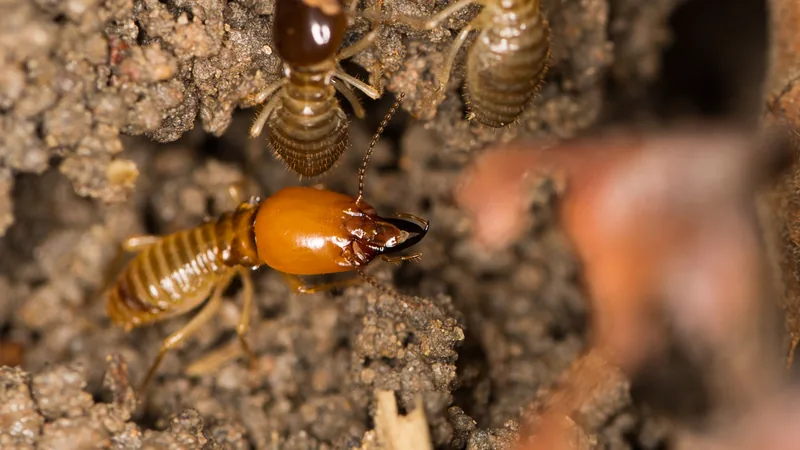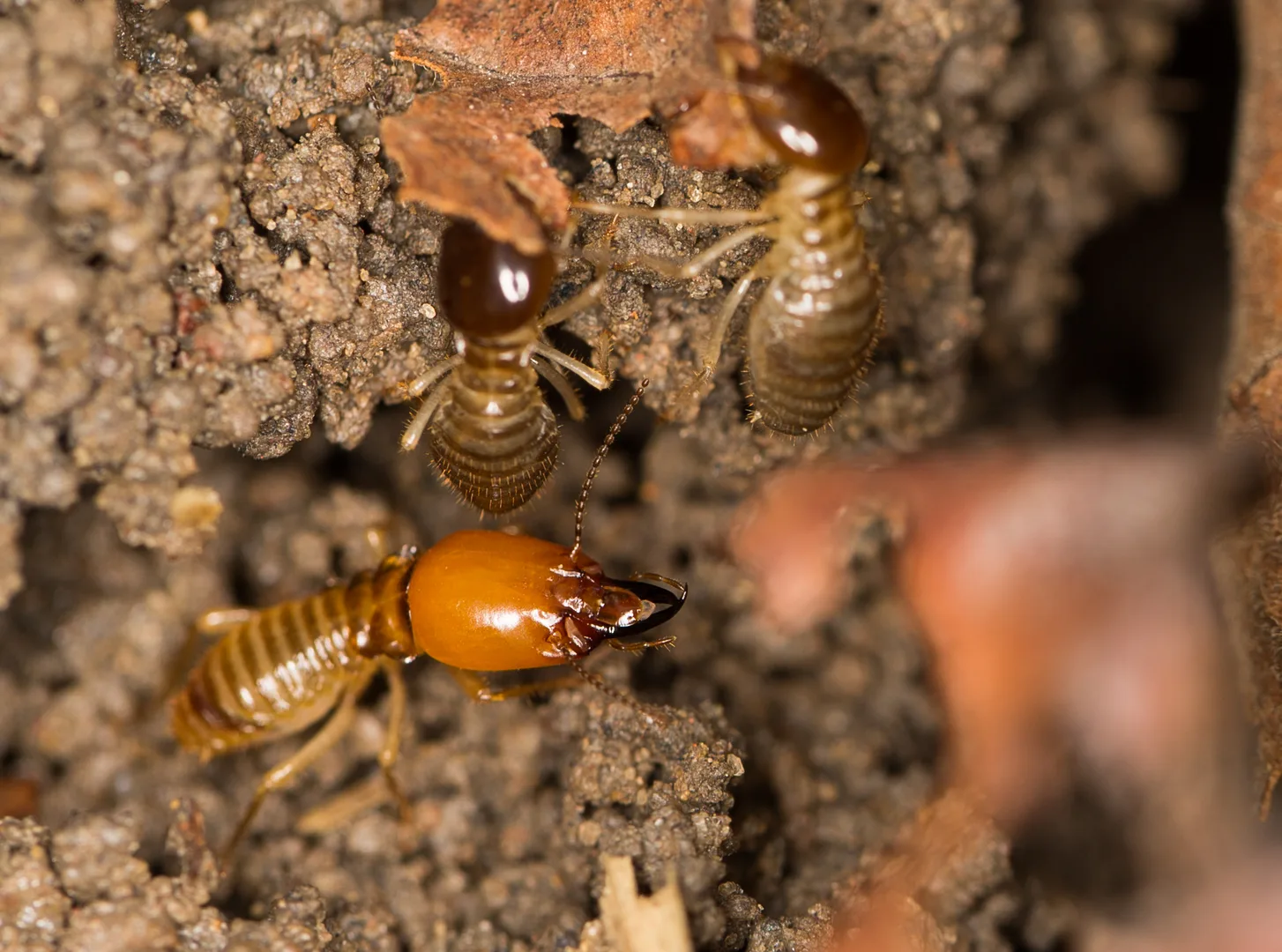
A minor soldier and major workers at a Macrotermes bellicosus foraging site.
Field
notes
A queen built for eggs
Macrotermes bellicosus is a fungus-growing, mound-building termite from Africa. Queens and kings are known to live as long as 20 years in the lab, while workers live only a few months. Queens of its genus, Macrotermes, are specialized egg-layers that produce about 20,000 eggs a day. Given how long they live, the researchers call them probably the most fecund terrestrial animals, meaning the most productive egg-layers on land.
In one wild study population in Ivory Coast, a colony’s median life expectancy once its mound appears is 6 years. Army ants that kill whole colonies are the major cause of chance deaths there once colonies are established.
Two kinds of workers
Workers are completely sterile. There are two worker castes, called majors and minors. Minors mostly work indoors, caring for young and building the mound. They are female and can develop into soldiers. Majors are male and generally do the more dangerous jobs, like foraging for food.
Workers change jobs as they age. In a study that tracked marked workers, they moved from caring for the queen to foraging between day 13 and day 25 after their moult into adults for majors, and between day 9 and day 32 for minors. Their traffic to a foraging arena was highest at 20:00 in the evening and lowest at 7:00 in the morning.
Fungus farmers
These termites grow a fungus of the genus Termitomyces on fungus combs inside the nest. The two live in an obligate mutualistic symbiosis, a partnership neither side can do without. The termites’ main food is dead wood, grass litter and dung.
Colonies reach high densities in African savannah, while in forests they are comparatively rare and found only in relatively open areas. In a three-year study of both habitats, savannah colonies reproduced annually, producing high numbers of offspring called alates. Forest colonies reproduced on average only once every 3 years.
Forest and savannah mounds In Ivory Coast’s Comoé National Park, mounds in the cooler gallery forest are dome-shaped with thick walls, while savannah mounds are more complex, with many ridges and thin walls. Savannah mounds have a very efficient circular airflow during the day. In the cooler forest, air moves upward less efficiently.
Published
Traits
Intel
& FAQ
Guess
first
How big is a Mound-Building Termite, really? Slide, lock in, and see what the sources say. Every answer is a figure from this page, quoted from where it came from.
Sources
- 01Elsner, Meusemann & Korb (2018). Longevity and transposon defense, the case of termite reproductives. Proceedings of the National Academy of Sciences.
- 02Hinze & Leuthold (1999). Age related polyethism and activity rhythms in the nest of the termite Macrotermes bellicosus (Isoptera, Termitidae). Insectes Sociaux.
- 03Korb & Linsenmair (1999). Reproductive success of Macrotermes bellicosus (Isoptera, Macrotermitinae) in two neighbouring habitats. Oecologia.
- 04Korb (2003). Thermoregulation and ventilation of termite mounds. Naturwissenschaften.
- 05Korb & Linsenmair (1998). Experimental heating of Macrotermes bellicosus (Isoptera, Macrotermitinae) mounds: what role does microclimate play in influencing mound architecture? Insectes Sociaux.
- 06Ejomah, Uyi & Ekaye (2020). Exposure of the African mound building termite, Macrotermes bellicosus workers to commercially formulated 2,4-D and atrazine caused high mortality and impaired locomotor response. PLOS ONE.
- 07Kinyuru et al. (2013). Nutrient composition of four species of winged termites consumed in western Kenya. Journal of Food Composition and Analysis.
What the sources say: 51 claims checked word for word against these sources →