Western Honeybee (Apis mellifera)
Field
notes
Three Sizes and a Barbed Sting
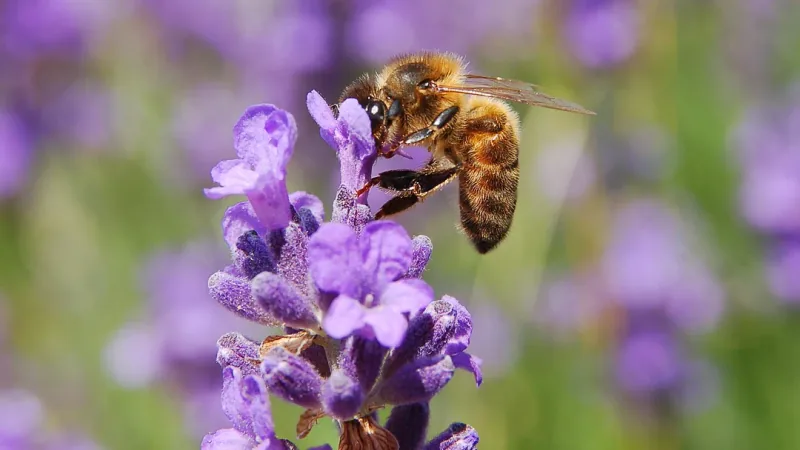
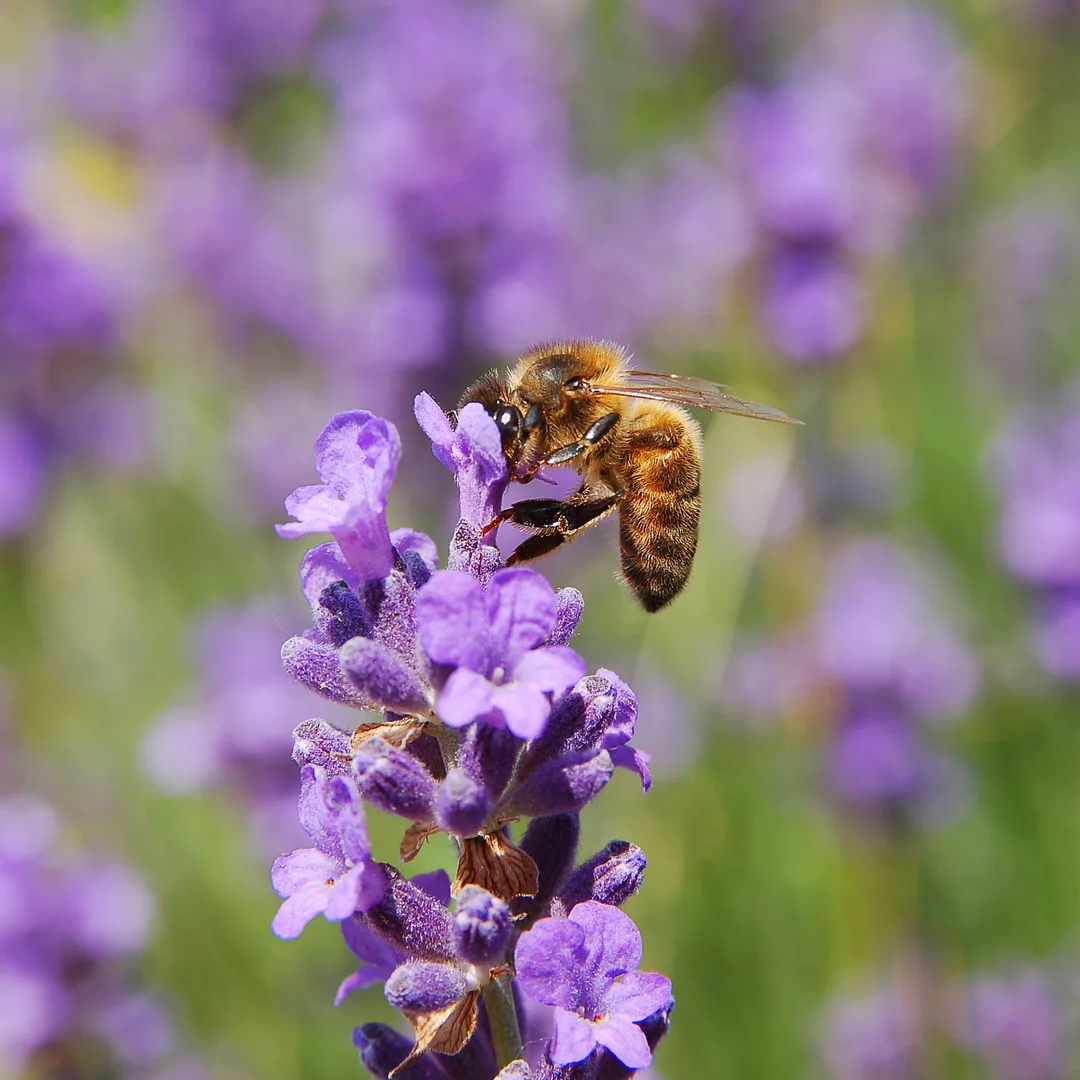
Apis mellifera comes in three sizes packed into one colony. Sterile female workers run 10 to 15 millimeters long, queens stretch to 18 to 20 millimeters, and males, called drones, land in between at 15 to 17 millimeters. In one laboratory feeding trial, caged worker bees weighed between 0.0776 and 0.1886 grams.
A worker’s sting is heavily barbed. When she uses it, the sting and its venom glands tear out of her abdomen and stay embedded in the target, and that kills her. A stinging worker also releases an alarm pheromone that makes other workers agitated and more likely to sting.
Dancing in a Dark Hive
A forager who finds food within about 300 meters of the hive does a simple “round dance” that says food is nearby but not in which direction. For food farther away she switches to the waggle dance: a straight run while shaking her abdomen, then a turn back to the starting point, circuit after circuit. On the vertical comb inside the dark hive she orients her body relative to gravity, and that angle stands in for the direction to the food relative to the sun’s position. Researchers who trained honeybees to feeders up to 1.7 kilometers away found that the straight run’s duration does not grow evenly with distance: it climbs faster over the first kilometer and more slowly beyond it.
Queens Outlive Their Workers
A queen has been reported living up to eight years, while her worker daughters typically live for only a few weeks.
A colony has one reproductive female, the queen, and she usually lives two to three years. Her sterile daughters, the workers, do all the colony’s work, and foraging keeps their lives short: two to four weeks in summer, though a worker that lives through the winter can last as long as 11 months. One caged feeding trial recorded worker lifespans anywhere from 3 to 61 days, averaging under three weeks.
Nectar, Pollen and a Worldwide Range
Apis mellifera feeds on nectar and pollen collected from blooming flowers, and pollen is its only source of protein. Workers build comb from wax they secrete, a sheet of hexagonal cells that also stores honey, which is processed nectar, and pollen. The species is native to Europe, western Asia and Africa. Human introduction to other continents began in the 17th century, and it now lives all around the world, including east Asia, Australia and the Americas. It favours places rich in flowering plants, such as meadows, open woodland and gardens, and nests in cavities such as hollow trees. The Red List’s most recent assessment, from 2025, covers Europe only and lists the western honeybee there as Data Deficient, with a decreasing population trend.
Published Updated
Traits
Intel
& FAQ
Guess
first
How big is a Western Honeybee, really? Slide, lock in, and see what the sources say. Every answer is a figure from this page, quoted from where it came from.
Sources
- 01Apis mellifera (honey bee). Animal Diversity Web, University of Michigan.
- 02Brown et al. (2022). Dream Team for Honey Bee Health: Pollen and Unmanipulated Gut Microbiota Promote Worker Longevity and Body Weight. Frontiers in Sustainable Food Systems.
- 03AnAge entry for Apis mellifera. AnAge: The Animal Ageing and Longevity Database, Human Ageing Genomic Resources.
- 04Kohl & Rutschmann (2021). Honey bees communicate distance via non-linear waggle duration functions. PeerJ.
- 05Moro et al. (2025). Apis mellifera. The IUCN Red List of Threatened Species 2025: e.T42463639A277757621.
What the sources say: 39 claims checked word for word against these sources →