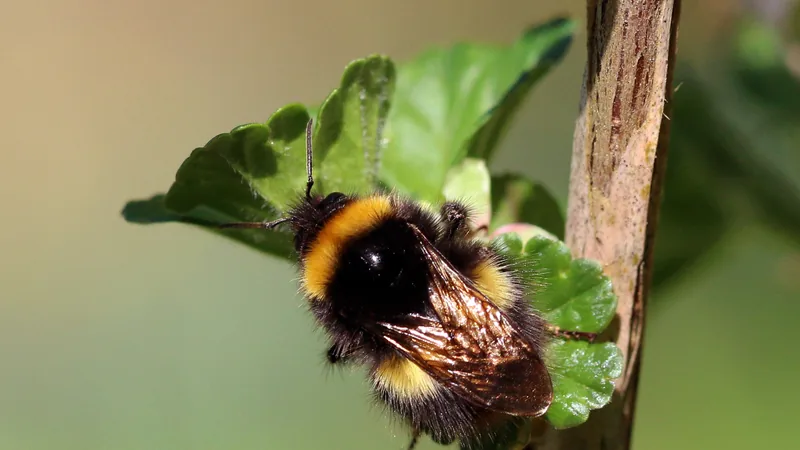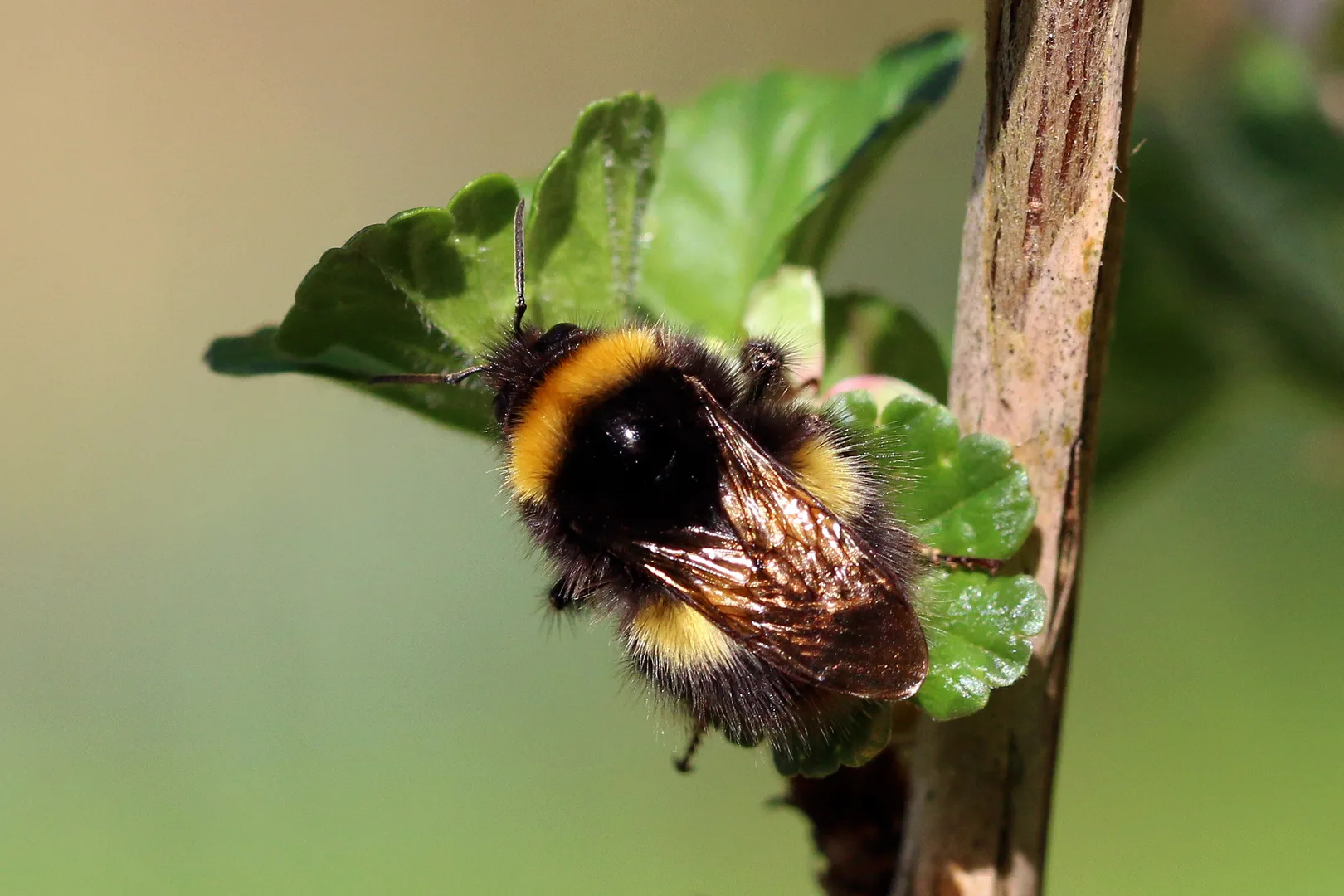
Resting on a leafy stem in the sun, its buff-tinged tail band showing.
Field
notes
The Flower Burglar
The buff-tailed bumblebee (Bombus terrestris) has a short tongue, and some flowers are too deep for it. Its fix is to bite a hole at the base of the flower and suck out the nectar. This is why it is known as a “nectar robber”. Other insects then use the hole too. It struggles with long, tubular flowers, and prefers open, daisy-like ones, where the nectar is easier to reach.
The Wildlife Trusts call it one of the UK’s biggest bumblebees, at 2.0 to 2.2 cm long. The Bumblebee Conservation Trust lists it among the “Big Eight” common and widespread bumblebees in the UK. It visits a wide variety of flowers for both pollen and nectar. A 2009 profile by the Bees, Wasps & Ants Recording Society gives its range as Europe and the middle and northern latitudes of Asia, east to northern Mongolia, plus the higher altitudes of the Atlas Mountains in northern Africa. Its Red List assessment for Europe, published in 2025 and last assessed in 2023, lists it as Least Concern there.
Queen Tails, Worker Tails
The name comes from the buff-coloured tail of the queen. Workers have white tails, and the Bumblebee Conservation Trust says the workers of this species and the white-tailed bumblebee generally cannot be told apart.
Nests sit underground, often in old mammal nests. The Bumblebee Conservation Trust puts a big nest at around 350 workers, and the Wildlife Trusts say up to 600 bees.
A Winter Worker
In the UK, queens are some of the first to emerge, in late winter or early spring, and can be seen from February. In southern parts of the UK, and in cities further north, the species can also be winter-active. There, nests are established in October or November, and workers forage all winter on Mahonia and other winter-flowering plants.
The AnAge database gives a maximum longevity of 0.27 years in captivity, from a study of the longevity of queens, and records specimens of the audax subspecies living up to 98 days.
Escape artists That 2009 profile says captive nests, not of the British sub-species, are used by commercial tomato and fruit growers. Some of the breeding bees may escape and interbreed with wild ones. Bees from commercial nests lack the deeper yellow bands and darker tail markings of the British sub-species.
Published
Traits
Intel
& FAQ
Guess
first
How big is a Buff-Tailed Bumblebee, really? Slide, lock in, and see what the sources say. Every answer is a figure from this page, quoted from where it came from.
Sources
- 01Can you bust these seven bumblebee myths? Bumblebee Conservation Trust.
- 02Buff-tailed bumblebee. The Wildlife Trusts.
- 03Buff-tailed bumblebee (Bombus terrestris). Bumblebee Conservation Trust.
- 04Bombus terrestris (Linnaeus, 1758). Bees, Wasps & Ants Recording Society.
- 05AnAge entry for Bombus terrestris. Human Ageing Genomic Resources, AnAge database.
- 06Ghisbain et al. (2025). Bombus terrestris. The IUCN Red List of Threatened Species 2025: e.T221880141A221880274.
What the sources say: 54 claims checked word for word against these sources →