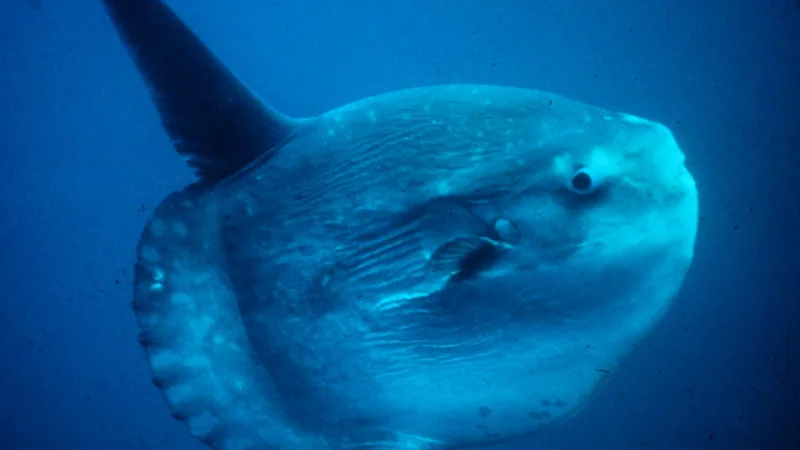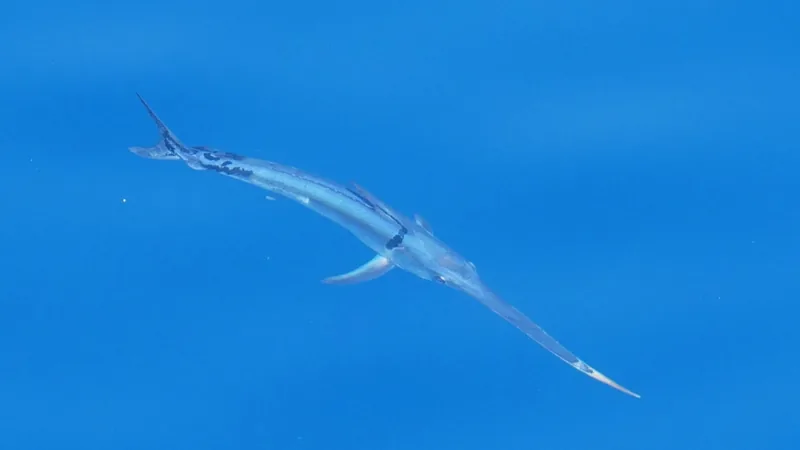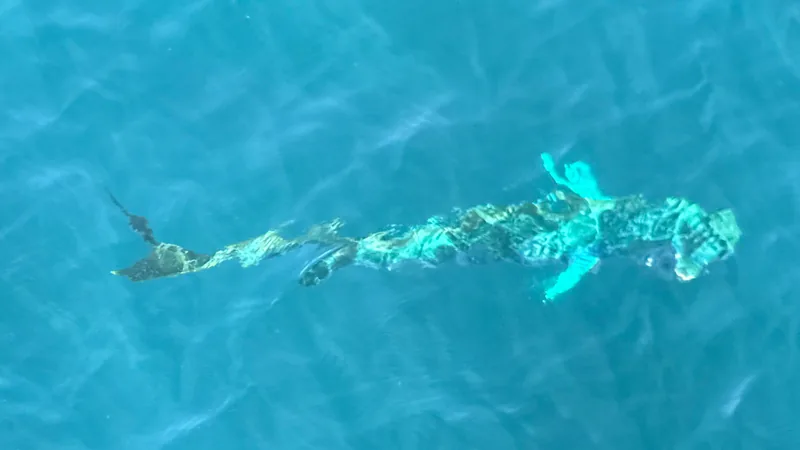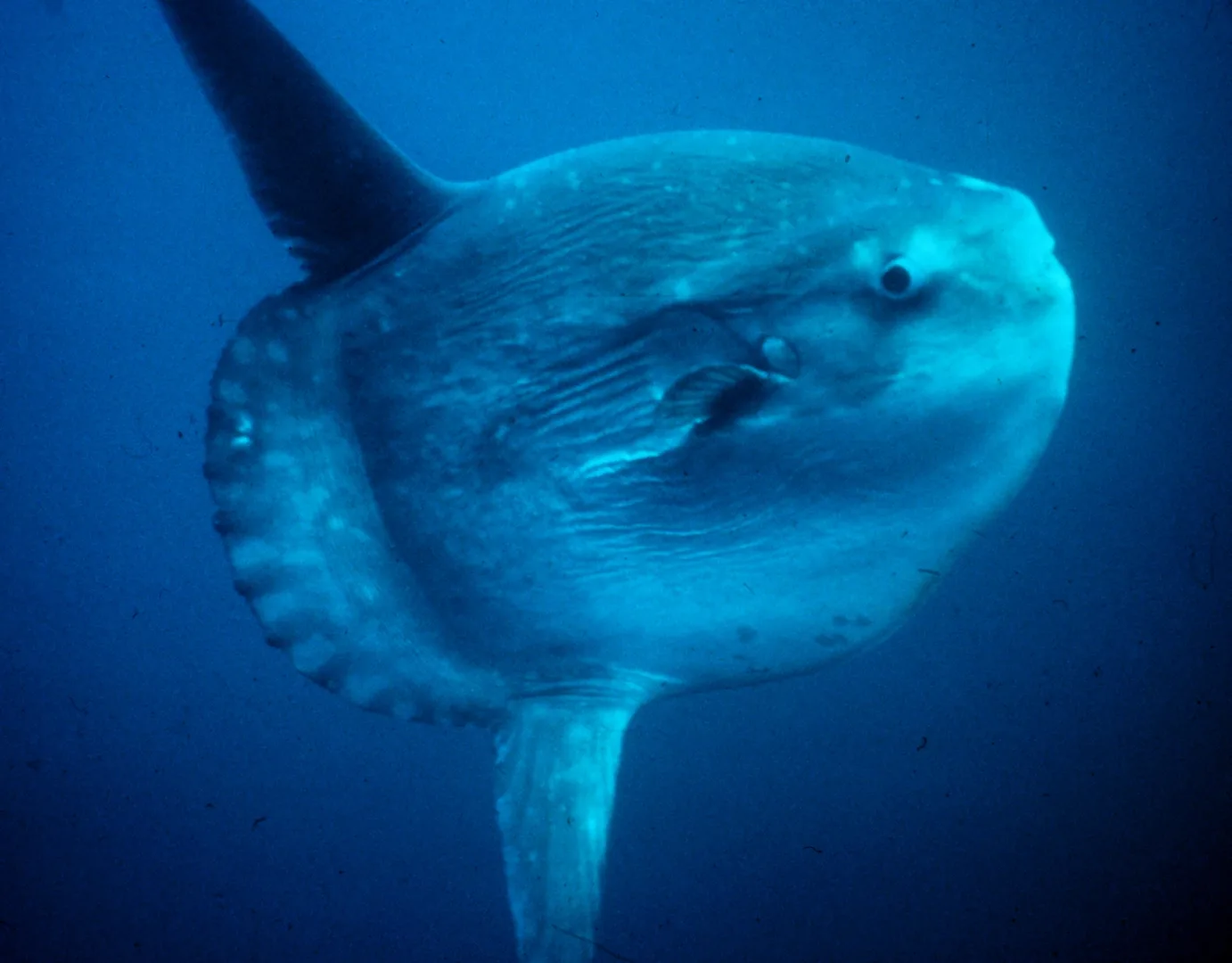
Mola mola (en: Ocean Sunfish; pt: Peixe lua)
Field
notes
How Heavy Is an Ocean Sunfish, Really
The ocean sunfish (Mola mola) can grow past 3 meters long and weigh up to 1.3 tonnes, and its family, Molidae, includes the largest bony fish in the world. For a long time it also carried a bigger title: the world’s heaviest bony fish, at around 2,300 kilograms. A 2022 review of giant-sunfish records found that the specimen behind that number wasn’t Mola mola. It was a giant sunfish, Mola alexandrini, a separate species caught off Japan in 1996, and the same review concluded M. alexandrini is the only living bony fish researchers could confirm above 2,000 kilograms. So Mola mola is enormous, just not the outright record-holder its old reputation claims. These species had long been confused for each other, and a 2017 taxonomic study designated a fixed reference specimen for Mola mola to sort them out. One clue that does separate them: the clavus, the sunfish’s rudder-like rear end, has a wavy, frilled edge in Mola mola and a rounded one with no indent in M. alexandrini.
Built From Cartilage and Jelly
Sunfish have no tail fin. The dorsal and anal fins do the work instead, beating side to side in sync the way a penguin flaps both flippers together, to generate lift-based thrust rather than a drag-based push. Tagged sunfish cruised at 0.4 to 0.7 meters per second, in the same range as salmon and marlin, and one GPS-tagged fish covered an estimated 1,819 kilometers over 92 days. This is not the limp drifter its reputation suggests.
The skeleton is mostly cartilage, and a thick gelatinous layer under the skin made up 44 percent of the weight of one 247-kilogram fish. Researchers studying the sunfish genome found several genes tied to growth-hormone signaling showing signs of positive selection or sped-up evolution, which the study says might explain its fast growth rate; juveniles can pack on up to 0.82 kilograms a day.
A Body Built Like a Water Balloon That gelatinous layer is roughly 90 percent water, threaded with a collagen and elastin meshwork, and it houses the muscles that drive the dorsal and anal fins while keeping the whole fish neutrally buoyant without a swim bladder.
Deep Dives, Then a Warm-Up
What a sunfish eats changes as it grows. In a study of juveniles and sub-adults off southern Portugal, all 37 centimeters to 1.1 meters long, the smaller fish ate mainly small crustaceans and fish from the seabed and coastal waters, while the larger ones relied on open-water prey and ate more kinds of jellyfish and their relatives. Camera tags have caught sunfish hunting siphonophores on repeated daytime dives to roughly 100 to 200 meters, in water colder than 12°C, and one tracking study logged a dive to 844 meters.
Deep dives cost heat. A sunfish’s body temperature drops on the way down, and researchers found the rate of heat exchange runs 3 to 7 times greater at the surface than while cooling, consistent with basking between dives to recover warmth. Large sharks often prey on sunfish, California sea lions go after the juveniles in Monterey Bay, and cleaner fish such as wrasses and angelfish pick off its parasites when it occasionally visits kelp beds and reefs.
Published Updated
Traits
Intel
& FAQ
Guess
first
How big is a Ocean Sunfish (Mola Mola), really? Slide, lock in, and see what the sources say. Every answer is a figure from this page, quoted from where it came from.
Sources
- 01Mola mola (Ocean Sunfish). Animal Diversity Web, University of Michigan.
- 02Mola mola (Linnaeus, 1758), Ocean sunfish. FishBase.
- 03Ocean Sunfish. Oceana.
- 04Ocean Sunfish, Mola mola. Australian Museum.
- 05Jing et al. (2015). Mola mola. The IUCN Red List of Threatened Species 2015: e.T190422A1951231.
- 06Sawai & Nyegaard (2022). A review of giants: Examining the species identities of the world's heaviest extant bony fishes (ocean sunfishes, family Molidae). Journal of Fish Biology.
- 07Watanabe & Sato (2008). Functional Dorsoventral Symmetry in Relation to Lift-Based Swimming in the Ocean Sunfish Mola mola. PLoS ONE.
- 08Sims et al. (2009). Long-Term GPS Tracking of Ocean Sunfish Mola mola Offers a New Direction in Fish Monitoring. PLoS ONE.
- 09Nakamura, Goto & Sato (2015). Ocean sunfish rewarm at the surface after deep excursions to forage for siphonophores. Journal of Animal Ecology.
- 10Sousa et al. (2016). DNA barcoding identifies a cosmopolitan diet in the ocean sunfish. Scientific Reports.
- 11Sawai et al. (2017). Redescription of the bump-head sunfish Mola alexandrini (Ranzani 1839), senior synonym of Mola ramsayi (Giglioli 1883), with designation of a neotype for Mola mola (Linnaeus 1758) (Tetraodontiformes: Molidae). Ichthyological Research.
- 12Johnson & Britz (2004). Leis' conundrum: Homology of the clavus of the ocean sunfishes. 2. Ontogeny of the median fins and axial skeleton of Ranzania laevis (Teleostei, Tetraodontiformes, Molidae). Journal of Morphology.
- 13Davenport et al. (2018). The locomotor system of the ocean sunfish Mola mola (L.): role of gelatinous exoskeleton, horizontal septum, muscles and tendons. Journal of Anatomy.
- 14Pan et al. (2016). The genome of the largest bony fish, ocean sunfish (Mola mola), provides insights into its fast growth rate. Gigascience.
What the sources say: 73 claims checked word for word against these sources →