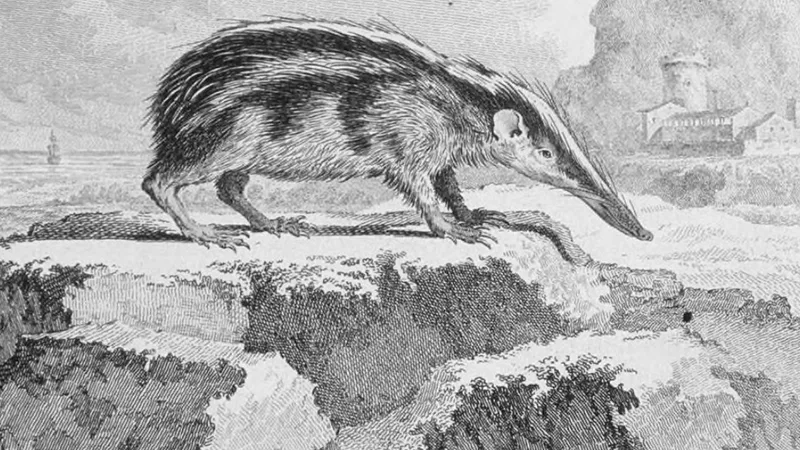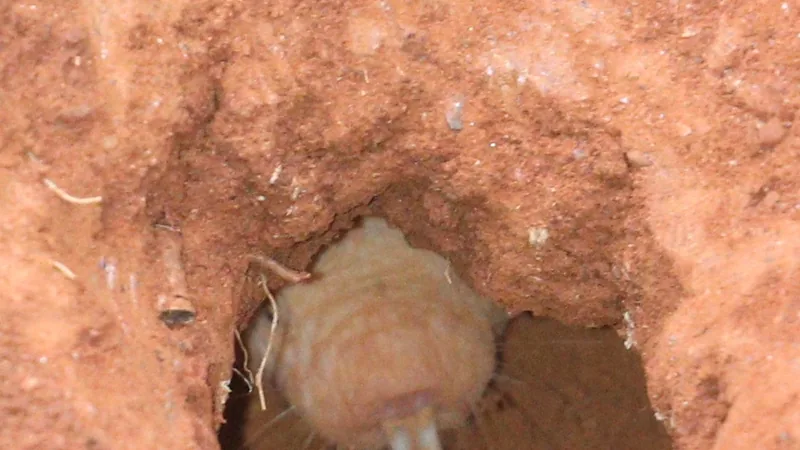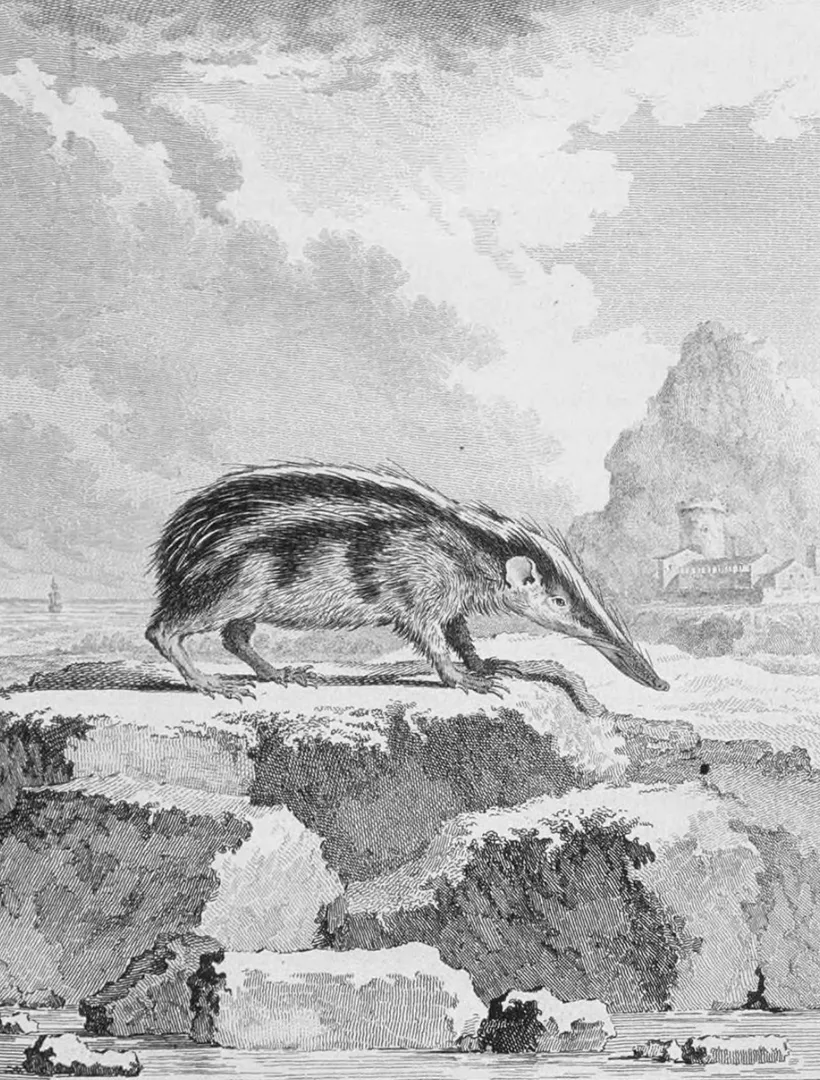
Lowland Streaked Tenrec foraging in Madagascar rainforest
Field
notes
Quills That Sing Above Your Hearing
The lowland streaked tenrec (Hemicentetes semispinosus) wears black and yellow quills, with four yellow stripes: one down the snout and three along the body. A group of 7 to 16 of them on the back is a stridulation organ. Rubbing them together to make sound is known as stridulation, which insects such as cicadas do too. When the quill tips rub together, they make high-frequency sounds that scientists think let tenrecs in a foraging group talk to each other. Humans can’t hear them.
A study confirmed thickened skin muscle beneath those quills. Its cells contain mainly fast myosin, and the findings indicate that it contributes to the vibration of the quills and to the sound they make.
Spiny head bobbing When disturbed, these tenrecs erect the spines on the head and move the head up and down over and over, which is how one can impale a possible enemy or predator. Stamping of the forefeet and rushing at the disturbance may follow.
A Handful of Spines
Streaked tenrecs of both species average 140 mm long and have no tail. The lowland species weighs 125 to 280 g, and the AnAge longevity database lists an adult weight of 180 g. The species lives in the rainforests on the east side of Madagascar, and it is found only on Madagascar.
In captivity, Animal Diversity Web reports up to 30 months. AnAge records 2.7 years from one captive animal and rates the data as questionable, with a small sample size. How long one lives in the wild is unknown.
Worm Hunter, Day Shift
Streaked tenrecs are almost exclusively worm-eaters, though they may eat other invertebrates too. They sometimes stamp on the ground with their forepaws, which may increase earthworm activity. Lowland streaked tenrecs are mainly active through the day.
Their burrows are sealed with a leaf plug. One burrow may hold one tenrec or, in the breeding season, as many as 23.
Warning Colours, Maybe
Streaked tenrecs are natural prey for Dumeril’s boas, Malagasy fossas, ring-tailed mongooses and civets. Their barbed, detachable quills are a defence mechanism. Nobody is sure why the stripes are bright. The Natural History Museum says scientists aren’t certain that they evolved as a warning, and among the leaves on the forest floor they are probably still quite well camouflaged.
The IUCN lists the species as Least Concern.
Published Updated
Traits
Intel
& FAQ
Guess
first
How big is a Lowland Streaked Tenrec, really? Slide, lock in, and see what the sources say. Every answer is a figure from this page, quoted from where it came from.
Sources
- 01Endo et al. (2010). A Quill Vibrating Mechanism for a Sounding Apparatus in the Streaked Tenrec (Hemicentetes semispinosus). Zoological Science.
- 02Hemicentetes semispinosus (streaked tenrec). Animal Diversity Web, University of Michigan.
- 03AnAge entry for Hemicentetes semispinosus. AnAge: The Animal Ageing and Longevity Database, Human Ageing Genomic Resources.
- 04The weird world of tenrecs. Natural History Museum, London.
- 05Stephenson, Soarimalala & Goodman (2016). Hemicentetes semispinosus. The IUCN Red List of Threatened Species 2016: e.T40593A97189434.
What the sources say: 41 claims checked word for word against these sources →