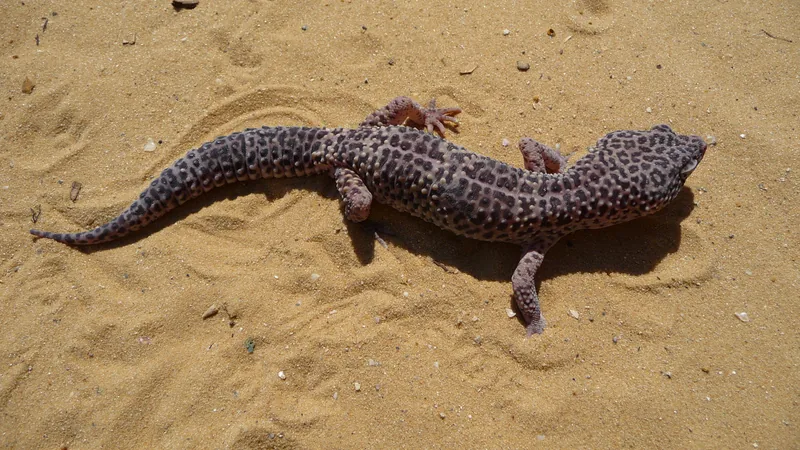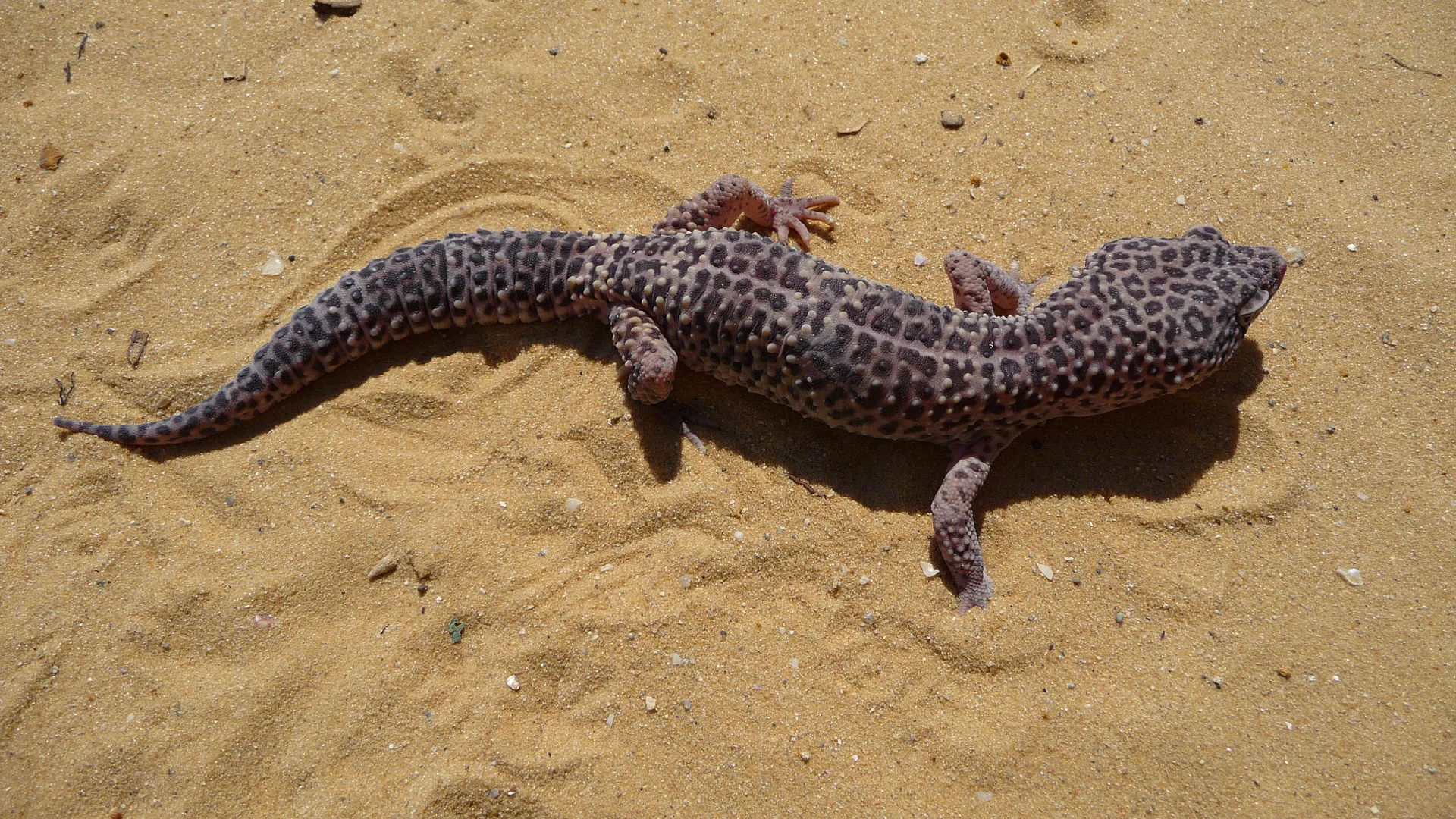
A wild-type leopard gecko on sand.
Field
notes
A tail that keeps the show going
Grab a leopard gecko firmly by the tail and the tail can come off. That is autotomy. Most of the tail bones have fracture planes, unmineralized gaps that permit controlled breakage. The dropped tail does not just lie there. Researchers recording the detached tails of leopard geckos found complex movement for up to 30 minutes, including acrobatic flips up to 3 cm high.
Regrowth, with a catch The gecko can grow the tail back in a minimum of 25 days at about 24°C, but in the regrown tail the bony vertebrae are replaced by a hollow cartilaginous cone.
From the outside, too, a regrown tail “may not look the same”, as the San Diego Zoo puts it.
Rocks, burrows and cold nights
Leopard geckos live in eastern Afghanistan, Pakistan, northwest India, Nepal and eastern Iran. The habitat is dry and semi-dry desert and arid grassland, with rocky ground and clay-gravel soil under a layer of sand. They are mostly limited to burrows and shade by day, and are more active at dawn and dusk. Winter temperatures can drop to 10°C, which drives them underground into semi-hibernation.
Unlike most geckos, they have no toe pads, and the toes end in a small claw. Leopard geckos cannot climb smooth surfaces. Their eyelids move, unlike some geckos. They can close their eyes, and a long tongue can give them a quick lick.
Small, spotted and hungry
Females are 18 to 20 cm long and males 20 to 28 cm. They weigh 50 to 80 grams, against 2 to 5 grams at hatching. In the wild they are known to eat scorpions, centipedes, spiders and beetles. They have to be wary of foxes, snakes and other large reptiles, and use keen hearing and sight to avoid them.
In captivity, a leopard gecko has lived 28.5 years, the record in the AnAge longevity database. They are among the most commonly kept pet lizards today.
The egg picks the sex
Females lay clutches of two eggs and bury them. The temperature in the first two weeks of incubation decides the sex. At 26°C the eggs produce mostly females, at 29 to 31°C about equal numbers of each, and at 32°C mostly males. The eggs hatch in 45 to 53 days. The IUCN Red List rated the species Least Concern in 2021.
Published Updated
Traits
Intel
& FAQ
Guess
first
How big is a Leopard Gecko, really? Slide, lock in, and see what the sources say. Every answer is a figure from this page, quoted from where it came from.
Sources
- 01Papenfuss, Shafiei Bafti & Sharifi (2021). Eublepharis macularius. The IUCN Red List of Threatened Species 2021: e.T164745A1072324.
- 02McLean & Vickaryous (2011). A novel amniote model of epimorphic regeneration: the leopard gecko, Eublepharis macularius. BMC Developmental Biology.
- 03Higham & Russell (2009). Flip, flop and fly: modulated motor control and highly variable movement patterns of autotomized gecko tails. Biology Letters.
- 04Leopard Gecko. San Diego Zoo Wildlife Alliance.
- 05Eublepharis macularius (Common Leopard Gecko). Animal Diversity Web, University of Michigan.
- 06Eublepharis macularius (Blyth, 1854). The Reptile Database.
- 07Eublepharis macularius (leopard gecko). AnAge: The Animal Ageing and Longevity Database.
What the sources say: 41 claims checked word for word against these sources →