This file was uploaded with Commonist .
Field
notes
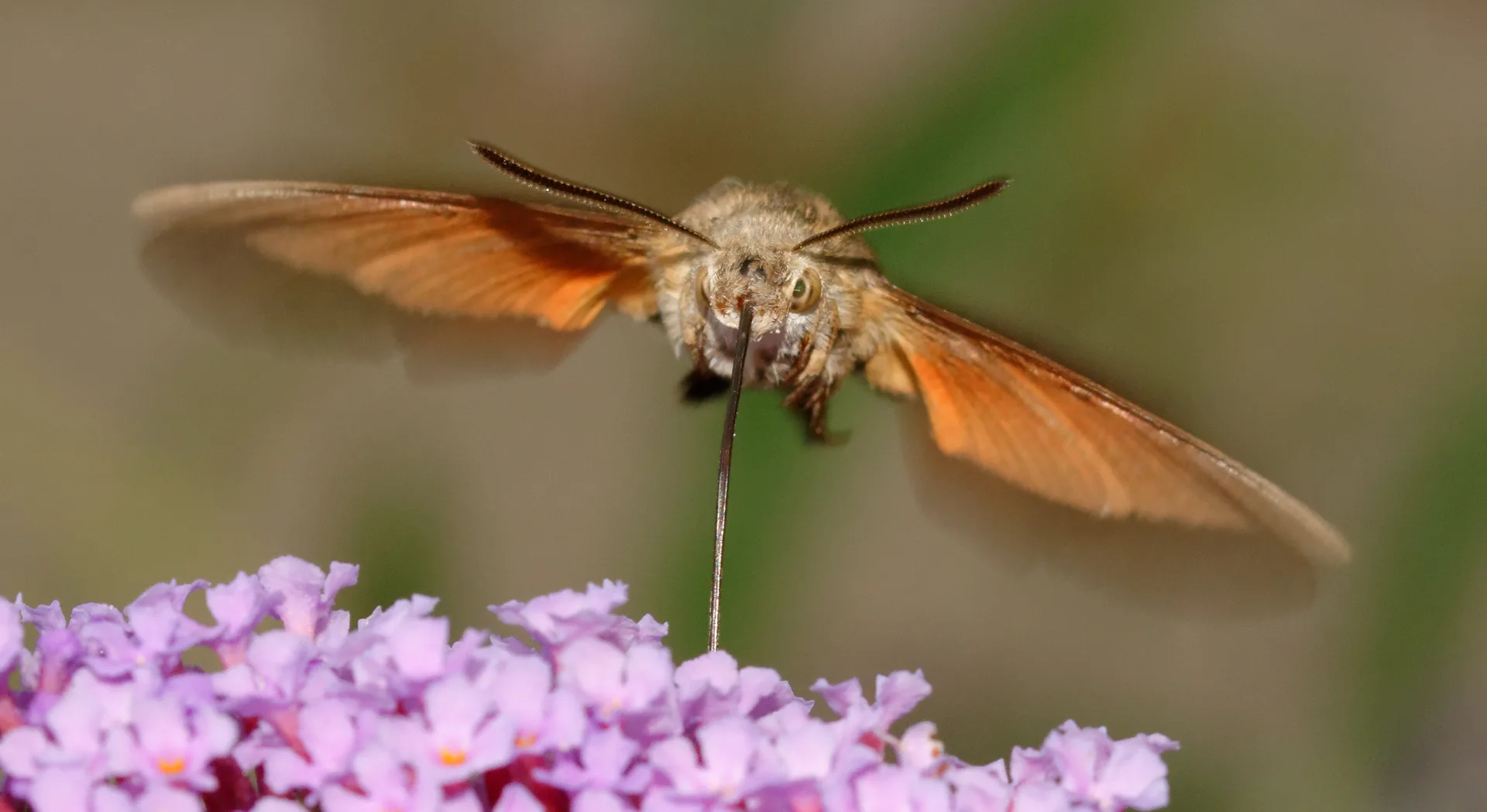
The moth that hangs in mid-air
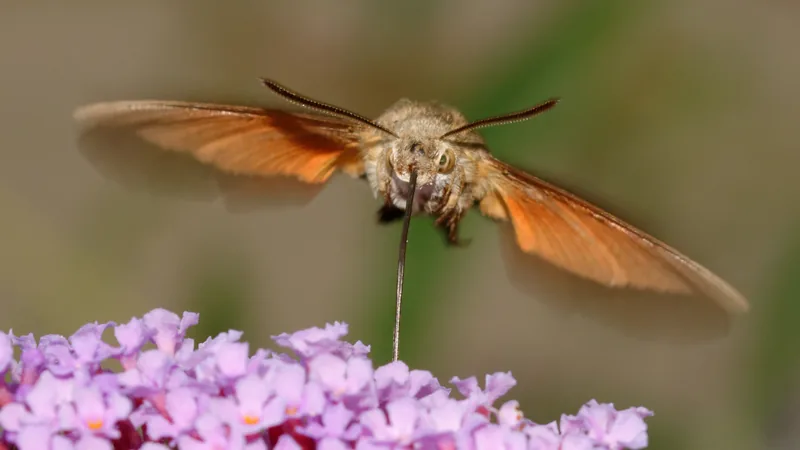
The hummingbird hawk-moth feeds from flowers while hovering in front of them. It flies by day. A nocturnal lifestyle is ancestral for the hawk-moth family, and this species evolved from moths that flew at night.
One specimen caught in the Fergana Valley had a body 29.25 millimetres long and a wingspan of 49.5 millimetres. Its proboscis, the feeding tube, measured 23 millimetres. Six moths weighed in a flight-control study averaged 252 milligrams, about a quarter of a gram.
An eye with a bullseye
The moth’s eye has a frontal acute zone, a patch with larger facets and more densely packed light-sensing cells than the rest of the eye. That patch gives the sharpest and brightest image, and the moth uses it to fixate flower entrances during hovering and feeding. In the front of the eye there are up to four rhabdoms, the light-sensing structures, behind each facet, so the moth does not have ommatidia, the usual units of an insect eye, in the accepted sense.
Electrical recordings found light receptors for ultraviolet, blue and green, most sensitive at 349, 440 and 521 nanometres.
Built for the heat In foraging moths at a flowering lavender patch in southeastern Spain, the thorax, the middle section of the body, stayed between 39 and 46 degrees Celsius while the air ranged from 19 to 36 degrees. The author called their tolerance of high thorax temperature unusual.
Steering with the antennae
Hovering takes more than good eyes. In a flight-cage test, moths with the flagella removed from their antennae (the long outer part) jittered more around an artificial flower than moths with intact antennae. The authors report that antennal mechanosensors, which feel movement, play a key role in controlling hovering flight, especially fast manoeuvres such as rapid turns.
Where it lives and what it eats
The species is found across the Palearctic region. Its southern range limit runs from North Africa through the Middle East and Pakistan to southern China and Japan. Its northern limit depends on climate and changes from year to year.
Adults drink nectar from many kinds of flower. Galium plants are the caterpillars’ native host plant. In the Fergana Valley the author saw three generations in the 2022 season, and reports that the species spends the winter as an adult.
Published Updated
Traits
Intel
& FAQ
Guess
first
How big is a Hummingbird Hawk-Moth, really? Slide, lock in, and see what the sources say. Every answer is a figure from this page, quoted from where it came from.
Sources
- 01Dahake et al. (2018). The roles of vision and antennal mechanoreception in hawkmoth flight control. eLife.
- 02Warrant, Bartsch & Günther (1999). Physiological optics in the hummingbird hawkmoth: a compound eye without ommatidia. Journal of Experimental Biology.
- 03Telles et al. (2014). Out of the blue: the spectral sensitivity of hummingbird hawkmoths. Journal of Comparative Physiology A.
- 04Kelber (1997). Innate Preferences for Flower Features in the Hawkmoth Macroglossum Stellatarum. Journal of Experimental Biology.
- 05Balkenius, Rosén & Kelber (2005). The relative importance of olfaction and vision in a diurnal and a nocturnal hawkmoth. Journal of Comparative Physiology A.
- 06Herrera (1992). Activity pattern and thermal biology of a day-flying hawkmoth (Macroglossum stellatarum) under Mediterranean summer conditions. Ecological Entomology.
- 07Cuadrado (2017). The year-round phenology of Macroglossum stellatarum (Linnaeus, 1758) at a Mediterranean area of South of Spain (Lepidoptera: Sphingidae). SHILAP Revista de lepidopterología.
- 08Qayumova (2023). Information on the biology of the butterfly (Lepidoptera, Sphingidae) Macroglossum stellatarum (Linnaeus, 1758) in the conditions of South Fergana. Scientific journal of the Fergana State University.
- 09van Deijk, Parsons & van Swaay (2026). Macroglossum stellatarum. The IUCN Red List of Threatened Species 2026: e.T259996857A259996876.
What the sources say: 44 claims checked word for word against these sources →