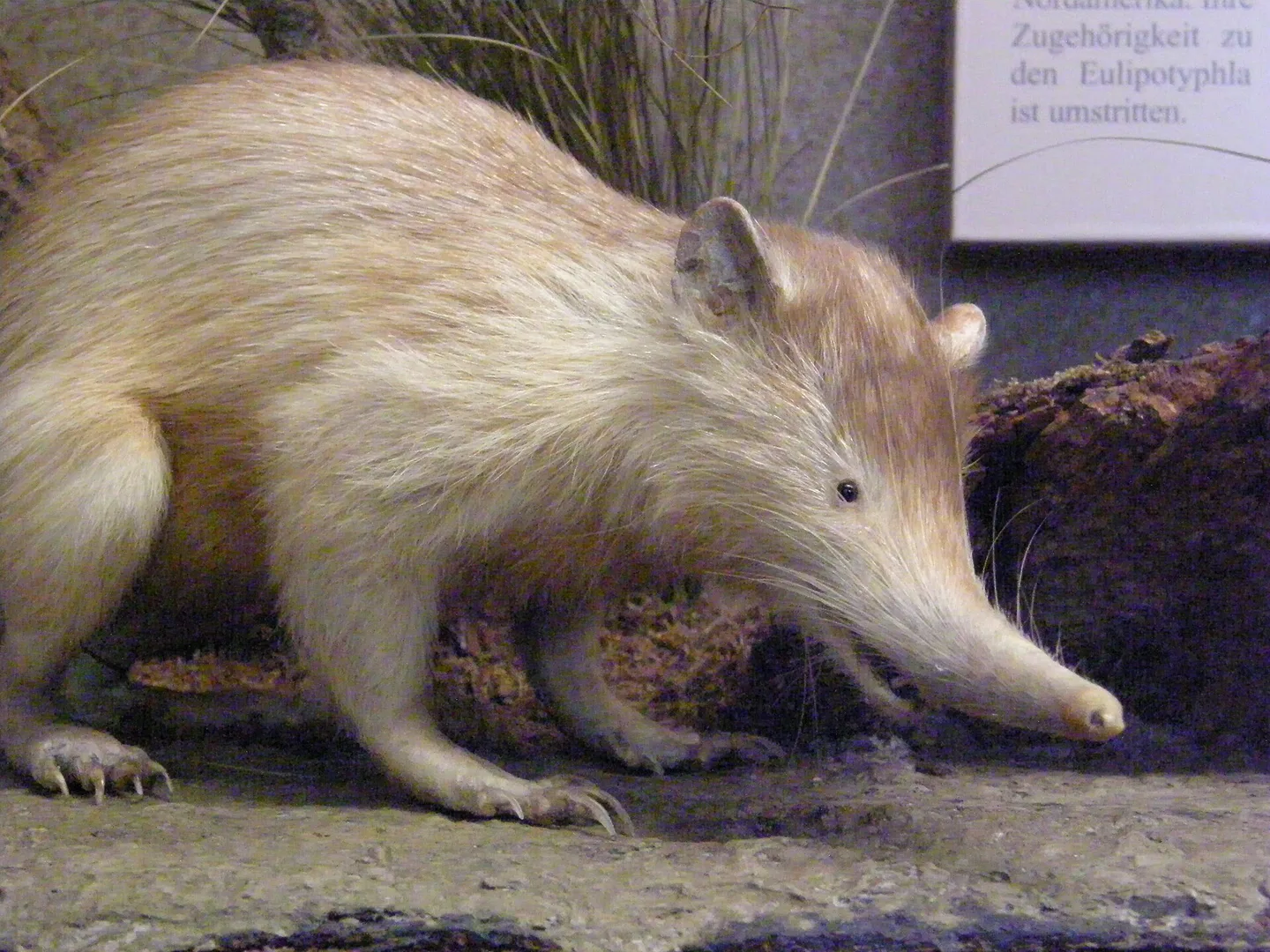
Hispaniolan solenodon (Solenodon paradoxus) in the Dominican Republic
Field
notes
Likely the Largest Venomous Land Mammal
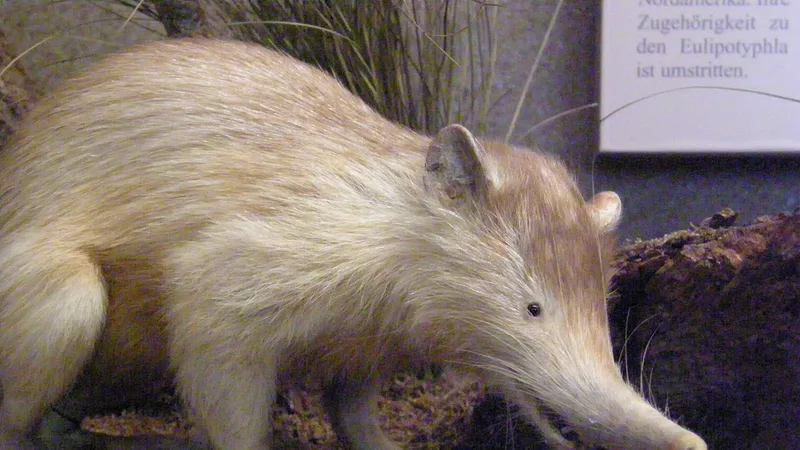
The Hispaniolan Solenodon (Solenodon paradoxus) looks much like a shrew, but a considerably larger one, with a long, cartilaginous snout. A 2019 genome study called solenodons likely the largest living venomous land mammals. Animal Diversity Web puts the species at 28 to 33 centimetres long and 600 grams to a full kilogram, and AnAge records one captive animal estimated to be 12.1 years old when it died. Molecular and fossil evidence suggests the solenodon lineage split from all other mammals more than 70 million years ago, in the Late Cretaceous. Venom is rare among mammals: it is restricted to four living orders, the monotremes (such as the platypus), bats, primates, and eulipotyphlans, the group of shrews, hedgehogs, moles and solenodons.
A Venom That Seems to Lower Blood Pressure
A solenodon makes venom in glands beneath its lower jaw and delivers it through an enlarged, grooved second lower incisor. When researchers analysed venom from two wild males, kallikrein serine proteases were its most numerous and abundant proteins, and their tests suggest the venom has a hypotensive effect, lowering blood pressure. Injected into anesthetized rats at 1 milligram per kilogram, it caused a transient drop in mean arterial pressure, peaking at 22 percent below baseline.
The Paralysis Test At up to 50 µg/mL, the venom had no effect on human muscle-type or locust acetylcholine receptors, which venoms commonly target to cause paralysis. It subtly inhibited mammalian sodium channels, yet locusts and centipedes injected with it showed no sign of immobilization.
The researchers concluded the venom is unlikely to paralyse invertebrates for storage, unlike that of Blarina shrews. They judged it most likely evolved for catching prey, in parallel with venomous shrews, and suggested it may first have evolved for vertebrate prey and now be partly a relic, after many of the region’s native vertebrates went extinct.
What’s on the Menu
Solenodons are nocturnal. They forage by digging tunnel systems under the ground and searching the surrounding soil for insects and other invertebrates. Animal Diversity Web lists their foods as millipedes, ground beetles, crickets and other orthopteran insects, earthworms and snails. In 64 droppings collected in the Dominican Republic, DNA tests found vertebrate prey in 12.3 percent. Solenodons feed predominately on invertebrates, but this fits natural history reports of them eating amphibians, reptiles, and occasionally nestlings and ground-dwelling birds. A 2022 study of droppings from pasture and agroforestry sites in the western Dominican Republic suggests these generalist insectivores find prey across different kinds of vegetation and can persist in agroforestry land outside protected areas.
Clumsy, Social, and Still Surviving
Animal Diversity Web describes it as a slow mover and a clumsy runner with no agility in avoiding enemies and a poor means of defense. It lacks any truly natural predators and has few anti-predator adaptations, but mongooses, cats and dogs, introduced to the island after European colonization, now prey on it. Solenodons are relatively social: both living species live in family groups of adults, subadults and young. The 2007 IUCN Red List rated the species Endangered, and earlier studies had predicted its likely extinction in Haiti by the start of the 21st century. In April 2007, local people brought researchers the remains of three dead solenodons, confirming it survived there. The IUCN’s current assessment, from 2015, rates it Least Concern.
Published Updated
Traits
Intel
& FAQ
Guess
first
How big is a Hispaniolan Solenodon, really? Slide, lock in, and see what the sources say. Every answer is a figure from this page, quoted from where it came from.
Sources
- 01Solenodon paradoxus. Animal Diversity Web, University of Michigan.
- 02Solenodon paradoxus. AnAge: The Animal Ageing and Longevity Database, Human Ageing Genomic Resources.
- 03Kennerley, Turvey & Young (2020). Solenodon paradoxus. The IUCN Red List of Threatened Species 2020: e.T20321A22327218.
- 04Casewell et al. (2019). Solenodon genome reveals convergent evolution of venom in eulipotyphlan mammals. Proceedings of the National Academy of Sciences.
- 05Mychajliw et al. (2022). Stable isotopes reveal seasonal dietary responses to agroforestry in a venomous mammal, the Hispaniolan solenodon (Solenodon paradoxus). Ecology and Evolution.
- 06Turvey, Meredith & Scofield (2008). Continued survival of Hispaniolan solenodon Solenodon paradoxus in Haiti. Oryx.
What the sources say: 77 claims checked word for word against these sources →