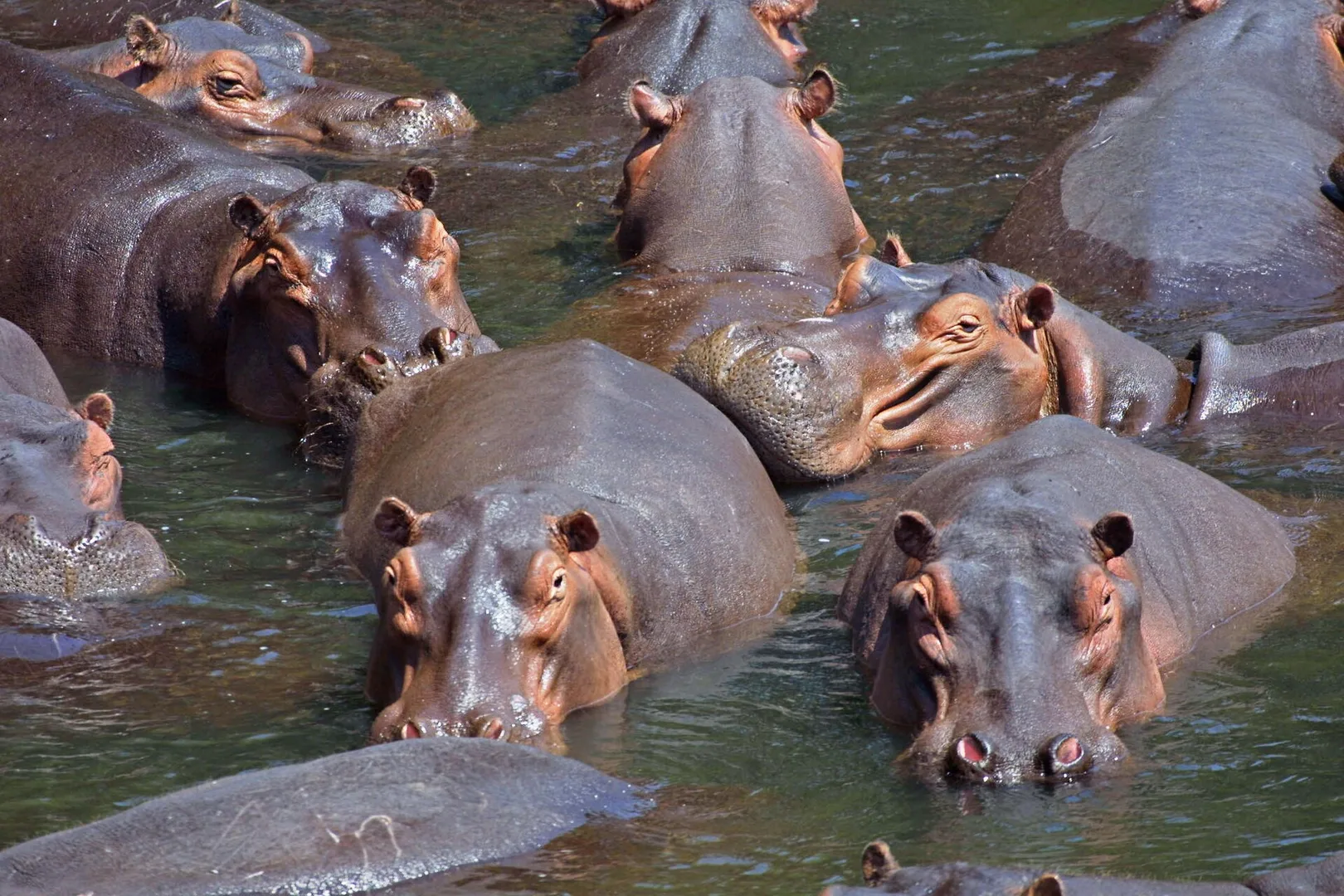
Pod of Hippos (Hippopotamus amphibius) in Luangwa Valley, Zambia
Field
notes
Walking the Riverbed Like It’s the Moon
The hippopotamus (Hippopotamus amphibius), found throughout Africa south of the Sahara Desert, usually spends the day in shallow lakes, rivers and swamps, and it walks underwater rather than swims. Researchers who filmed two captive hippos underwater never once saw them swim: instead the animals push off the bottom in a slow-motion gallop, gliding through long unsupported “in flight” moments between footfalls, a gait the researchers compare to moving in microgravity. Dense, heavy limb bones keep a hippo’s body denser than water, so it stays glued to the riverbed instead of floating up, coming to the surface to breathe as needed and able to hold its breath for up to 30 minutes at a stretch. On land, hippos are often said to reach about 30 km/h, but a 2024 study points out that their top speed has not been reliably measured. Its survey of 32 hippos on video found every one trotting or nearly trotting, and at their fastest relative speeds they were briefly airborne mid-stride, apparently a new discovery.
Blood That Isn’t Blood, Sweat That Isn’t Sweat
Hippos have no sweat glands. Instead, mucous glands release a thick fluid. It starts out colorless, then turns red within minutes and brown as it dries. For years people thought it was a mix of blood and sweat, which earned it the nickname “blood sweat.” The chemists who isolated its two pigments, hipposudoric acid and norhipposudoric acid, found they have antibiotic as well as sunscreen activity. San Diego Zoo Wildlife Alliance notes that hippos suffer many bite wounds from fighting, and the red pigment’s antibiotic properties hold back harmful bacteria.
Tusks That Keep Growing
A hippo’s jaw hinges far enough back to gape open 150 degrees; a human manages only 45. A bull’s canine tusks keep growing for life and can reach 50 centimeters, kept sharp as the teeth grind together during grazing. Bulls are heavier too: an average bull weighs around 1,546 kg and can reach about 2,065 kg, while cows average 1,385 kg. Doctors in Burundi who treated eleven hippo-bite patients called the species aggressive and dangerous, recording wound infections, amputations and permanent disability among the outcomes. Besides people, adult hippos have no known predators, though lions, hyenas and crocodiles occasionally prey on young ones.
Yawning for dominance Hippos usually display dominance by yawning, roaring, dung showering and jaw clashing.
Grass by Night, Water by Day
Hippos graze between four and five hours each night, pulling up grass with muscular lips 50 cm wide. They don’t chew it with their teeth, putting away roughly 40 kg, about 1 to 1.5 percent of body weight, before heading back before dawn. They usually stay within a few kilometers of water, though scarce grass can push them farther. Females and calves hold the center of a resting pool while bulls guard its edges, and in accredited zoos hippos have a median lifespan around 36.6 years; the longest-lived hippo on record passed 61 years in captivity. The IUCN lists the species as Vulnerable. Animal Diversity Web, citing the Red List, reports a 7 to 20 percent decline over ten years and an estimated 125,000 to 148,000 hippos in the wild.
Published Updated
Traits
Intel
& FAQ
Guess
first
How big is a Hippopotamus, really? Slide, lock in, and see what the sources say. Every answer is a figure from this page, quoted from where it came from.
Sources
- 01Hippopotamus amphibius (hippopotamus). Animal Diversity Web, University of Michigan.
- 02Hippopotamus (Hippopotamus amphibius) & Pygmy Hippopotamus (Choerpsis liberiensis) Fact Sheet: Physical Characteristics. San Diego Zoo Wildlife Alliance Library.
- 03Hippopotamus (Hippopotamus amphibius) & Pygmy Hippopotamus (Choerpsis liberiensis) Fact Sheet: Diet & Feeding. San Diego Zoo Wildlife Alliance Library.
- 04Hippopotamus (Hippopotamus amphibius) & Pygmy Hippopotamus (Choerpsis liberiensis) Fact Sheet: Reproduction & Development. San Diego Zoo Wildlife Alliance Library.
- 05Saikawa et al. (2004). The red sweat of the hippopotamus. Nature.
- 06Coughlin & Fish (2009). Hippopotamus Underwater Locomotion: Reduced-Gravity Movements for a Massive Mammal. Journal of Mammalogy.
- 07Haddara et al. (2020). Hippopotamus bite morbidity: a report of 11 cases from Burundi. Oxford Medical Case Reports.
- 08Hutchinson & Pringle (2024). Footfall patterns and stride parameters of Common hippopotamus (Hippopotamus amphibius) on land. PeerJ.
What the sources say: 60 claims checked word for word against these sources →