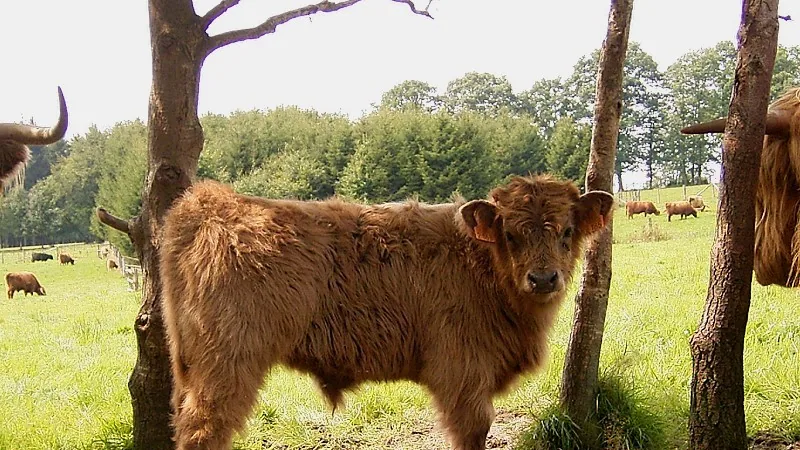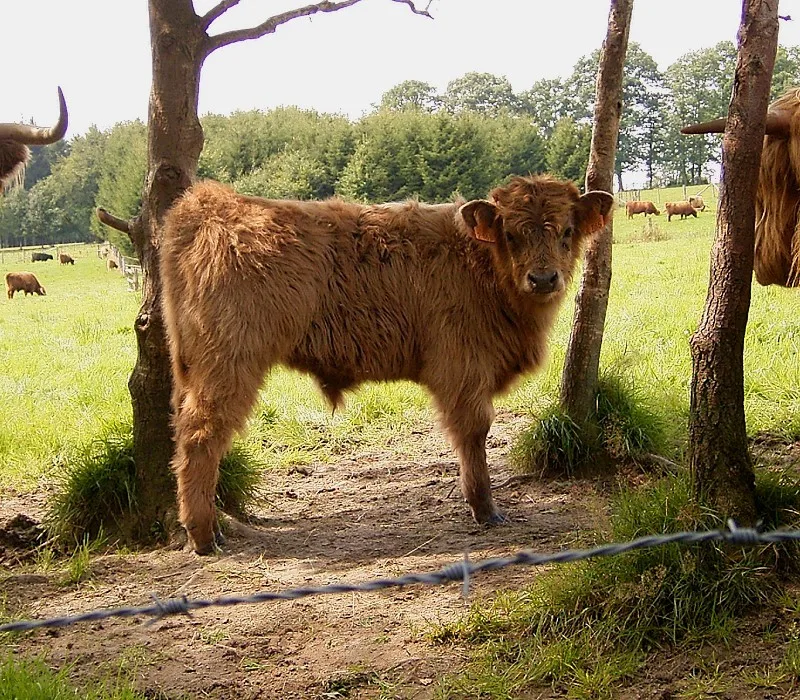
Bos taurus Highland cattle calf
Field
notes
A Double Coat
One of the most notable differences between Highland cattle (Bos taurus) and other cattle is their double coat: a long, coarse outer layer over a soft, woolly inner layer. The coat reduces the need for expensive barns and shelters. Highlands shed it earlier in the spring and grow less hair in warmer climates.
No back fat needed Thanks to the double coat, the breed does not need a heavy layer of back fat for insulation. According to the breed association, that lets the animal marble naturally, growing thin streaks of fat inside the muscle, on low-input forage while still producing lean, low-fat beef.
From the Scottish Highlands
Highland cattle are a domestic breed, and the American Highland Cattle Association calls them one of the oldest breeds in the world, originating in Scotland as far back as the 6th century. In the harsh, remote Scottish Highlands, only the fittest and most adaptable animals survived to carry on the breed, a process called natural selection. Originally there were two types: a slightly smaller, usually black Kyloe from the islands off the west coast of northern Scotland, and a larger, generally reddish animal from the Highlands. Today both count as one breed. Besides red and black, yellow, dun (a dull grayish brown), white, brindle and silver are traditional colors too.
The first herd book, a register of the breed’s animals, was published in 1885 by the Highland Cattle Society in Scotland. The first recorded shipment to the United States arrived in the late 1890s, and Highlands are now found in all fifty states.
Highland cattle stand 0.9 to 1.1 meters (about 3 to 3.6 feet) at the shoulder. Bulls average 1,500 to 1,800 pounds (about 680 to 815 kilograms), depending on forage, while mature cows average 900 to 1,200 pounds (about 410 to 545 kilograms). A Highland may live more than 20 years.
Horns With a Job
Highland cows and bulls both carry long horns, but the shapes differ. A cow’s horns are generally upswept and finer textured, while a bull’s point further forward and are more massive. The horns are used mainly for knocking down brush to graze, fending off predators and scratching. Despite those horns, Highlands tend to be calm, do not stress easily and are easy to work with. They also have a long history of living with humans: early Scots kept the family cow inside their homes in winter, and both shared the warmth.
Mothers and Grazers
Highland cows are noted for being devoted, protective mothers and for calving ease. Calves are small at birth, 60 to 70 pounds (about 27 to 32 kilograms), so difficult births are less common, and cows may keep having calves into their late teens.
Highlands mainly graze on grasses but are also excellent browsers, meaning they feed on shrubs and brush too. In the US and worldwide, they have been used to clear brush lots and to restore oak savannas, grasslands dotted with oak trees. Cattle in general can eat as much as 70 kilograms (150 pounds) of grass and graze about eight hours each day. As in cattle generally, food passes through a four-chambered stomach: partly digested food, called cud, is brought back up, chewed again and swallowed, and digestion takes 70 to 100 hours, one of the slowest passage rates of any animal.
Published Updated
Traits
Intel
& FAQ
Guess
first
How big is a Highland Cattle, really? Slide, lock in, and see what the sources say. Every answer is a figure from this page, quoted from where it came from.