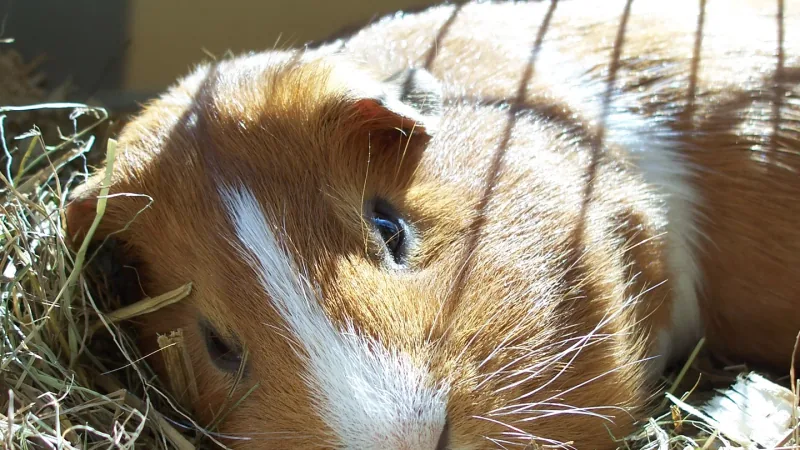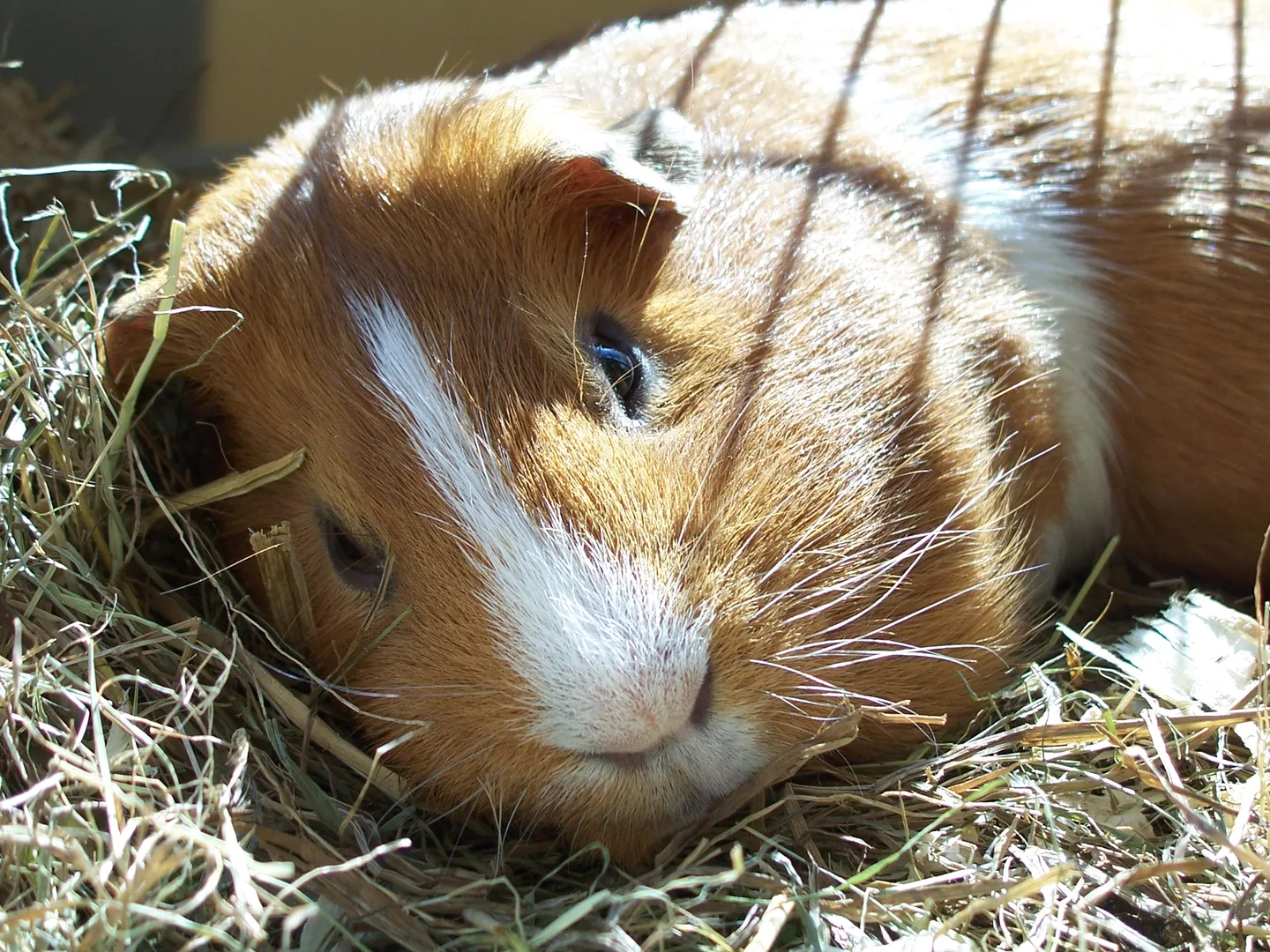
Pet guinea pig resting in hay
Field
notes
Popcorn Party
A guinea pig (Cavia porcellus) is a tailless rodent, and it may popcorn. That is a playful jump that scientists file under locomotor play. In an online survey of 1,181 German-speaking guinea pig caretakers, 26.8% said they saw it at least daily.
In the same survey, popcorning, friendly behaviour between animals and use of enrichment were more frequent when caretakers interacted positively with their animals and provided food enrichment more often. The study lists play like this among the signs of good welfare.
A Small Rodent with a Big Vocabulary
Guinea pigs generally range from 20 to 25 centimetres long and weigh 700 to 1,100 grams, and males tend to be larger than females. They can live up to 8 years in human care, but an average life is 4 to 5 years. At the National Zoo they eat root vegetables, leafy greens, hay and nutritionally complete pellets.
Six main vocalizations Guinea pigs make chutts, squeaks, whines, whistles, purrs and chirps. Whistles and chirps convey the presence of food and are used for long-distance communication. Squeals, squeaks and tweets indicate the presence of danger or injury.
Freeze or Scatter
A guinea pig has two defensive responses. When one animal senses danger, it goes completely still until the threat has passed. When a group senses a threat, the animals scatter and split up to confuse a predator.
Made by People
The domestic guinea pig does not live in the wild. It is most likely derived from the Andean montane guinea pig, Cavia tschudii. The Smithsonian’s National Zoo dates its first domestication to 5,000 B.C. Today it is kept around the world as a pet and for its meat.
In one study, 15 adult wild cavies of C. tschudii averaged 295 grams, significantly smaller than 25 creole guinea pigs from Bolivia and Chile, which averaged 639 grams. Two improved breeds were selected for size and meat, and one of them, Peru’s Tamborada, averaged 1,241 grams.
Guinea pigs also had a ritual role. Early Spaniards reported that the Inkas periodically slaughtered hundreds of animals, and that guinea pigs were the most common sacrificial animals. At the Inka site of Tambo Viejo in Peru, several dozen sacrificed guinea pigs were found, some adorned with colourful string earrings and necklaces.
One even went to space. In 1961 the Soviet dog Chernushka was launched on Sputnik 9 with a dummy cosmonaut, some mice and a guinea pig.
Published Updated
Traits
Intel
& FAQ
Guess
first
How big is a Guinea Pig, really? Slide, lock in, and see what the sources say. Every answer is a figure from this page, quoted from where it came from.
Sources
- 01Guinea Pig. San Diego Zoo Wildlife Alliance.
- 02Guinea pig. Smithsonian's National Zoo and Conservation Biology Institute.
- 03Cavia porcellus (Guinea pig). Animal Diversity Web, University of Michigan.
- 04Elsbacher et al. (2025). Guinea Pig (Cavia porcellus) Welfare: Associations Between Husbandry Practices, Human–Animal Interactions, and Animal Behaviour. Animals.
- 05Spotorno et al. (2006). Ancient and modern steps during the domestication of guinea pigs (Cavia porcellus L.). Journal of Zoology.
- 06Valdez (2019). Inka sacrificial guinea pigs from Tambo Viejo, Peru. International Journal of Osteoarchaeology.
- 07Animals in Space. NASA History.
What the sources say: 50 claims checked word for word against these sources →