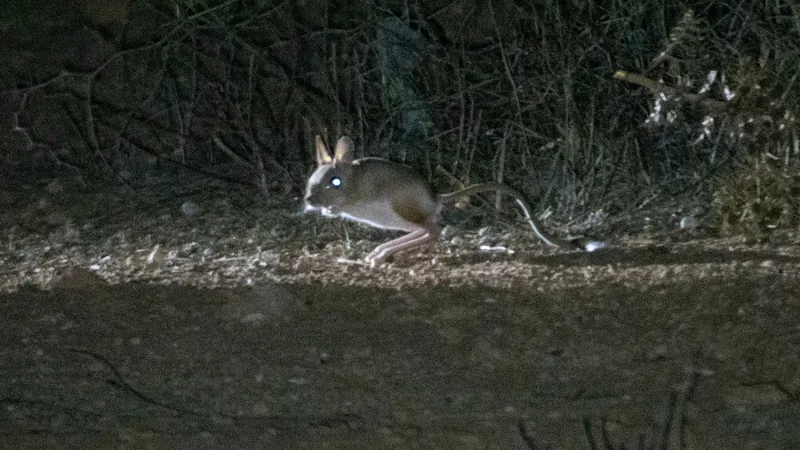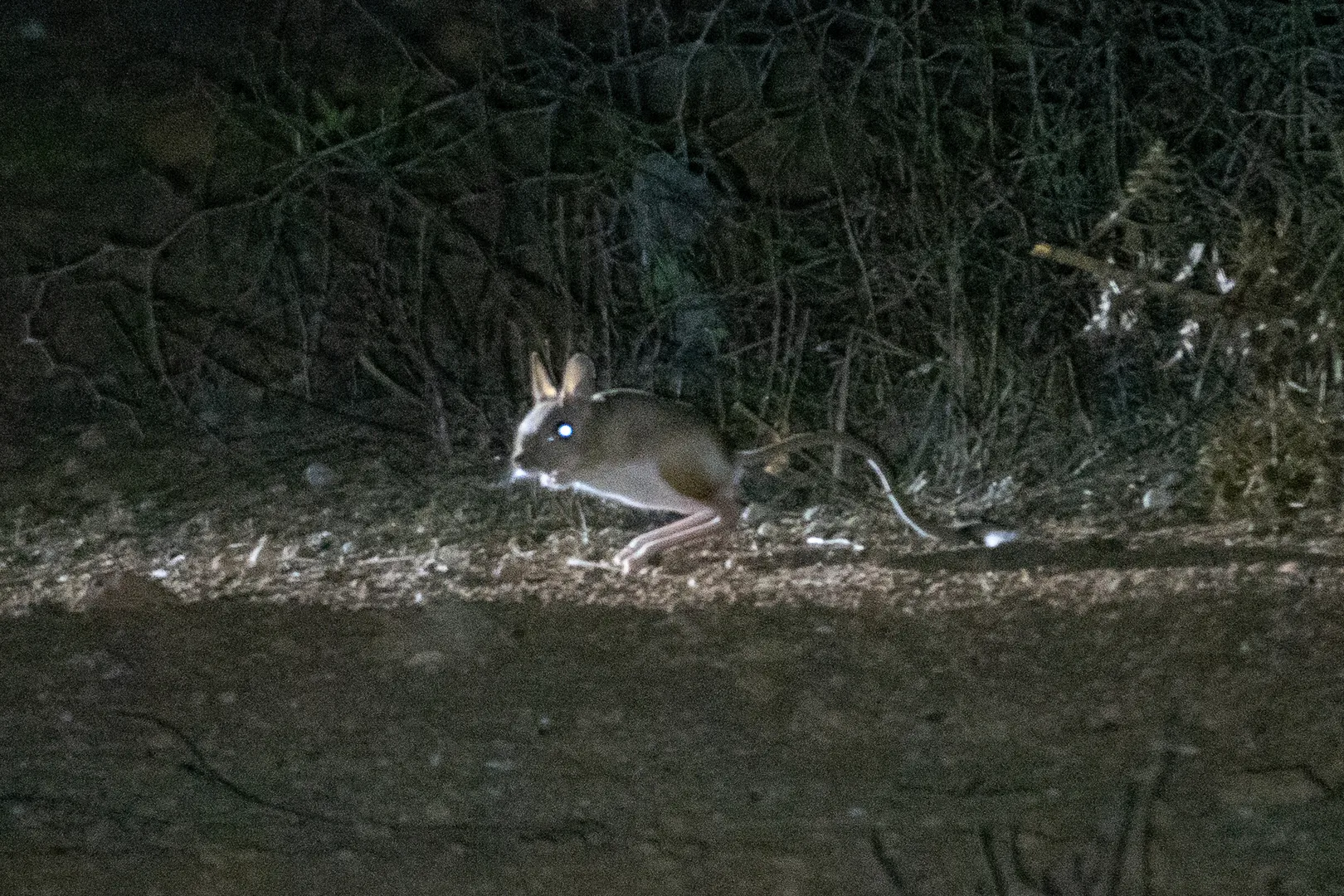
A greater jerboa on a track at night in Berkane Province, Morocco.
Field
notes
Built for Leaping
The greater jerboa is a small desert rodent whose normal gait is a walk or run on its two hind legs. An adult averages 139.1 grams and measures 9.5 to 16 centimeters, with males slightly larger than females, plus a tail that averages 12.8 to 25 centimeters and ends in a tuft of black and white hair. Its hind legs are roughly four times the length of its forelimbs. In each hind foot the metatarsals, the long bones between ankle and toes, are fused into a cannon bone, and the first and fifth toes are missing, leaving three long, flattened toes. Hair along the sides and bottom of those toes increases the foot’s surface area and aids its movement on sand. When standing, it rests its tail in a curve for support and balance.
The front paws do other work: sifting through sand and loose soil for seeds, holding food, and climbing plants. When alarmed at night, the jerboa heads for its burrow or other shelter, and its bipedal walk turns into great leaps, measured at 1.5 to 3 meters long and 1 meter high. That leap is its only line of defense.
Water From Plants
Its diet is mostly succulent roots, sprouts, seeds and grains, plus a few cultivated vegetables and the occasional insect. Water comes from the green plants it eats, and it can go long stretches without a drink.
A Burrow for Every Season
Home is a burrow dug into desert sand and clay by brushing, pushing and beating away the soil, running 0.75 to 1.75 meters deep and 1 to 2.5 meters long, with a main chamber and, in most cases, an emergency exit tunnel. The nest inside is often lined with camel hair, dry shredded plants and plant wool. In wet winters burrows are dug into hillsides to avoid flooding, and the entrance is usually left open. Summer burrows usually sit on lower ground near vegetation, with the entry hole plugged with soil, possibly to keep out snakes and warm air. The jerboa emerges from its burrow in late dusk and retreats at dawn.
A True Desert Hibernator
Earlier studies found no hypothermia or temperature-induced torpor in Jaculus, suggesting the greater jerboa was active year-round. But Bedouin reports suggest the animals disappear in winter, which implies long stays underground. Later investigations supported that idea and have depicted it as an ideal model for deep hibernation: during cold periods it accumulates lipid reserves and develops a seasonal obesity.
A Slowed Heart After that fattening, its body temperature drops to around 9.8°C, against 37°C when active, and its heart rate falls to about 9.3 beats a minute, from around 300.
Its lifespan in the wild is unknown, but one captive jerboa lived 5.5 years. The IUCN lists the species as Least Concern. It is found across North Africa, in Morocco, Algeria, Tunisia, Libya and Egypt, and reaches east through Sinai into southern Israel.
Published Updated
Traits
Intel
& FAQ
Guess
first
How big is a Greater Jerboa, really? Slide, lock in, and see what the sources say. Every answer is a figure from this page, quoted from where it came from.
Sources
- 01Jaculus orientalis (greater Egyptian jerboa). Animal Diversity Web, University of Michigan.
- 02Aulagnier (2016). Jaculus orientalis. The IUCN Red List of Threatened Species 2016: e.T10913A115518664.
- 03Jaculus orientalis. AnAge: The Animal Ageing and Longevity Database, Human Ageing Genomic Resources.
- 04Soukri et al. (1996). Occurrence of a differential expression of the glyceraldehyde-3-phosphate dehydrogenase gene in muscle and liver from euthermic and induced hibernating jerboa (Jaculus orientalis).
What the sources say: 49 claims checked word for word against these sources →