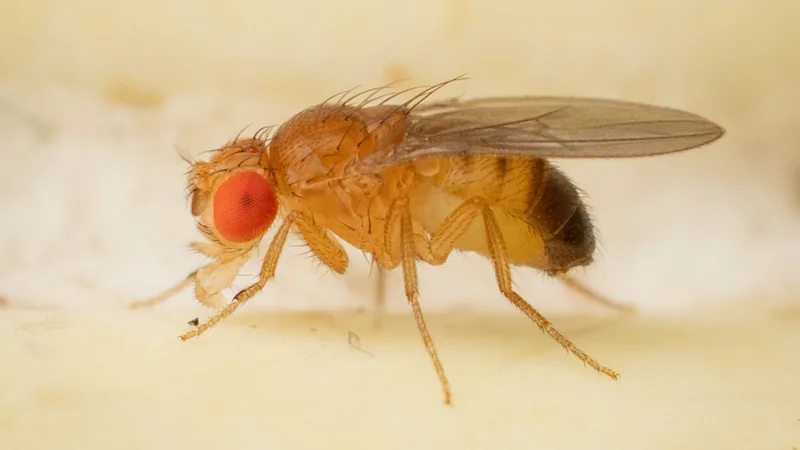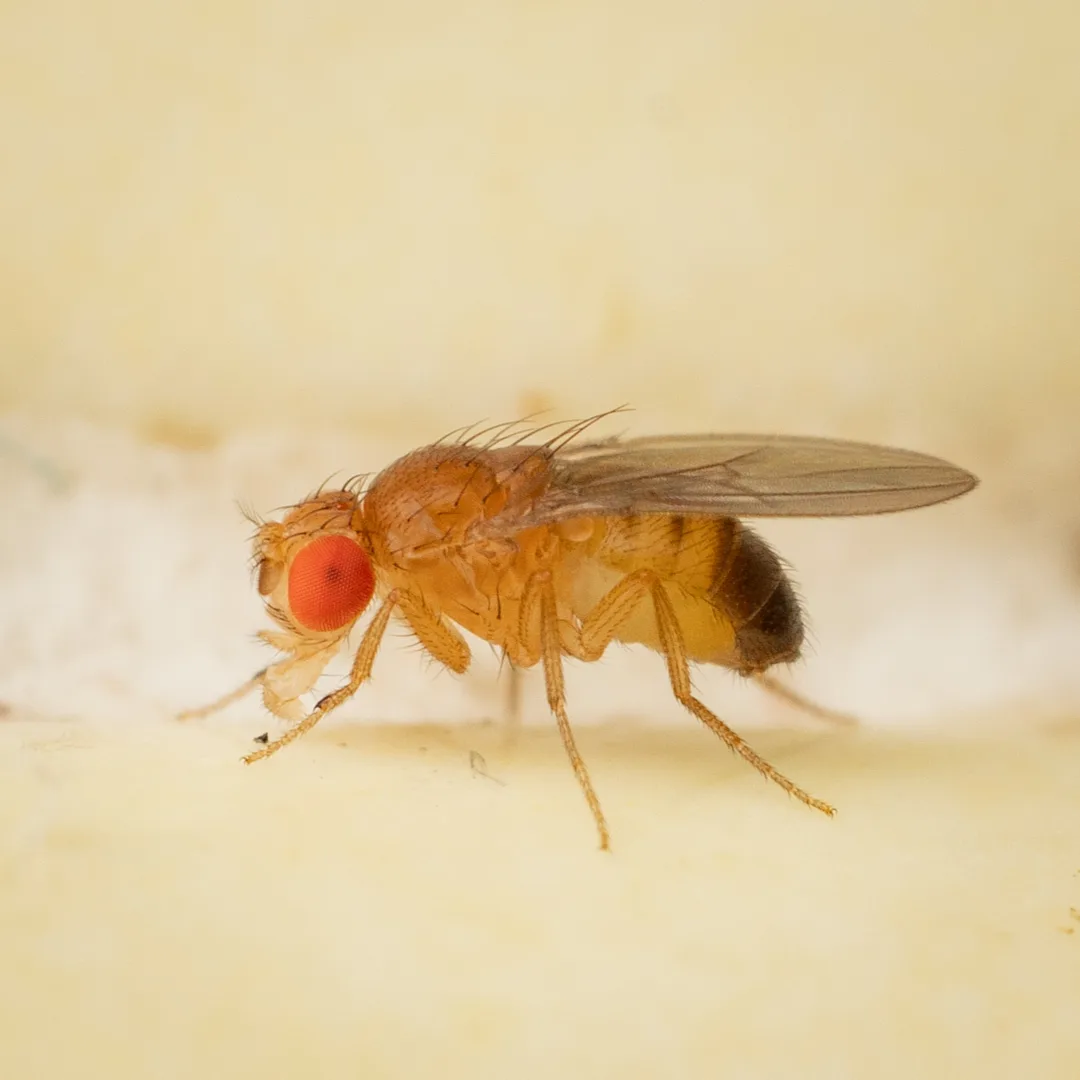
Fruit Fly (Drosophila melanogaster), Windsor Hills, Austin, TX, USA
Field
notes
A tiny fly, a huge reputation
The fruit fly Drosophila melanogaster is about 3 mm long and 2 mm wide. The female is slightly larger than the male. It is normally yellow-brown, with large red compound eyes (eyes built from many tiny lenses) and black stripes on its abdomen. Like other flies, it has a single pair of wings. Where a second pair would sit, it has knobby balancing organs called halteres.
In one lab study, females of a lab-adapted strain had a median lifespan of 69 days on whichever of five diets kept them alive longest. Few studies have been done in the wild, but those that have show wild flies tend to be larger than lab-reared ones.
From Africa to everywhere
The species appears to have originated in sub-Saharan Africa. It is thought to have spread to Europe and Asia 10,000 to 15,000 years ago, and its range is now worldwide. It is a human commensal, a fly that lives alongside people, mostly around rotting fruit.
Females lay their eggs in necrotic material, meaning dead and rotting matter, and the larvae (the maggot stage) develop and pupate there. Two life stages are completely immobile: the egg and the pupa. In the wild, larvae and flies are exposed to predators such as ants, beetles, pseudoscorpions and lizards.
Some of the microbes in its rotting food are food for the fly, and larvae or adults eat them selectively. Of the fly species that share a rotting fruit, its close relative Drosophila simulans arrives first, then D. melanogaster. That order is consistent with D. melanogaster tolerating more ethanol (alcohol) than D. simulans does.
A lab celebrity
Nobel history From its first use in the laboratory in the early 1900s until now, this fly has been central to major breakthroughs in genetics. Thomas Hunt Morgan won the 1933 Nobel Prize in Physiology or Medicine for discoveries about the role of the chromosome in heredity.
Morgan’s former student Herman J Muller later won the prize in 1946 for discovering that X-rays cause mutations. The first full read of the fly’s genome, published in 2000, counted approximately 13,600 genes. The fly has played an increasingly important role in creating animal models of human disease. Approximately 65% of human disease genes are estimated to have counterparts in it.
Published
Traits
Intel
& FAQ
Sources
- 01Drosophila melanogaster. Animal Diversity Web, University of Michigan.
- 02Markow (2015). The secret lives of Drosophila flies. eLife.
- 03Adams et al. (2000). The Genome Sequence of Drosophila melanogaster. Science.
- 04Metaxakis & Partridge (2013). Dietary Restriction Extends Lifespan in Wild-Derived Populations of Drosophila melanogaster. PLoS ONE.
What the sources say: 46 claims checked word for word against these sources →