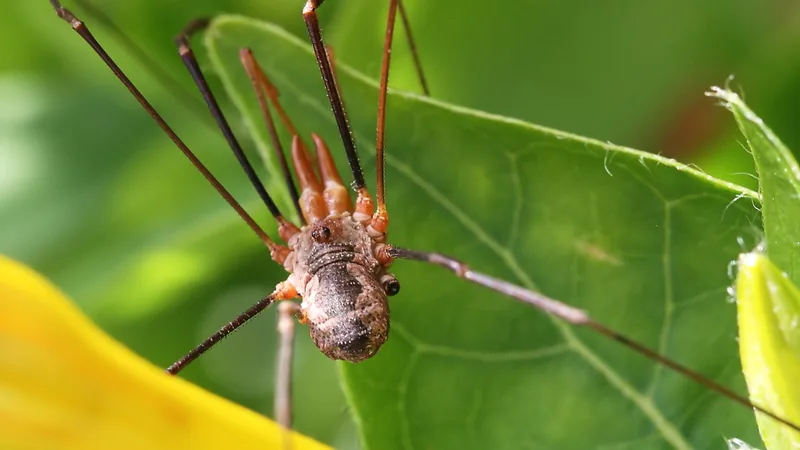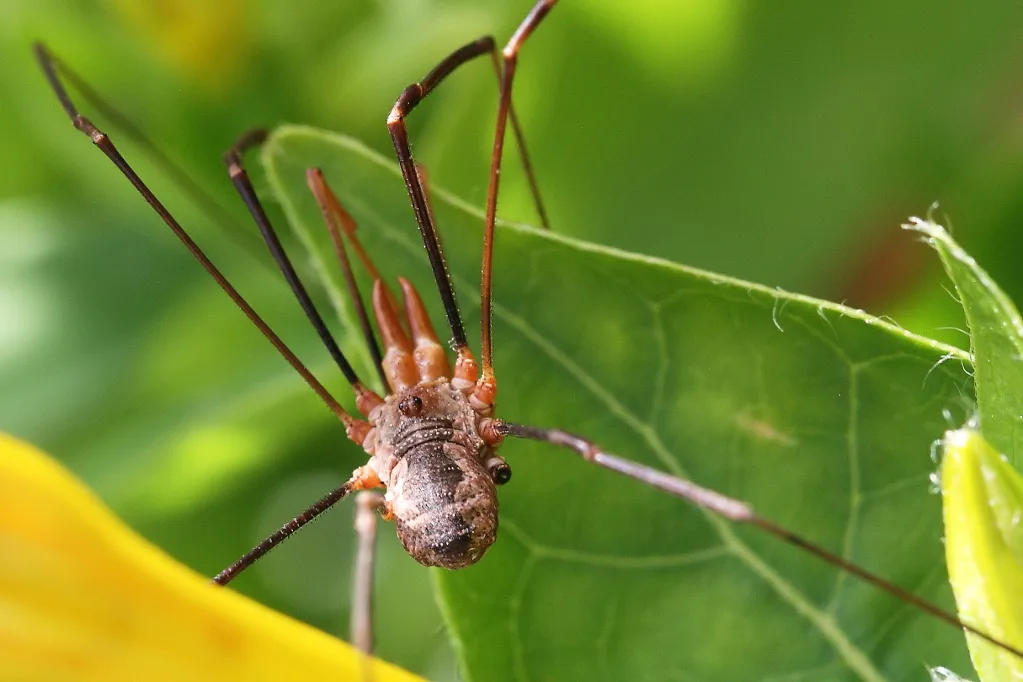
Male harvestman of species Phalangium opilio
Field
notes
Not a spider, just on stilts
Long, slender legs and a short, globular body are the European harvestman’s most notable features. That body is about 3.5 to 9 mm long in adults, and males are generally smaller than females. The top carries an indistinct, variable pattern of light gray or brown, and the underside is typically light cream.
Like a spider, a harvestman has two main body sections, eight legs and no antennae. Unlike a spider’s, its two sections are broadly joined. It belongs to Opiliones, the third-largest order of arachnids, with over 6,500 described species. Phalangium opilio was the first harvestman described with the Linnean system, the scientific naming scheme.
Harvestmen also carry repugnatorial glands, which deter predators. Their openings are called ozopores, and in a lab-reared P. opilio embryo red pigment starts to show around them at about day 14.
A menu with plenty of choices
In crops, harvestmen feed on many soft-bodied arthropods, such as aphids, caterpillars, leafhoppers, beetle larvae, mites and small slugs. P. opilio may also eat dead insects, earthworms, spiders and other harvestmen, and it has a tendency toward cannibalism.
On its own it appears unable to keep any pest under control. It is one member of a gang of generalist predators found in many crops, though, and together they help keep pest numbers low.
An egg machine on a short clock
Egg factory In a lab colony kept at 26 °C, females laid one egg clutch about every three days, and a typical clutch held approximately 250 embryos.
The eggs are almost spherical and about 0.55 mm across. In Europe the species has one generation a year and overwinters as eggs. In parts of North America, two or more generations may occur in a year. The eggs hatch in three weeks to five months or more, depending on temperature, and the young take two to three months to mature, also depending on temperature. Adults in a research colony lived 40 to 60 days.
Of the many harvestman species, P. opilio tends to be the most common in disturbed habitats such as crop fields in temperate regions. It is found in Europe and northern Asia, and it has been introduced to Canada. Adults can be collected in temperate parts of North America, Europe and East Asia, and in New Zealand.
Published
Traits
Intel
& FAQ
Guess
first
How big is a European Harvestman, really? Slide, lock in, and see what the sources say. Every answer is a figure from this page, quoted from where it came from.
Sources
- 01Phalangium opilio. Biological Control: A Guide to Natural Enemies in North America, Cornell University.
- 02Phalangium opilio Linnaeus, 1758 (TSN 1014112). Integrated Taxonomic Information System.
- 03Gainett et al. (2022). Eggs to long-legs: embryonic staging of the harvestman Phalangium opilio (Opiliones), an emerging model arachnid. Frontiers in Zoology.
What the sources say: 35 claims checked word for word against these sources →