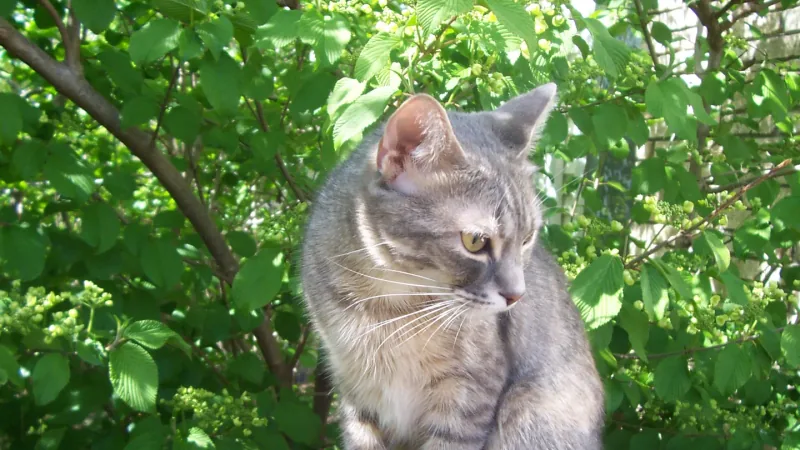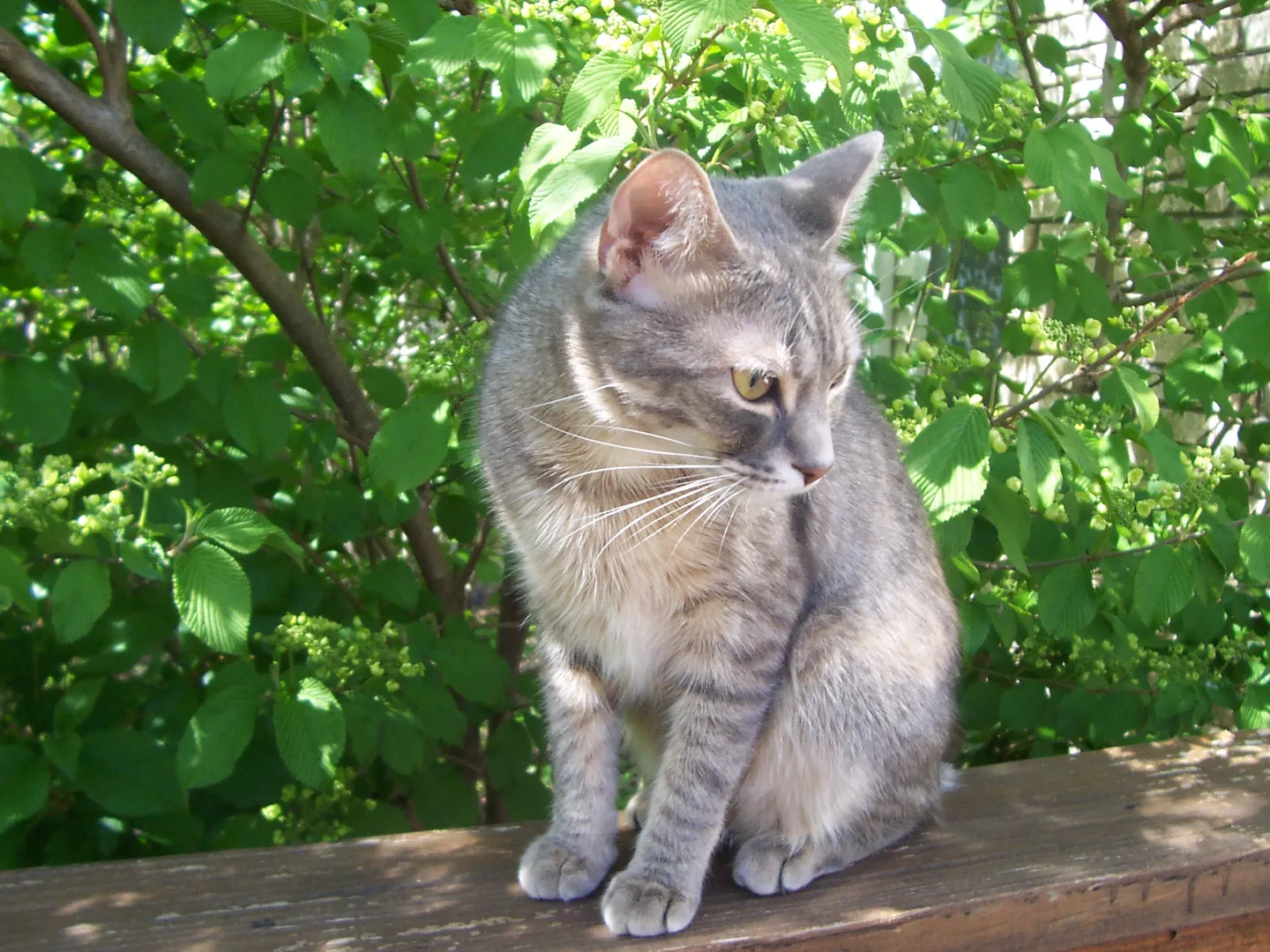
Domestic Cat (Felis catus)
Field
notes
A Spine That Twists
The domestic cat (Felis catus) belongs to a family of obligate carnivores, and adults weigh 4.1 to 5.4 kg and average about 76 cm long. Its shoulder blades lie close in against its body, and it can slip through narrow spaces. Its spine holds about 30 vertebrae, a count that varies with the cat’s length. With so many vertebrae, a cat can rotate half its spine through 180 degrees, and it can jump five times its own height. In an English study of 4,009 cats that had attended veterinary practices and died, the median lifespan was 14 years, and the oldest reached 26.7.
85 kilohertz is the top of the domestic cat’s hearing range for sounds at 70 decibels, one of the broadest ranges of any mammal.
Built for the Stealthy Approach
Force-plate recordings of six walking cats found that the lower a cat crouched, hips held close to the ground, the more evenly it spaced its footfalls. The researchers judged that evenly spaced footfalls likely add stability, helpful when stalking prey, but cost the cat energy: cats recover less mechanical energy while walking than mammals specialized for distance. To kill, a cat bites the back of the prey’s neck at the base of the skull, severing the spinal cord from the brainstem. Feral cats’ main prey includes small rodents, birds, fish and some arthropods, while some pet cats depend on food people supply. Cats also show no interest in sweet foods, and a broken gene accounts for it: without a working copy, they lack the receptor likely needed to detect sweetness.
Eyes, Ears and Whiskers
Behind the retina, a reflective layer called the tapetum lucidum reflects light back and intensifies it, and animals that have one see exceptionally well in low light. Each ear can rotate 180 degrees. Tested on two cats, the species’ hearing for sounds at 70 decibels runs from 48 hertz to 85 kilohertz. Whiskers on the muzzle, eyebrows and elbows sense changes in air flow, helping a cat steer around obstacles in low light.
From Wildcat to Every Continent
The domestic cat descends from the African wildcat. A 2007 genetic study of 979 domestic cats and wildcats placed domestication in the Near East, probably as farming villages developed in the Fertile Crescent, with at least five founders from across the region. The exact birthplace is still open: a 2025 study says it remains uncertain whether domestic cats originated in the Levant, Egypt or elsewhere in the African wildcat’s range. Its analysis of ancient and modern genomes suggests cats did not spread to Europe with Neolithic farmers, and were introduced there around 2,000 years ago, probably from North Africa. Today cats live on every continent except Antarctica, generally where people do, alongside a large feral population.
Published Updated
Traits
Intel
& FAQ
Guess
first
How big is a Domestic Cat, really? Slide, lock in, and see what the sources say. Every answer is a figure from this page, quoted from where it came from.
Sources
- 01Felis catus (domestic cat). Animal Diversity Web, University of Michigan.
- 02O’Neill et al. (2014). Longevity and mortality of cats attending primary care veterinary practices in England. Journal of Feline Medicine and Surgery.
- 03Driscoll et al. (2007). The Near Eastern Origin of Cat Domestication. Science.
- 04De Martino et al. (2025). The dispersal of domestic cats from North Africa to Europe around 2000 years ago. Science.
- 05Li et al. (2005). Pseudogenization of a Sweet-Receptor Gene Accounts for Cats' Indifference toward Sugar. PLoS Genetics.
- 06Bishop, Pai & Schmitt (2008). Whole Body Mechanics of Stealthy Walking in Cats. PLoS ONE.
- 07Heffner & Heffner (1985). Hearing range of the domestic cat. Hearing Research.
- 08Vélez García, Vélez Cabrera & Miglino (2026). Updating the forelimb anatomy of the domestic cat ( Felis catus , Felidae) based on evolutionary inferences of its muscles and nerves I: Shoulder and brachium. Journal of Anatomy.
What the sources say: 42 claims checked word for word against these sources →