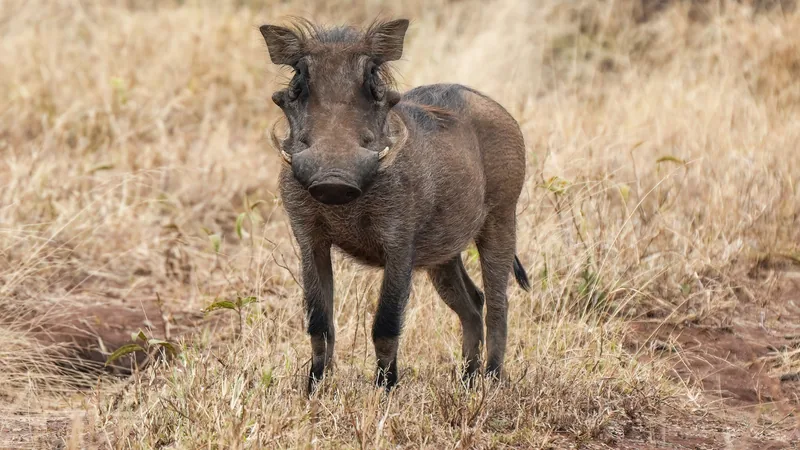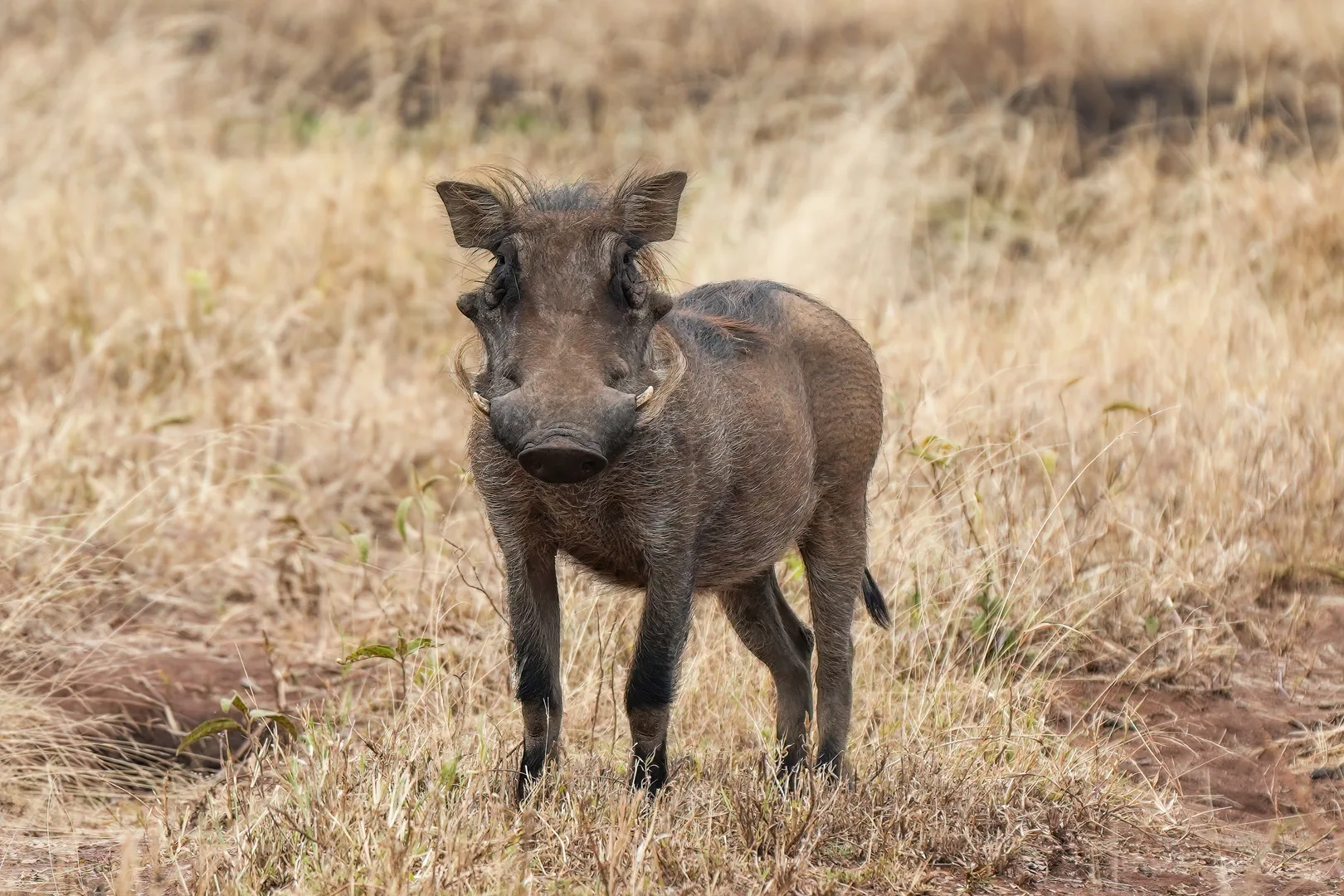
Common warthog in the Serengeti National Park, Tanzania.
Field
notes
Tusks, Warts and Head-Butts
Large upper tusks, a lower pair and three pairs of facial warts give the common warthog (Phacochoerus africanus) a brawler’s face. It measures 90 to 150 centimeters from head to rump, stands 63.5 to 85 centimeters at the shoulder, and weighs 50 to 150 kilograms, with females 15 to 20 percent lighter than males. A male’s upper tusks run 25.5 to 63.5 centimeters, a female’s 15.2 to 25.5. The lower tusks are the more dangerous pair, and Animal Diversity Web says they are rarely used in fights between males. In the wild, Animal Diversity Web puts a typical lifespan at 7 to 11 years. AnAge lists one captive warthog that reached 30.
Not Bone or Cartilage San Diego Zoo Wildlife Alliance says a warthog’s facial warts are “just thick growths of skin” that “don’t have any bones or cartilage.” Rival boars ram heads and blunt upper tusks together at mating time, and the warts act as pads to cushion the blows so the fighters “rarely injure each other.”
Kneeling to Eat, Digging for Bulbs
To graze short grass, a warthog lowers itself onto the calloused, padded wrist joints of its front legs, and it will even shuffle along in that kneeling position. It digs up rhizomes and bulbs with its snout and tusks, and it also eats roots, berries, the bark of young trees and occasionally carrion. During drought, those same bulbs and rhizomes may double as a source of water. Common warthogs range across open and wooded savanna, grass-steppe and semi-desert from Mauritania to Ethiopia and south to Namibia and eastern South Africa, avoiding rainforest and severe desert.
Backing Into a Bunker
A running warthog holds its tail up, bushy tip hanging down, a signal that “may serve as a warning to other warthogs if danger is near.” Instead of digging its own den, it moves into an abandoned aardvark hole or a natural burrow, usually backing in so its sharp tusks face the doorway and can “scare off any animal that bothers them.” San Diego Zoo Wildlife Alliance, whose page covers both warthog species, names lions, cheetahs, leopards, hyenas, painted dogs and eagles as predators and puts a fleeing warthog at up to 55 kilometers an hour. Animal Diversity Web calls lions the predominant predators and says warthogs usually avoid attack by fleeing. They avoid nocturnal predators by being active during the day and sheltering in burrows at night, and they use the warning calls of red-billed and yellow-billed oxpeckers to avoid predators. Where people disturb them, warthogs often become more active at night.
A warthog has no subcutaneous fat and a sparse coat, which leaves it susceptible to extreme temperatures. Burrows protect it from temperature extremes, and it will even raise its young in one.
Published Updated
Traits
Intel
& FAQ
Guess
first
How big is a Common Warthog, really? Slide, lock in, and see what the sources say. Every answer is a figure from this page, quoted from where it came from.
Sources
- 01Phacochoerus africanus (common warthog). Animal Diversity Web, University of Michigan.
- 02Warthog. San Diego Zoo Wildlife Alliance.
- 03Jong et al. (2016). Phacochoerus africanus. The IUCN Red List of Threatened Species 2016: e.T41768A109669842.
- 04Phacochoerus africanus (Wart hog). AnAge: The Animal Ageing and Longevity Database, Human Ageing Genomic Resources.
What the sources say: 34 claims checked word for word against these sources →