NPS / Jacob W. Frank
Field
notes
An arms race with newts
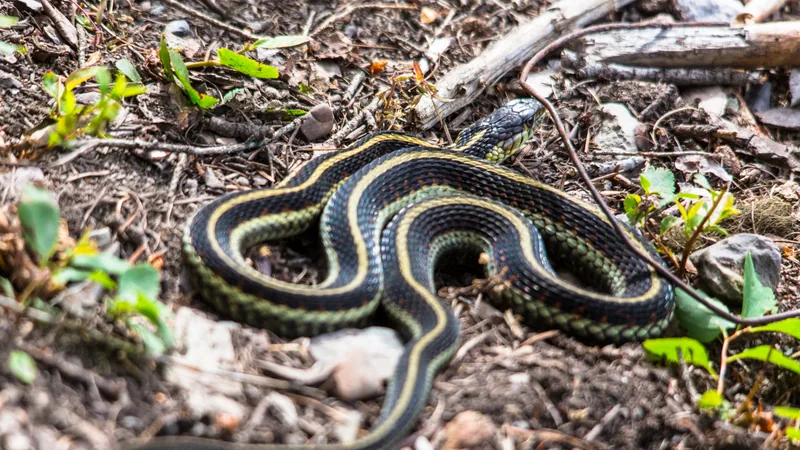
Some populations of the common garter snake, Thamnophis sirtalis, prey on newts of the genus Taricha. Those newts carry tetrodotoxin (TTX), a toxin. Garter snake populations have evolved resistance to it, to different degrees in different places, in an arms race with their toxic prey. Researchers traced the resistance to TTX-resistant sodium channels in skeletal muscle, the muscle that moves the body.
Resistance hotspots Researchers tested over 2,900 garter snakes from 40 populations in western North America. Resistance varied by over three orders of magnitude among populations, even over short distances. The study found two hotspots of resistance, and its phylogenetic data indicate the two evolved independently.
Striped and widespread
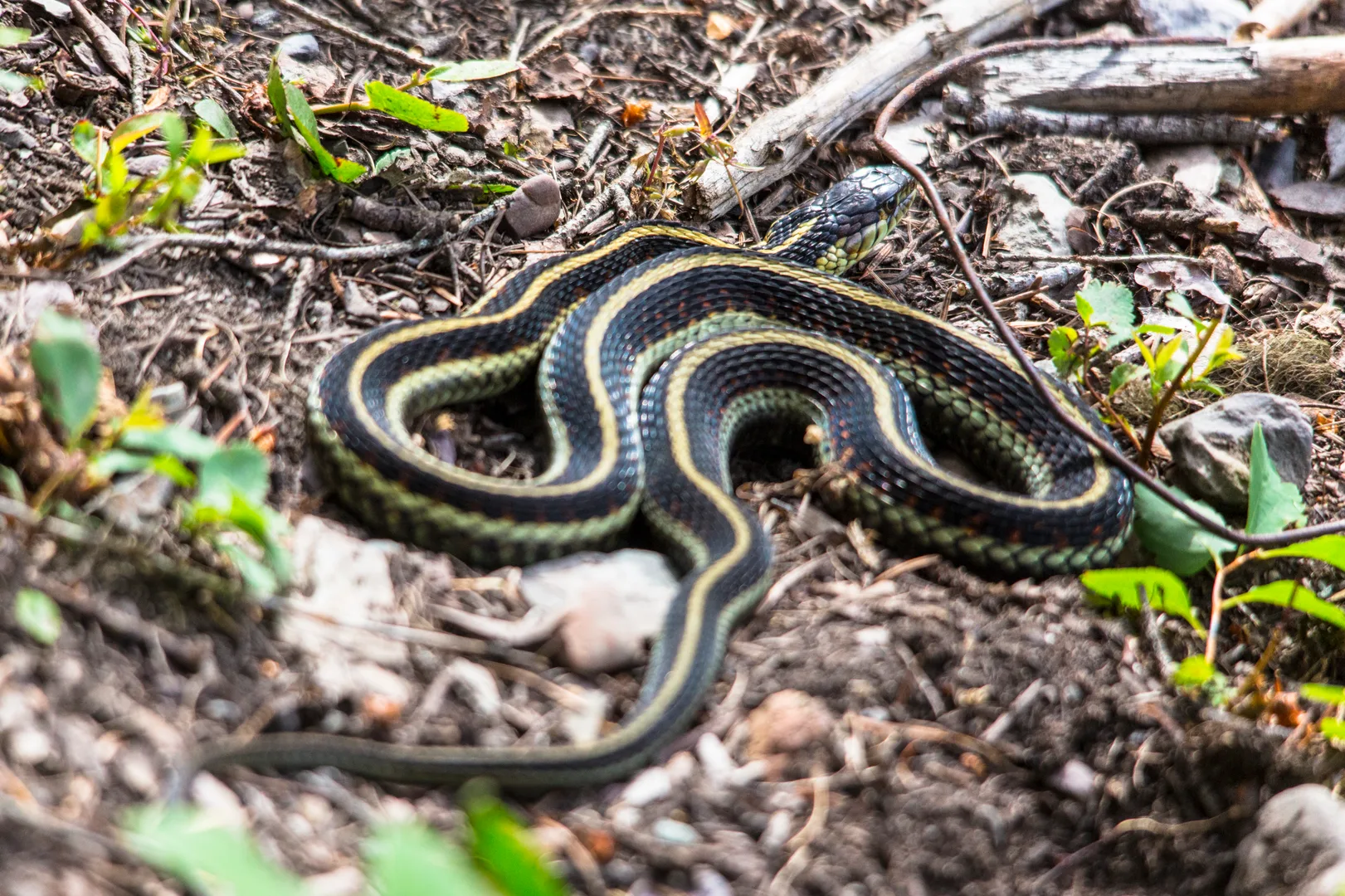
Common garter snakes grow to 46 to 137 cm in total length, and the average is 88 cm. Newborns measure 12.5 to 23 cm. An adult weighs about 150 g. AnAge lists a maximum longevity of 14 years, recorded in captivity.
Common garter snakes live throughout eastern North America from Florida to coastal Quebec, and west to British Columbia. They use meadows, marshes, woodlands and hillsides, and they tend to prefer moist, grassy places, often near the edges of ponds, lakes, ditches and streams.
They typically eat earthworms, amphibians, leeches, slugs, snails, insects, crayfish, small fish and other snakes. They find prey with their sense of smell and their vision, and hunt by peering, craning and ambushing. Like other snakes, they swallow food whole.
Hide, bolt, stink
Stripes make a garter snake hard to see in grassy areas. It relies on stealth and camouflage, and it flees into water to escape predators on land. Hawks, raccoons and great blue herons are among the animals that eat it.
If unable to flee, it coils to look larger and may strike and bite. If grabbed, it writhes and releases a foul-smelling secretion. It also urinates on its attacker.
Winter piles and spring crowds
Common garter snakes hibernate from late October through March or early April, in natural cavities or burrows such as rodent burrows, crayfish burrows, rock piles or stumps. They gather in large numbers at good hibernation sites. Lying together in tight coils, they can prevent heat loss and keep their bodies warmer.
Mating starts in spring as soon as they emerge. Males leave the den first and wait for the females. Once the females leave, the males surround them. In the Canadian red-sided garter snake (the subspecies T. s. parietalis), the female’s attractiveness pheromone is a series of long-chain methyl ketones, while the male’s recognition pheromone contains squalene.
Published
Traits
Intel
& FAQ
Guess
first
How big is a Common Garter Snake, really? Slide, lock in, and see what the sources say. Every answer is a figure from this page, quoted from where it came from.
Sources
- 01Thamnophis sirtalis. Animal Diversity Web, University of Michigan.
- 02AnAge entry for Thamnophis sirtalis. AnAge: The Animal Ageing and Longevity Database, Build 15, Human Ageing Genomic Resources.
- 03Brodie, Ridenhour & Brodie (2002). THE EVOLUTIONARY RESPONSE OF PREDATORS TO DANGEROUS PREY: HOTSPOTS AND COLDSPOTS IN THE GEOGRAPHIC MOSAIC OF COEVOLUTION BETWEEN GARTER SNAKES AND NEWTS.
- 04Geffeney et al. (2002). Mechanisms of Adaptation in a Predator-Prey Arms Race: TTX-Resistant Sodium Channels. Science.
- 05Mason et al. (1989). Sex Pheromones in Snakes. Science.
- 06Frost, Hammerson & Santos-Barrera (2015). Thamnophis sirtalis. The IUCN Red List of Threatened Species 2015: e.T62240A68308267.
What the sources say: 50 claims checked word for word against these sources →