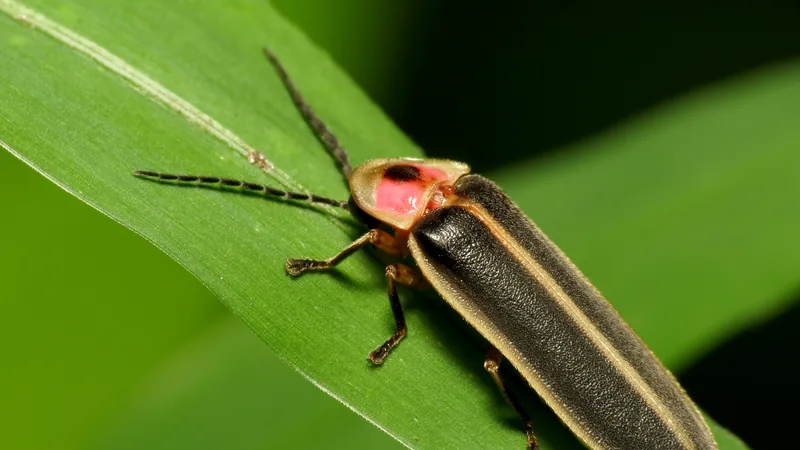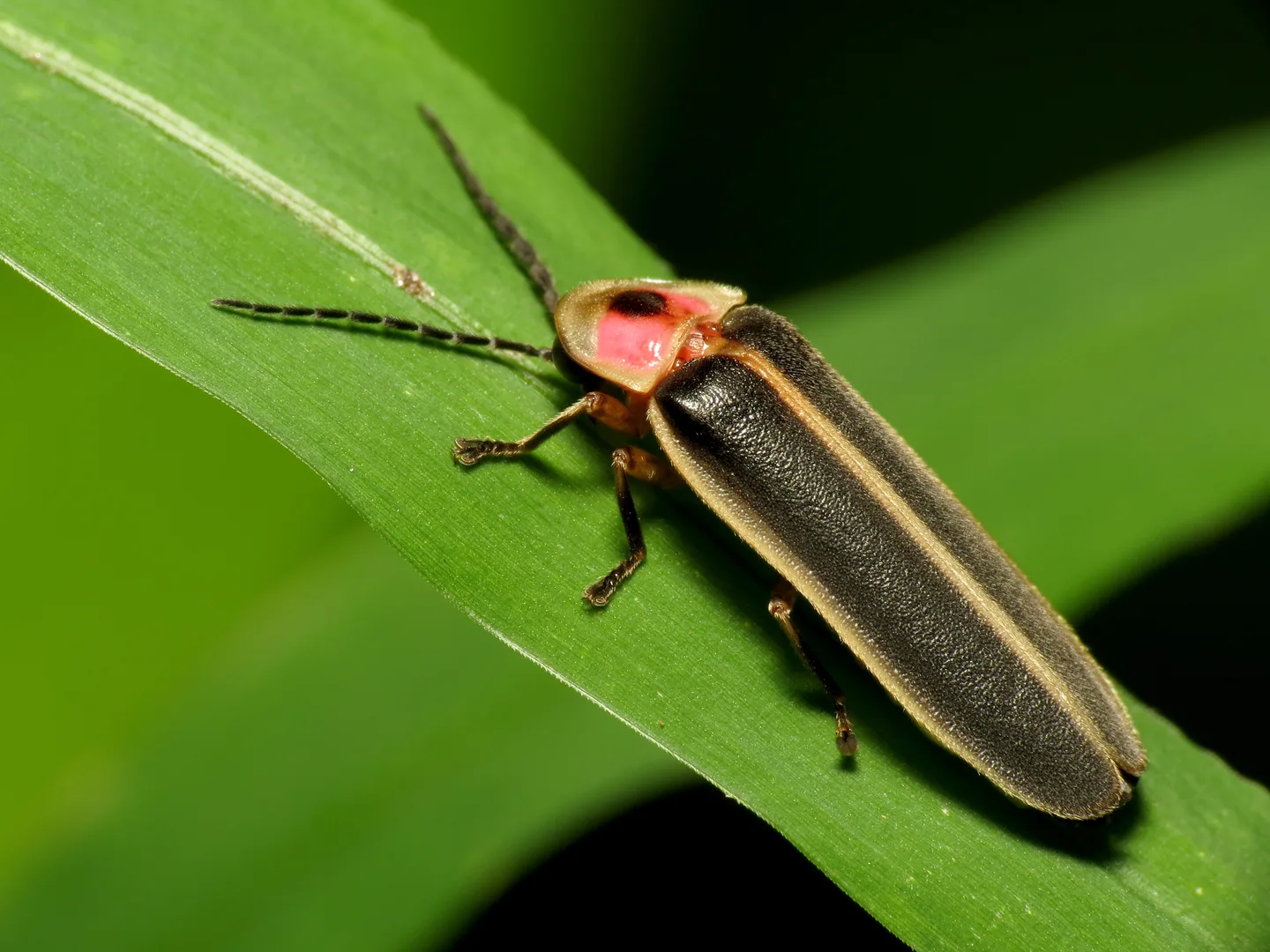
Photinus pyralis . Rock Creek Park, Washington, DC, USA.
Field
notes
A flash code with a fatal hack
At dusk, a male Common Eastern Firefly takes flight and gives one flash of about 300 milliseconds roughly every 5 to 10 seconds. As he dips down and then rises, his light traces a J shape. A female of his species perches on a plant and answers with a single flash after a delay of 2 to 3 seconds. That gap is the password.
Other fireflies fake replies like this. Females of the genus Photuris prey on males of the genus Photinus, which includes this species, by imitating the reply of a Photinus female. A male who flies down to meet her can become her meal.
Poison in the blood
Her meal gives her more than food. Female Photuris are unable to make lucibufagins, the defensive steroids that Photinus males carry. They acquire them by eating the males. Phidippus jumping spiders reject a Photuris female that has eaten a male or been fed the chemical.
Named for light and toad Lucibufagins closely resemble the bufalin steroids in the venom of poisonous Chinese toads, so Cornell researchers built the name from the Latin words for “light” and “toad”.
Male Common Eastern Fireflies carry lucibufagins in their hemolymph, the insect version of blood. When a male is attacked, he releases copious amounts of hemolymph that coagulates rapidly. This reflex bleeding may also give him physical protection against small predators.
A lantern in the abdomen
The light comes from the last segment of the abdomen, which flashes yellow-green. It runs on a reaction in which the enzyme luciferase oxidizes a molecule called luciferin, using ATP, the energy molecule cells run on, plus magnesium and oxygen. The first luciferase gene was cloned from this species, and luciferase is now widely used as a reporter in biomedical research.
Weeks in the air, winters in the dirt
Despite the name, this insect is a beetle, 10 to 14 mm long. Adults live 2 to 3 weeks, and they are typically considered non-feeding, though both sexes have been reported drinking milkweed nectar. Mated females lay roughly 30 to 50 eggs on moss or moist soil, and the eggs take 2 to 3 weeks to hatch.
The larvae are the predators. They live on and beneath the soil and appear to specialize in earthworms. In the northern parts of the range, slower development likely requires them to overwinter at least twice.
The species is a habitat generalist. It turns up in fields, meadows, suburban lawns, forests and woodland edges, and even in cities such as New York and Washington D.C. It is found with confidence from roughly Connecticut to Texas.
Published
Traits
Intel
& FAQ
Guess
first
How big is a Common Eastern Firefly, really? Slide, lock in, and see what the sources say. Every answer is a figure from this page, quoted from where it came from.
Sources
- 01Walker (2021). Photinus pyralis. The IUCN Red List of Threatened Species 2021: e.T164046430A166771623.
- 02Fallon et al. (2018). Firefly genomes illuminate parallel origins of bioluminescence in beetles. eLife.
- 03Eisner et al. (1997). Firefly “femmes fatales” acquire defensive steroids (lucibufagins) from their firefly prey. Proceedings of the National Academy of Sciences.
- 04Segelken (1997). Lured and liquidated, gullible male fireflies supply 'femmes fatales' with a lifesaving chemical. Cornell Chronicle.
- 05McKenzie. Photinus pyralis. Animal Diversity Web, University of Michigan.
What the sources say: 50 claims checked word for word against these sources →