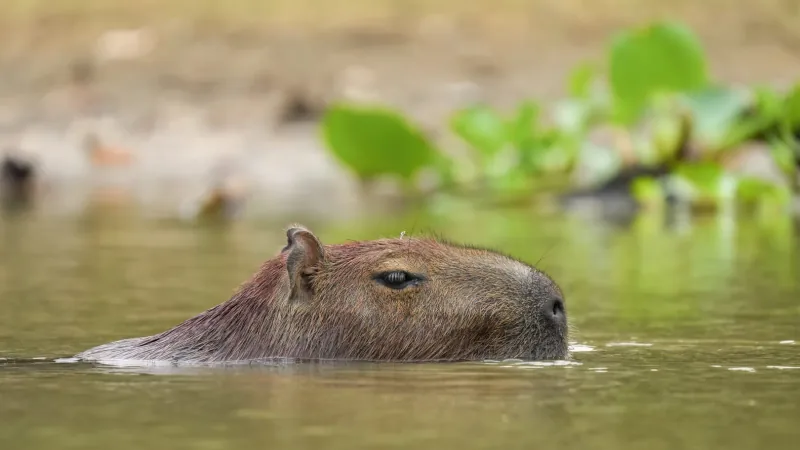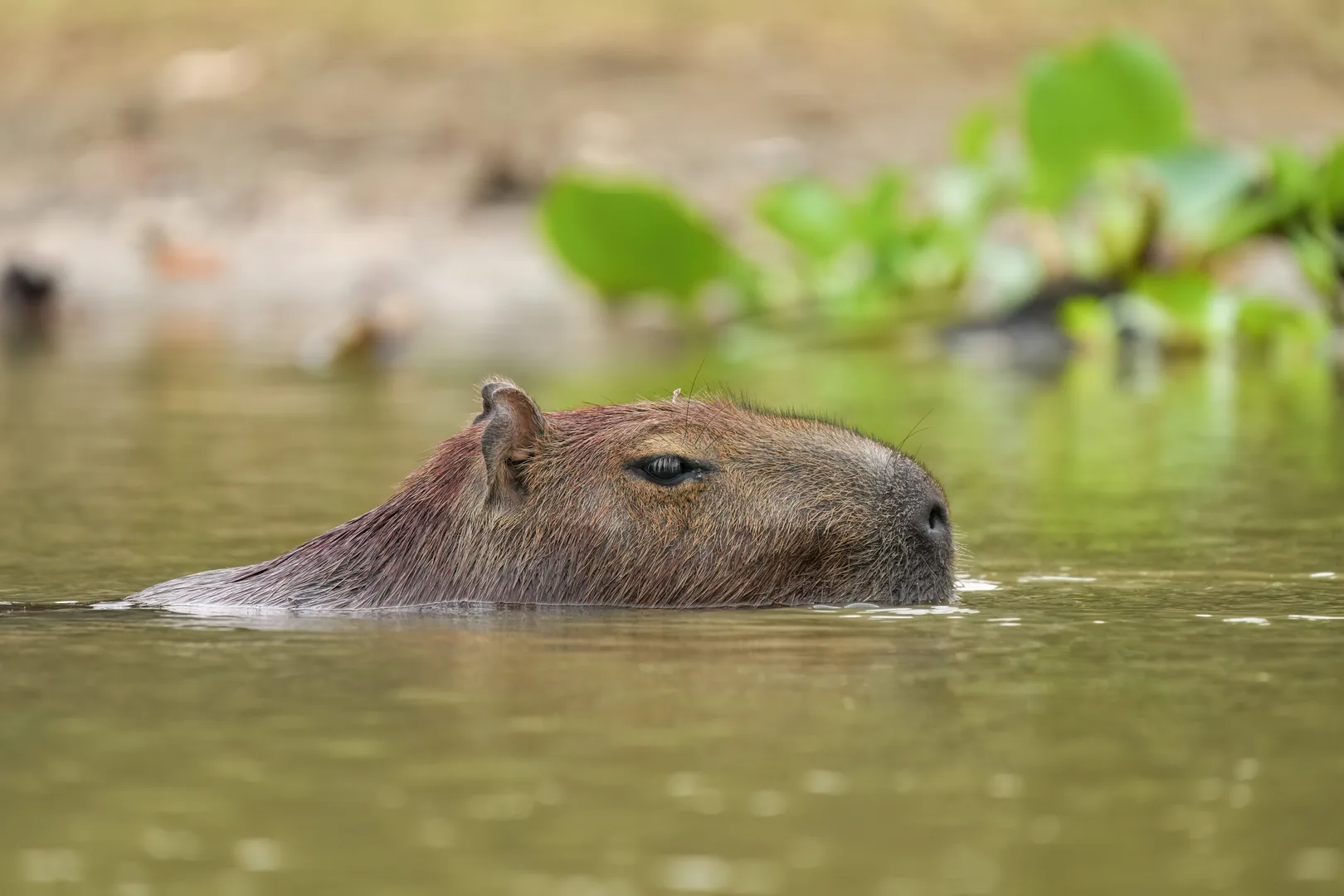
A capybara swims in the Encontro das Águas State Park, Brazil, with its eyes, ears and nostrils just above the water
Field
notes
The Biggest Rodent on Earth
The Capybara (Hydrochoerus hydrochaeris) is the largest rodent in the world, closely related to cavies and guinea pigs. A full-grown capybara weighs 35 to 66 kilograms (77 to 145 pounds) and measures 106 to 134 centimeters (3.5 to 4.4 feet) long, standing up to 60 centimeters (2 feet) at the shoulder, and females are slightly larger than males. Like mice, squirrels and porcupines, it carries ever-growing front teeth, long and sharp, and uses them for grazing on grass and water plants. Wild capybaras live about 6 years on average and as many as 10, and up to 12 years in captivity.
Built for a Life Half in the Water
Capybaras are strictly South American, ranging through most of Brazil, Uruguay, Venezuela and Colombia, south into the Argentinian pampas and west to the Andes. Flooded grasslands are a favorite, along with marsh edges and lowland forests where grazing is good and there is water year-round. A capybara’s eyes, ears and nostrils sit on top of its head, and it often hides in the water with just its nostrils and eyes exposed. Its feet are partially webbed, and its body is only slightly denser than water, which makes it a strong swimmer. That build pays off the moment danger shows up. While grazing, capybaras stay constantly on the lookout for predators and give an alarm bark when one is spotted, and that often sends the whole group rushing for the water, where a capybara can stay completely submerged for up to five minutes. Jaguars, green anacondas and spectacled caimans are among its known predators.
Grass by the Kilo, Twice
Capybaras graze mainly on grasses and aquatic plants, and an adult can eat 2.7 to 3.6 kilograms (6 to 8 pounds) of grass a day. In the dry season, when the fresh grasses and water plants dry up, they switch to reeds, grains and melons.
They chew like a cow but share no family tree with one. Capybaras regurgitate their food to chew it some more, working it side to side like a camel instead of up and down the way we do.
They also spend part of each morning re-eating the previous day’s food. It sounds disgusting, but it gets them beneficial bacteria that help break down the thick fiber in their meals.
A Very Popular Neighbor
Capybaras usually live in small groups of about ten, though as many as 40 may be found together in the wet season. Extra sets of eyes matter, because the young can easily fall victim to caimans, ocelots, harpy eagles and anacondas, and an animal with no group is shut out of most grazing habitat, so solitary capybaras are seldom found. Birds turn up too. Yellow-headed caracaras and cattle tyrants are among the capybara’s mutualists and commensals, birds that either pick parasitic insects out of a capybara’s fur or follow it around to catch the insects it stirs up while grazing.
Published Updated
Traits
Intel
& FAQ
Guess
first
How big is a Capybara, really? Slide, lock in, and see what the sources say. Every answer is a figure from this page, quoted from where it came from.
Sources
- 01Reid (2016). Hydrochoerus hydrochaeris. The IUCN Red List of Threatened Species 2016: e.T10300A22190005.
- 02Hydrochoerus hydrochaeris (capybara). Animal Diversity Web, University of Michigan.
- 03Capybara. San Diego Zoo Wildlife Alliance.
What the sources say: 59 claims checked word for word against these sources →