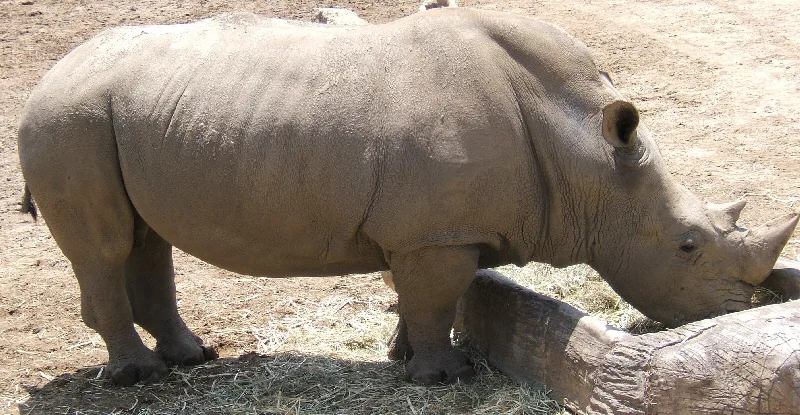
White rhinoceros (male) in the Kalahari Desert of Namibia
Field
notes
Built Like a Grey Tank
The white rhinoceros (Ceratotherium simum) is a grey giant, not a white one. Adults weigh 1,800 to 2,700 kilograms (4,000 to 6,000 pounds), stand 1.5 to 1.8 meters at the shoulder, and measure 3 to 5 meters in head-and-body length. Tied with the greater one-horned rhino, it’s the second-largest land mammal alive; only elephants are bigger. Its grey hide is dense and tough, with a dermis 18 millimeters thick on average, under a thin 1-millimeter epidermis. A white rhino can live to be 35 to 40 years old.
The Name Nobody Has Proven
Nobody knows for certain why an animal this grey got called “white.” The popular story, still told by conservation groups today, blames a mistranslation: early English settlers supposedly mistook wyd, the Afrikaans word for wide that described the rhino’s mouth, for “white.” A 2003 paper in the journal Pachyderm reviewed the earliest records of the name. It reports that combinations like wydrenoster or wydbek renoster have never been recorded in written Dutch or Afrikaans, making it, in the paper’s own words, “impossible” for white to be a corruption of wyd or any other Dutch or Afrikaans word of the early 19th century. It lists ten theories, from sunlight that can make a rhino look pale at a distance to white droppings from the cattle egrets that often perch on its back, and says none stands out as obviously correct, though few can be ruled out completely. The scientific name is on firmer ground: Ceratotherium comes from Greek words for horn and beast, and simum from simus, meaning flat-nosed.
The Original Lawnmower
Today white rhinos live in small pockets of southern Africa, in long and short-grass savanna and shrubland. A white rhino’s wide, square lip crops grass so short that it creates “grazing lawns,” which benefit smaller plant-eaters and can serve as firebreaks. Short grasses are its favorite food. Dominant bulls hold small territories, allowing only one or two subordinate males to share them. Adult females are more social, often living in groups of up to a dozen with calves and subadults, and a group of rhinos is known as a crash.
Hunted for Its Horn
A white rhino’s eyesight is poor, though its hearing and sense of smell are sharp. Because rhinos are nearsighted, they often charge when startled, which has given them an undeserved reputation for a bad temper.
No bone inside A white rhino’s horn has no bony core. It’s made of keratin, the same material as fingernails and hair, and if it breaks off, it can gradually grow back.
Rhino horn has been used for centuries in folk medicine, but it has not been proven to cure any illness, and demand for it leads to poaching. The latest estimate is 15,752 white rhinos in the wild, the vast majority of them in South Africa, down from 17,464 in 2023, mostly because of poaching there. The northern subspecies is faring far worse: only two are left anywhere on Earth, and both are female.
Published Updated
Traits
Intel
& FAQ
Guess
first
How big is a White Rhinoceros, really? Slide, lock in, and see what the sources say. Every answer is a figure from this page, quoted from where it came from.
Sources
- 01White Rhino. International Rhino Foundation.
- 022026 State of the Rhino. International Rhino Foundation.
- 03White Rhinoceros. San Diego Zoo Wildlife Alliance.
- 04Ceratotherium simum (white rhinoceros). Animal Diversity Web, University of Michigan.
- 05Rookmaaker (2003). Why the name of the white rhinoceros is not appropriate. Pachyderm.
- 06Emslie (2020). Ceratotherium simum. The IUCN Red List of Threatened Species 2020: e.T4185A45813880.
What the sources say: 54 claims checked word for word against these sources →