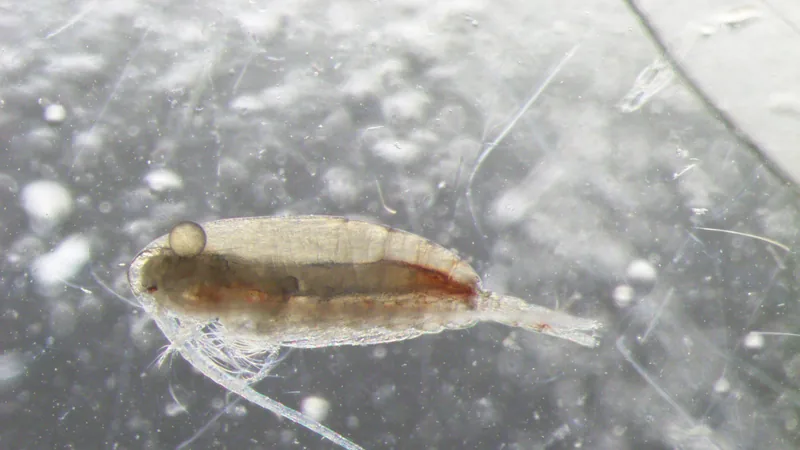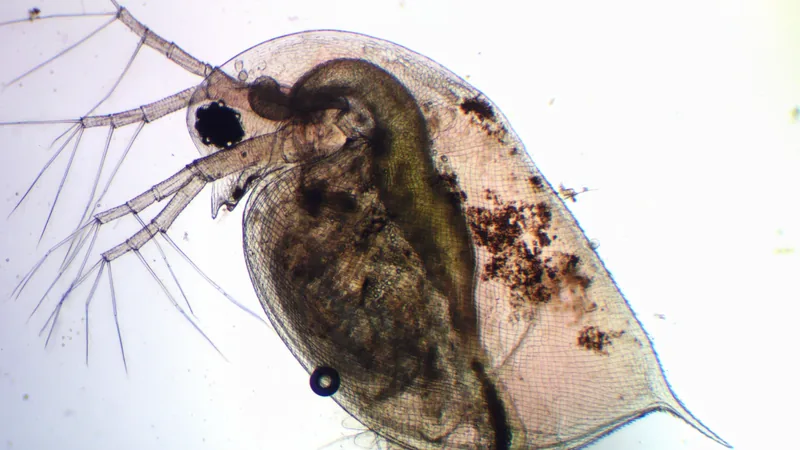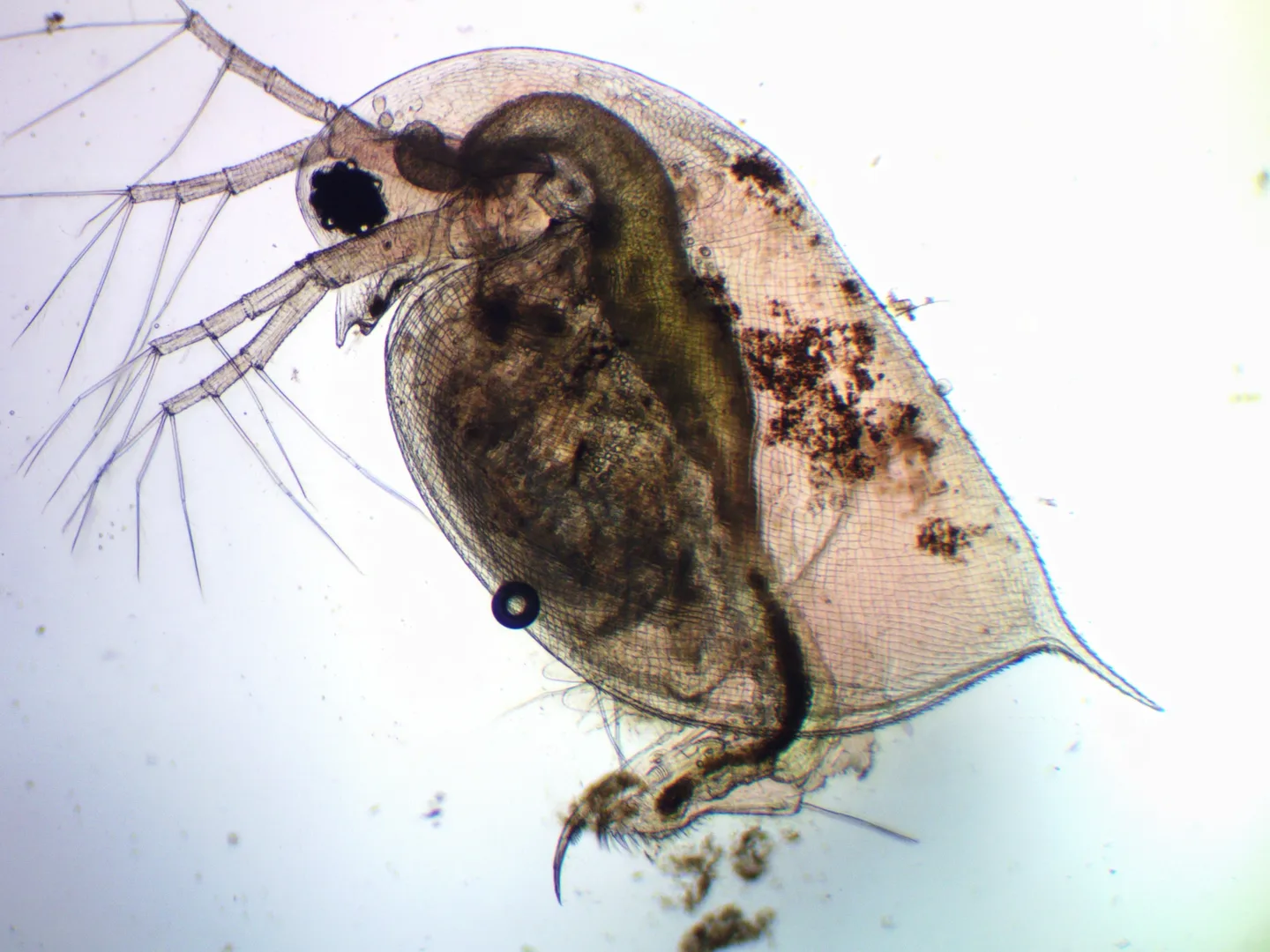
Water Flea (Daphnia pulex), Балашиха, Московская обл., Россия
Field
notes
A small genome with a crowded gene list
The water flea Daphnia pulex is a microcrustacean, a tiny kind of crustacean. Water fleas as a group are generally 0.2 to 3.0 mm long. Most of its outer covering is clear, showing most of the internal organs at work, including the heart. They got their name from their general appearance and their jerky swimming, which resemble a land flea’s.
Its genome, the full set of its DNA, is only 200 megabases. Yet it holds at least 30,907 genes. The reason is copying: the animal has an elevated rate of gene duplication, which makes tandem gene clusters, copies sitting side by side. More than a third of its genes have no detectable match in any other available proteome, the full set of proteins an organism makes. The animal that was sequenced was a natural isolate within the D. pulex species complex.
Genes that answer the pond In the genome study, Daphnia-specific genes, including many loci in stretches otherwise devoid of annotations, were the most responsive genes to ecological challenges.
Clones in summer, sex in a crisis
D. pulex reproduces by cyclical parthenogenesis, which alternates bouts of clonal and sexual reproduction. In the clonal phase, females make summer eggs that develop right away in the mother’s brood chamber, with no fertilization.
Crowding, lower temperatures or a food shortage can switch the program. They can bring on males, which are genetic copies of their mothers, or haploid eggs that are fertilized and overwinter in a dormant state called diapause.
Some lineages reproduce by obligate parthenogenesis: they have lost the requirement for meiosis and fertilization to produce viable resting eggs. A genome study of 11 sexual and 11 asexual genotypes indicates that today’s asexual lineages are very young. Genes passed in from a sister species, Daphnia pulicaria, underlie the origin of their asexuality. The spread of asexuality is as recent as 1,250 years, although the genetic element that suppresses meiosis could be substantially older.
Armor on demand
In the genome project, a D. pulex clone from arctic Canada, called R9, was shown to respond to chemical cues from the predator Chaoborus by producing distinct neckteeth. All juveniles in the induction treatment carried neckteeth.
Cues from invertebrate predators are known to induce longer tail spines, bigger helmet crests or neck teeth in Daphnia, a defence that makes the prey harder to handle or better at escaping.
Life in the pond
Animal Diversity Web calls it the most common water flea, a group found in almost every permanent, nutrient-rich water body, and lists it as native to the Nearctic, Palearctic, Oriental, Ethiopian, Neotropical and Australian regions, biologists’ names for land from North America to Australia. Daphnia are filter feeders that do not usually seek out food: their legs keep water moving through the shell, and bristles called setae filter out food particles. Like most Daphnia, it eats phytoplankton, tiny drifting algae, and detritus, bits of decaying matter.
Lifespan varies by clone. In a lab study of 11 clones kept under identical conditions, the median lifespan ran from about 15 to about 85 days.
Pollution reaches it too. In a lab study, after exposure to polystyrene nanoplastic, the digestive organs glowed with the particles, and every treatment group produced fewer offspring per female.
Published
Traits
Intel
& FAQ
Sources
- 01Daphnia pulex. Animal Diversity Web, University of Michigan.
- 02Colbourne et al. (2011). The Ecoresponsive Genome of Daphnia pulex. Science.
- 03Schurko, Logsdon & Eads (2009). Meiosis genes in Daphnia pulex and the role of parthenogenesis in genome evolution. BMC Evolutionary Biology.
- 04Eads et al. (2007). Profiling sex-biased gene expression during parthenogenetic reproduction in Daphnia pulex. BMC Genomics.
- 05Tucker et al. (2013). Population-genomic insights into the evolutionary origin and fate of obligately asexual Daphnia pulex. Proceedings of the National Academy of Sciences.
- 06Leoni & Garibaldi (2009). Population dynamics of Chaoborus flavicans and Daphnia spp.: effects on a zooplankton community in a volcanic eutrophic lake with naturally high metal concentrations (L. Monticchio Grande, Southern Italy). Journal of Limnology.
- 07Ukhueduan et al. (2022). Relationship between oxidative stress and lifespan in Daphnia pulex. Scientific Reports.
- 08Liu et al. (2019). Polystyrene nanoplastic exposure induces immobilization, reproduction, and stress defense in the freshwater cladoceran Daphnia pulex. Chemosphere.
What the sources say: 48 claims checked word for word against these sources →