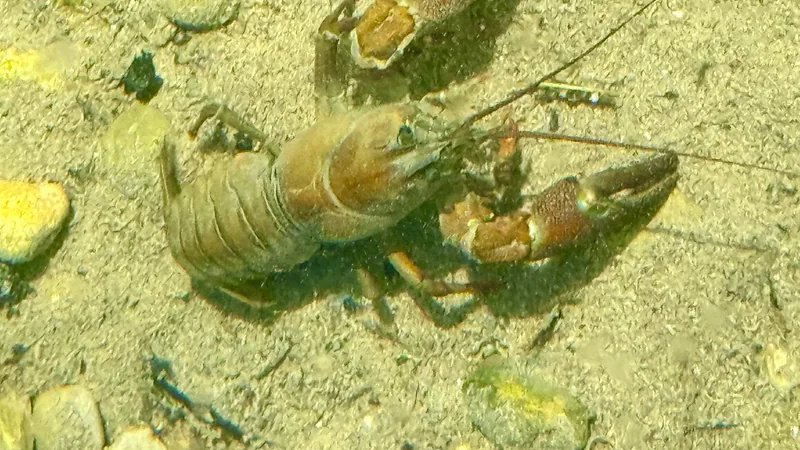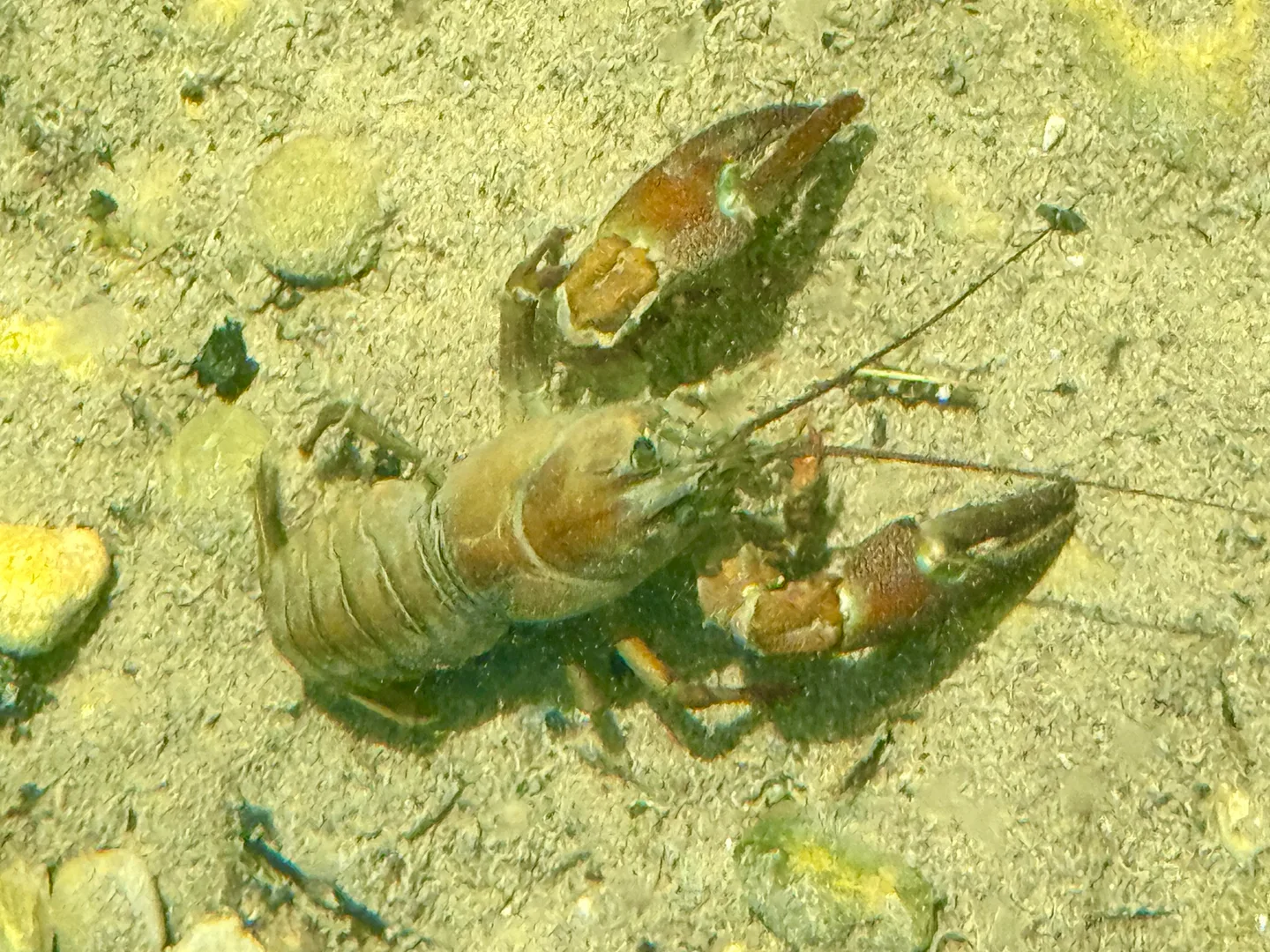
Signal Crayfish (Pacifastacus leniusculus), Steyr
Field
notes
A rescue that carried the disease
Europe’s native crayfish were dying of crayfish plague, a disease caused by a fungus-like organism called Aphanomyces astaci. Beginning in the 1960s, signal crayfish were imported to Sweden and introduced across Europe to build a plague-resistant stock that would supplement the stocks the plague had decimated.
The signal crayfish, Pacifastacus leniusculus, carries the plague itself. Its spread across Europe has helped the plague spread too, decimating native crayfish populations.
Plague carrier The signal crayfish is highly resistant to the plague. Asiatic, Australian and European crayfish are very susceptible to its ill effects.
Size and lifespan
Males can reach 16 cm long, while females reach a maximum of 12 cm. The average adult has a carapace, the hard shell over its head and chest, 50 to 70 mm long. Age at maturity varies from 1 to 3 years.
In the wild a signal crayfish may survive up to 9 years or more, and a life expectancy of up to 20 years is possible.
Red claws and a night shift
The back is typically brownish-tan. The claws are bright red underneath, and a white or turquoise patch sits at the base of each claw joint.
It is a nocturnal species, active at night. Its menu is opportunistic: aquatic plants, freshwater invertebrates and carrion, and it may eat more animal than plant material when it can. In crowded populations, competition and cannibalism can greatly affect survival. Females carry their eggs through the winter, usually 200 to 400 of them.
Native to the Northwest, invading Europe
At home it is native to the Columbia River Basin, whose tributaries reach into Washington, Oregon, Idaho and British Columbia, and south along Oregon’s coast to the Klamath River. It lives in everything from small streams to large rivers and natural lakes and tolerates water temperatures up to 33°C. People have also established it in new waters in Oregon, Washington, California, Nevada, Utah and Montana.
In Europe it now occurs in many countries, from the UK and France in the west to Russia in the east, and from Norway, Sweden and Finland in the north to the Iberian Peninsula in the south. It has also been introduced to Japan.
Crater Lake in Oregon had no signal crayfish until they were stocked there in 1915 to feed game fish. At sites with high crayfish density, benthic macroinvertebrate biomass, the weight of bottom-dwelling animals without backbones, was 99% lower than at low-density sites. The IUCN rates the species Least Concern.
Published
Traits
Intel
& FAQ
Guess
first
How big is a Signal Crayfish, really? Slide, lock in, and see what the sources say. Every answer is a figure from this page, quoted from where it came from.
Sources
- 01Signal Crayfish (Pacifastacus leniusculus) Ecological Risk Screening Summary. U.S. Fish and Wildlife Service.
- 02Pacifastacus leniusculus biological summary. Alaska Center for Conservation Science.
- 03Pacifastacus leniusculus species summary. Smithsonian Environmental Research Center, NEMESIS.
- 04Sbragaglia & Breithaupt (2021). Daily activity rhythms, chronotypes, and risk-taking behavior in the signal crayfish. Current Zoology.
- 05Schuster, Taylor & Cordeiro (2010). Pacifastacus leniusculus. The IUCN Red List of Threatened Species 2010: e.T153648A4526314.
What the sources say: 47 claims checked word for word against these sources →