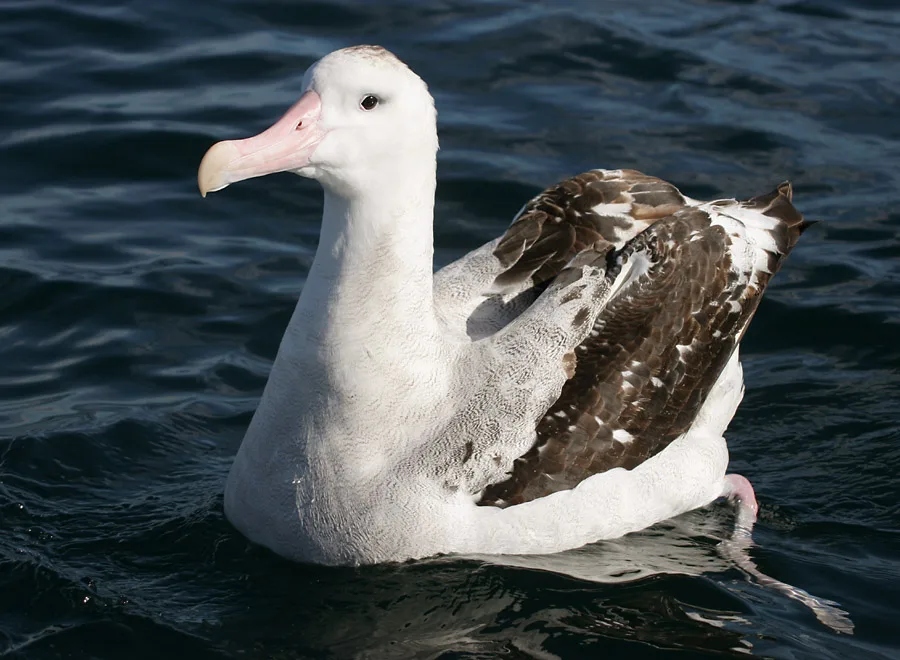
Wandering albatrosses on Prion Island, South Georgia
Field
notes
Wings Built for the Windiest Place on Earth
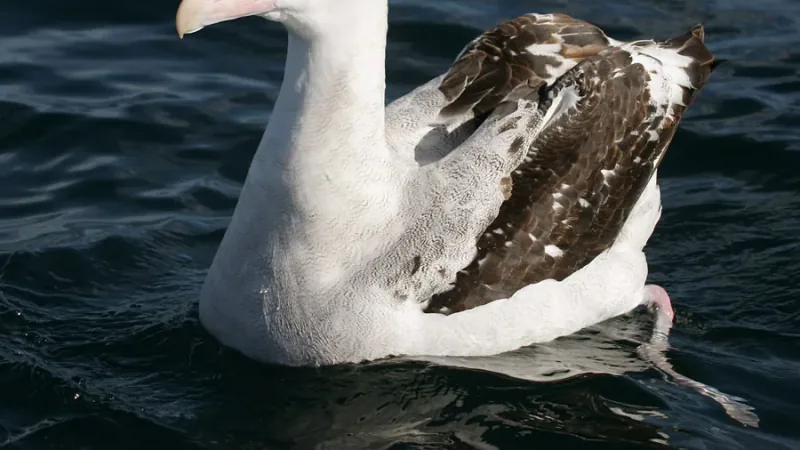
The wandering albatross has perhaps the longest wingspan of any bird. A note on names. Scientists have split the old wandering albatross into several species. The name Diomedea exulans now goes to the large form of the high southern latitudes, which is sometimes called the snowy albatross. Some sources, such as Animal Diversity Web (ADW), treat several of these forms as subspecies of one species, so this page says whose birds were measured.
D. exulans breeds on the French island groups of Crozet and Kerguelen, South Africa’s Prince Edward Islands, Australia’s Macquarie Island and South Georgia. Across all of ADW’s subspecies, wingspans run from 2.5 to 3.5 metres and average 3.1 metres. On the Crozet Islands, adult males averaged a wing span of 311 cm and a weight of 9.44 kg.
Fuel economy Cruising with a tail or side wind, a wandering albatross can fly fast while using little more energy than a bird resting on land. Effort peaks when it takes off from or lands on the water.
A Nose for Dinner
Fish and cephalopods (the squid and octopus group) are its main food, from about 50 squid species and 10 fish species, and Patagonian toothfish is the main fish. That food is patchy and spread over thousands of square kilometres of open ocean.
Smell helps. GPS loggers and stomach-temperature recorders showed that first detecting prey by smell was involved in nearly half (46.8%) of the flights that ended in a catch. Birds tracking a smell fly across the wind, then zigzag upwind toward the source. Birds that see their prey just fly straight at it.
A Very Slow Life
Breeding is a long game. It is a biennial breeder, normally nesting every other year, and lays a single egg. Incubation averages 78 to 79 days, and on South Georgia most chicks spend 278 days in the nest. On the Crozet Islands, birds hatched from 1982 to 1990 started breeding at an average age of 9.6 years for females and 10.4 for males.
In the year off between breeding attempts, a third of the tracked Crozet and Kerguelen birds that circled Antarctica went round twice, and two went round three times. Those double and triple trips covered 79,000 to more than 120,000 km. AnAge lists a maximum lifespan of 50 years in the wild, while noting that detailed studies are lacking. In a 30-year study, performance declined with age, then breeding success rose sharply at a bird’s final attempt.
Caught by Accident
The IUCN Red List (the global conservation list) rated the species Vulnerable in 2018. ADW says wandering albatrosses are highly vulnerable to becoming bycatch, meaning they are caught by accident in fishing gear, and attributes population declines mostly to it. During late chick-rearing and outside the breeding season, birds from Marion Island and Crozet overlap with intense tuna long-line fishing south of South Africa, where bycatch rates are high.
Published Updated
Traits
Intel
& FAQ
Guess
first
How big is a Wandering Albatross, really? Slide, lock in, and see what the sources say. Every answer is a figure from this page, quoted from where it came from.
Sources
- 01Diomedea exulans (wandering albatross). Animal Diversity Web, University of Michigan.
- 02Diomedea exulans. The IUCN Red List of Threatened Species 2018: e.T22698305A132640680.
- 03ACAP Species assessment: Wandering Albatross Diomedea exulans. Agreement on the Conservation of Albatrosses and Petrels.
- 04AnAge entry for Diomedea exulans. Human Ageing Genomic Resources, AnAge database.
- 05Shaffer, Weimerskirch & Costa (2001). Functional significance of sexual dimorphism in Wandering Albatrosses, Diomedea exulans. Functional Ecology.
- 06Weimerskirch et al. (2000). Fast and fuel efficient? Optimal use of wind by flying albatrosses. Proceedings of the Royal Society of London. Series B: Biological Sciences.
- 07Sachs et al. (2012). Flying at No Mechanical Energy Cost: Disclosing the Secret of Wandering Albatrosses. PLoS ONE.
- 08Nevitt, Losekoot & Weimerskirch (2008). Evidence for olfactory search in wandering albatross, Diomedea exulans. Proceedings of the National Academy of Sciences.
- 09Weimerskirch et al. (2015). Extreme variation in migration strategies between and within wandering albatross populations during their sabbatical year and their fitness consequences. Scientific Reports.
- 10Froy et al. (2013). Age-related variation in reproductive traits in the wandering albatross: evidence for terminal improvement following senescence. Ecology Letters.
What the sources say: 51 claims checked word for word against these sources →