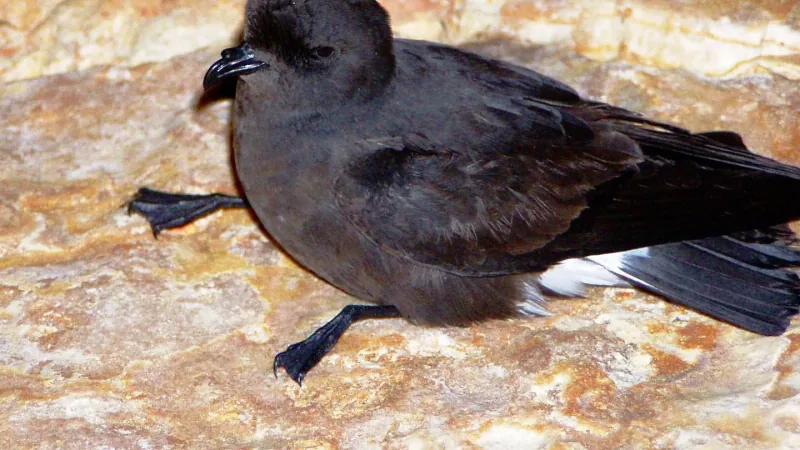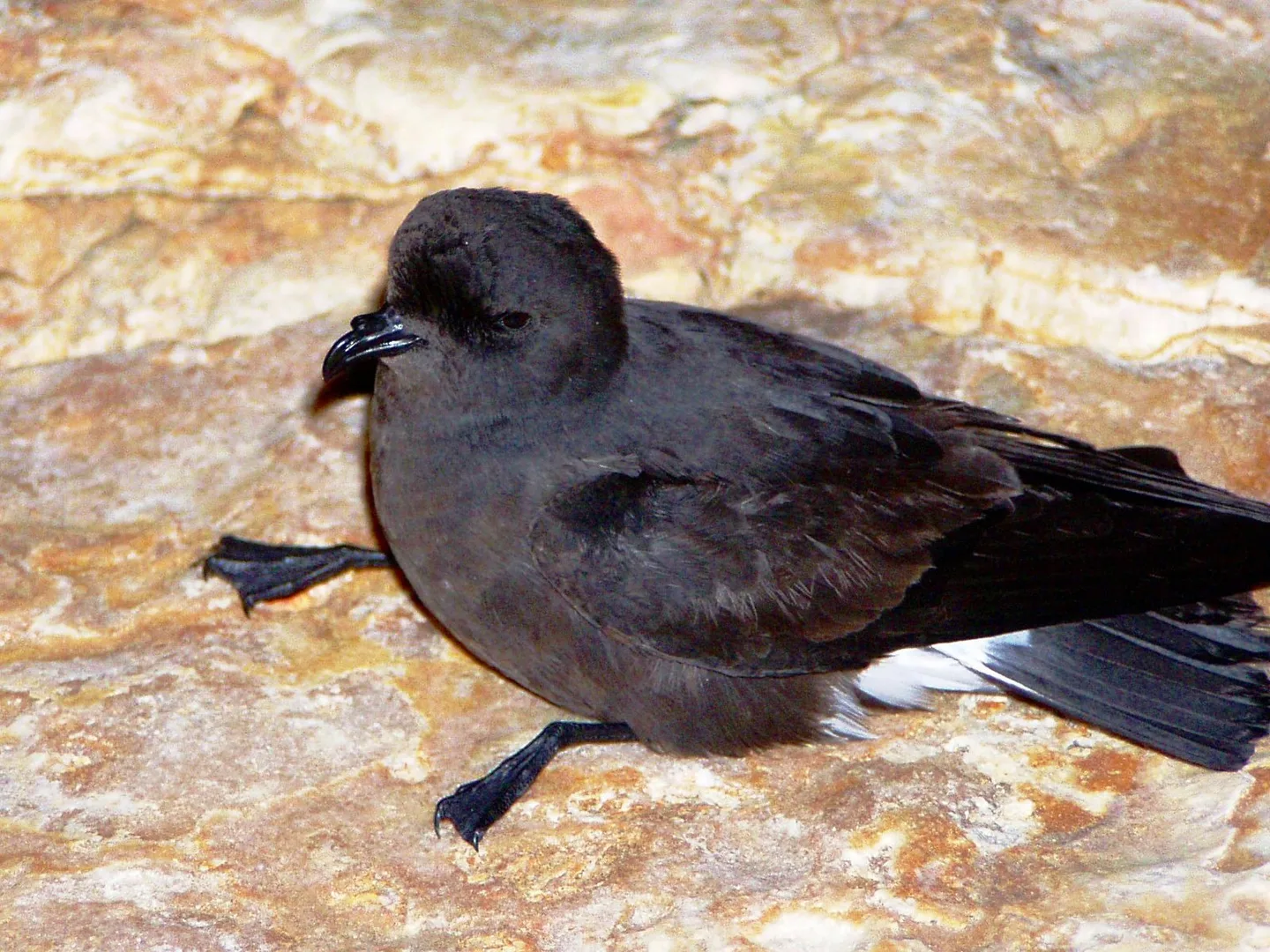
European Storm-petrel. Photographed on rock cliff upon release after being ringed.
Field
notes
The Atlantic’s Smallest Seabird
The European Storm Petrel (Hydrobates pelagicus) is the smallest seabird in the Atlantic Ocean. British ringing data show most adults weigh between 22.5 and 29.1 grams, with a wing just over 12 centimeters long. The oldest ringed storm petrel on the BTO’s books reached 38 years and 17 days, a record set in 2017, and the BTO gives a typical life expectancy of 11 years for a bird that reaches breeding age, with breeding typically starting at four. Despite its size, it migrates from breeding colonies in the north-east Atlantic to wintering grounds off southern Africa, in the south Atlantic and Indian oceans.
Fuel From Its Own Gut
A study of storm petrels breeding in artificial nest chambers measured how fast sitting birds burn energy, both from their carbon dioxide output and from how quickly they lose weight. A shift on the egg usually ends when the foraging partner returns, and the partner comes back once it has regained a threshold body mass of about 31 grams, however long it has spent at sea.
A gut that doubles as a fuel tank If a sitting storm petrel’s energy during incubation comes entirely from the oil stored in its stomach, as the study assumed, then burning that oil accounts for 76 percent of the weight it loses each day on the nest.
Hunting Where It’s Darkest
Many nocturnal seabirds forage more under moonlight, but GPS tracking of storm petrels from one colony found that offshore they forage under the darkest conditions, a pattern strongly influenced by cloud cover. The researchers suggest smell probably helps the birds detect patches of prey at night, and that bioluminescence may help them spot individual prey by eye. Atlantic birds feed mainly by hovering over the surface and picking off plankton, but the larger, heavier-billed Mediterranean subspecies, melitensis, feeds mainly by diving for pelagic fish.
Crevices, Scent and Rats
Storm petrels are active in their colonies only at night. On Shetland’s Mousa they nest in crevices in dry stone walls, boulder beaches, rock scree and abandoned buildings. Experiments found that chicks can apparently recognize their own body odor, even when tested against the scent of another storm petrel chick, and the researchers suggest such individual odors may help a bird recognize its nest. Mousa has no mice, rats or cats, and its only mammalian predator, the Eurasian otter, rarely takes storm petrel nests; a 2014 study reported that the colony had more than doubled in size since 1996. Across a survey of about 300 western Mediterranean islands, rat presence was a limiting factor, at the regional scale, only for the storm petrel’s abundance, while the three shearwater species there were shaped more by island characteristics.
Published Updated
Traits
Intel
& FAQ
Guess
first
How big is a European Storm Petrel, really? Slide, lock in, and see what the sources say. Every answer is a figure from this page, quoted from where it came from.
Sources
- 01Storm Petrel. BTO BirdFacts.
- 02Hydrobates pelagicus. The IUCN Red List of Threatened Species 2021: e.T22698477A166331807.
- 03Bolton (1996). Energy expenditure, body-weight and foraging performance of Storm Petrels Hydrobates pelagicus breeding in artificial nesting chambers. Ibis.
- 04Medeiros et al. (2012). Molecular Evidence for Gender Differences in the Migratory Behaviour of a Small Seabird. PLoS ONE.
- 05Wilkinson et al. (2026). Under the cover of darkness: Foraging behaviour increases on cloudy, new moon nights in a pelagic seabird. Ibis.
- 06Carboneras, Jutglar & Kirwan (2020). European Storm-Petrel (Hydrobates pelagicus). Birds of the World.
- 07Watson, Bolton & Monaghan (2014). Out of sight but not out of harm's way: Human disturbance reduces reproductive success of a cavity-nesting seabird. Biological Conservation.
- 08Ruffino et al. (2009). Invasive rats and seabirds after 2,000 years of an unwanted coexistence on Mediterranean islands. Biological Invasions.
- 09Belliure, Mínguez & De León (2003). Self-odour recognition in European storm-petrel chicks. Behaviour.
- 10Sanz-Aguilar et al. (2020). Infestation of small seabirds by Ornithodoros maritimus ticks: Effects on chick body condition, reproduction and associated infectious agents. Ticks and Tick-borne Diseases.
What the sources say: 43 claims checked word for word against these sources →