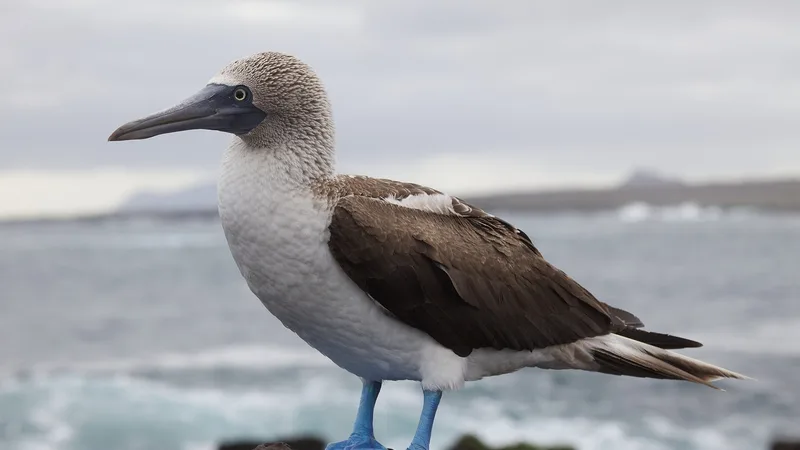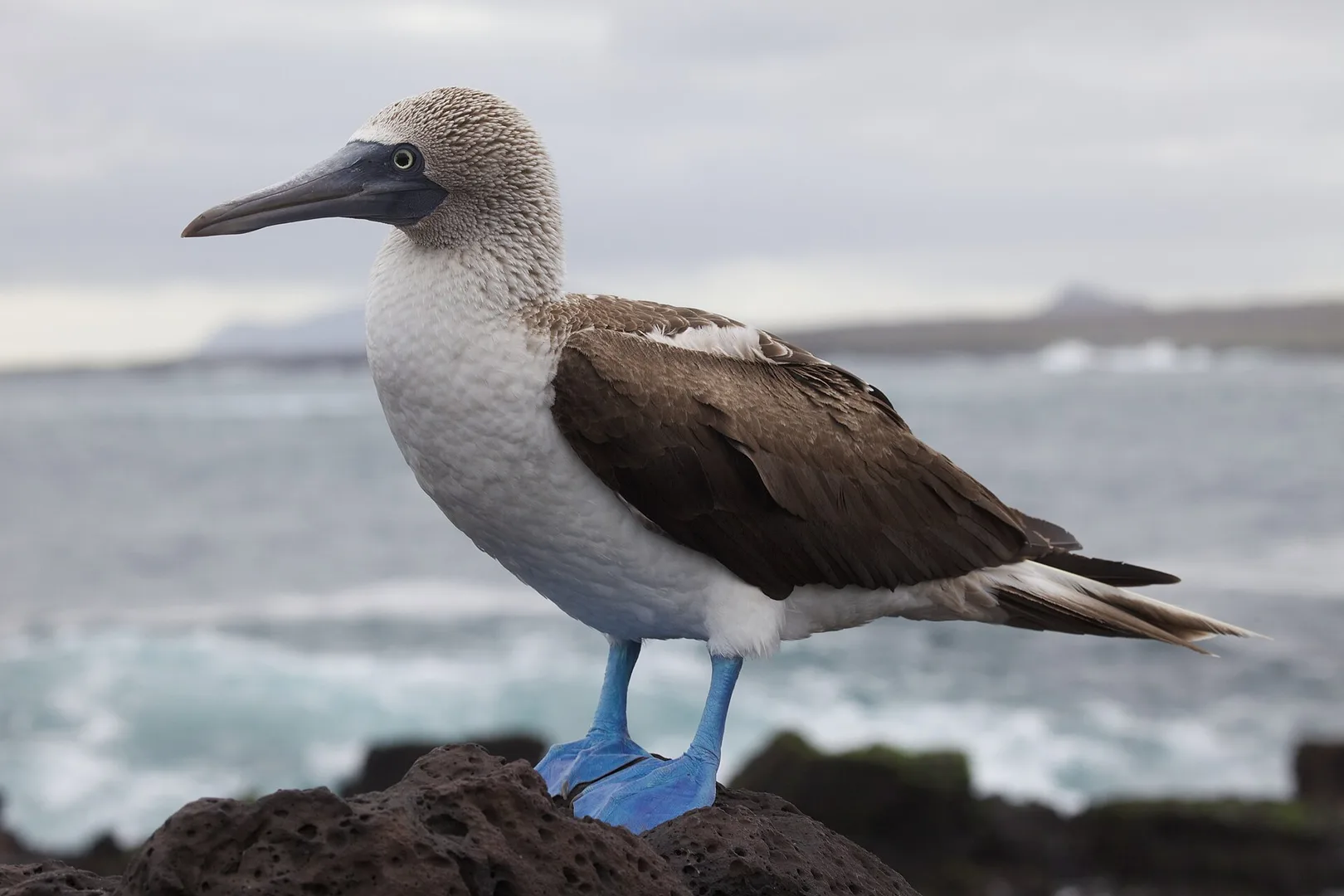
A Blue-footed Booby on Santa Cruz, Galapagos Islands, Ecuador.
Field
notes
The Booby That Dive-Bombs at Up to 60 Miles an Hour
The blue-footed booby (Sula nebouxii) folds back its wings and plunges: its dives can start more than 20 metres above the water, and it hits the surface at speeds up to 60 miles an hour. Its nostrils are permanently closed, which means it can swim underwater easily, and air sacs in its skull protect its brain from the impact of the dive.
Females measure 80 to 90 centimetres long and weigh 1.5 to 2 kilograms; males are smaller, at 80 to 85 centimetres and 1.2 to 1.6 kilograms. The sexes are adapted to catch prey of different sizes: the smaller male makes shallow dives, while the heavier female can dive deeper, farther offshore. The Galapagos Conservation Trust gives an average lifespan of 17 years.
Diving in Sync
Blue-footed boobies breed on arid islands off the Pacific coasts of tropical America, including the Galápagos, and in some years small numbers stray north into the southwestern United States, mainly to California’s Salton Sea. They hunt schools of small fish such as sardines and anchovies, often foraging in groups of up to 200 birds. A booby may feed alone, but flocks also hunt together: when one bird spots a fish, it whistles to alert the others, and the rest follow it into the water in perfectly synchronized movements.
Feet a Female Reads
A male’s foot color is both structural, built from arrays of collagen fibres in the skin, and pigment-based, from carotenoids, colored pigments in his food.
A Signal That Shifts in Two Days In one experiment, males’ feet turned duller within 48 hours when they were kept from food, and brighter when they were fed fresh fish again. Changing the carotenoids in their food shifted their immune function and foot color together. The researchers suggest the color is a rapid honest signal of a male’s current condition.
In a second experiment, researchers painted some males’ feet a duller blue with make-up the day after the first egg was laid, and their mates laid smaller second eggs than other females. In this species, brood reduction (the loss of a chick from a nest) is linked to size differences between chicks at hatching, and laying a lighter second egg makes it easier. The researchers say their data indicate that females keep evaluating their mates.
Courtship, Divorce, and Old Age
A courting male flaunts his blue feet in an exaggerated high-stepping walk and presents pieces of nest material to the female. Both birds also tip their bills to the sky: he gives a piercing whistle, and she answers with groaning calls.
Blue-footed boobies have a high divorce rate, but pairs that have been together longer do better. A study of 24 years of records found that they started their clutches five weeks earlier in the season and raised 35 percent more fledglings (chicks old enough to leave the nest), regardless of age or breeding experience.
A male’s breeding success rises at first, then falls steadily with age. Scientists gave males of two age groups a substance that sets off an immune response, which made them seem less likely to survive. Breeding success dropped in the mature males but rose 98 percent in the old ones. That fits terminal investment: the idea that animals should put more effort into breeding as they age and their chances of surviving and breeding again decline.
Published Updated
Traits
Intel
& FAQ
Guess
first
How big is a Blue-Footed Booby, really? Slide, lock in, and see what the sources say. Every answer is a figure from this page, quoted from where it came from.
Sources
- 01Sula nebouxii (blue-footed booby). Animal Diversity Web, University of Michigan.
- 02Blue-footed Booby. Audubon Field Guide, National Audubon Society.
- 03Blue-footed booby. Galapagos Conservation Trust.
- 04Velando, Beamonte-Barrientos & Torres (2006). Pigment-based skin colour in the blue-footed booby: an honest signal of current condition used by females to adjust reproductive investment. Oecologia.
- 05Velando, Drummond & Torres (2006). Senescent birds redouble reproductive effort when ill: confirmation of the terminal investment hypothesis. Proceedings of the Royal Society B: Biological Sciences.
- 06Sánchez-Macouzet, Rodríguez & Drummond (2014). Better stay together: pair bond duration increases individual fitness independent of age-related variation. Proceedings of the Royal Society B: Biological Sciences.
- 07Sula nebouxii. The IUCN Red List of Threatened Species 2021: e.T22696683A168988087.
What the sources say: 48 claims checked word for word against these sources →