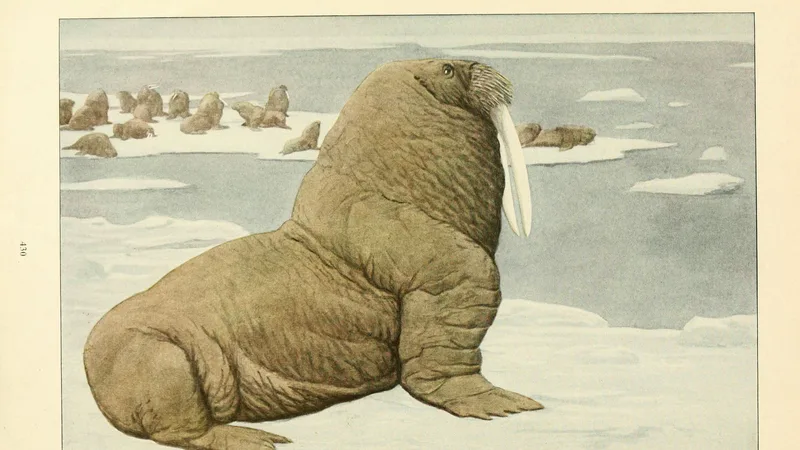
A walrus with its mouth open, resting in a crowd on Wahlbergøya, Svalbard.
Field
notes
A Mouth Built Like a Vacuum
A walrus eats by suction. Except for the tusks, its teeth are flat, so it pulls its piston-like tongue back quickly, and the powerful suction draws food into its mouth. It sucks the soft parts out of clams and snails and leaves the shells to fall to the seafloor. A walrus may eat 3,000 to 6,000 clams in a single feeding.
Walruses have short-range vision and often can’t see when they are on the ocean floor looking for food. To locate food, a walrus uses its whiskers, called vibrissae. It has about 400 to 700 of them on its snout, attached to muscles and supplied with blood and nerves. It moves its snout through the bottom sediment to find food. Walruses live in relatively shallow water, generally no more than 80 meters (262 feet) deep.
An Arctic Heavyweight
Adult males measure 2.7 to 3.6 meters (9 to 12 feet) long and weigh about 800 to 1,700 kilograms; females measure 2.3 to 3.1 meters (7.5 to 10 feet) and weigh about 400 to 1,250 kilograms. The Pacific subspecies is larger than the Atlantic. The walrus is the third-largest pinniped, the group that includes seals and sea lions.
That bulk comes wrapped in a tough hide that can be an inch thick and a blubber layer that may be up to 15 centimeters (6 inches) thick. In winter, blubber may make up a third of a walrus’s body mass. Most walruses live where the air temperature is about minus 15 to 5°C (5 to 41°F), and the blubber insulates them. Walruses may live up to 40 years.
Largest confirmed walrus An Atlantic walrus male from southeastern Svalbard, Norway, weighed 1,883 kilograms and measured 3.8 meters long.
What the Tusks Are Actually For
A walrus’s tusks are its upper canine teeth, and they grow throughout its life. They can reach 90 centimeters (about 3 feet), though roughly 50 centimeters is average. The wear on them shows they are dragged through the sediment, not used to dig up prey. To dig, a walrus may take in a mouthful of water and squirt powerful jets at the seafloor, excavating burrowing clams.
Their main jobs seem to be helping a walrus haul out onto ice and rocky shores and establishing social dominance. Females threaten and jab each other for better position on haulouts, and in the breeding season males threaten and fight with their tusks to compete for females. Two males with similar-sized tusks will usually fight and may stab each other, leaving bruises and punctures. The genus name Odobenus means “tooth-walker.”
Predators and Sea Ice
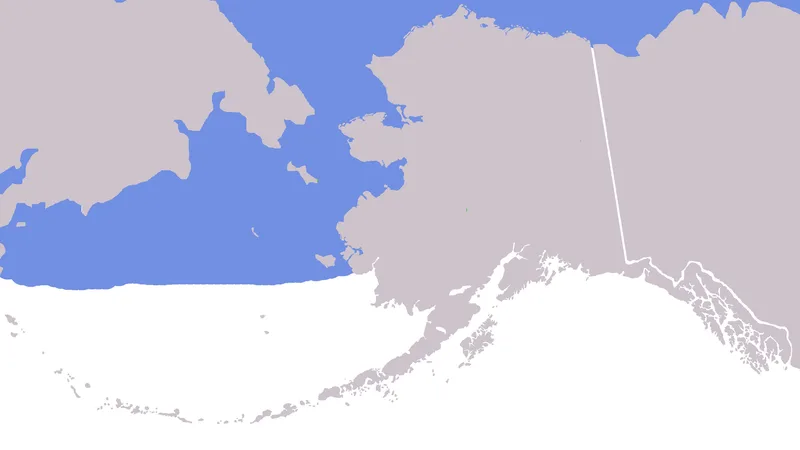
Walrus predators include polar bears and killer whales. Adults use their tusks as a weapon to defend themselves, and young walruses are more vulnerable to predation. Female walruses are known to become dangerously aggressive if their calf is threatened. Alaska’s wildlife agency also lists a reduction in sea ice among the potential threats to the Pacific walrus. Walruses use sea ice as a drifting platform for resting between foraging trips, giving birth and traveling. With less of it, Pacific walruses will likely spend more time on shore haulouts along the Russian and Alaskan coasts. On land haulouts, a disturbance can panic the herd into a rush for the water that runs over and crushes calves and yearlings. The IUCN lists the walrus as Vulnerable.
Published Updated
Traits
Intel
& FAQ
Guess
first
How big is a Walrus, really? Slide, lock in, and see what the sources say. Every answer is a figure from this page, quoted from where it came from.
Sources
- 01Walrus. Alaska Department of Fish and Game.
- 02Walrus. SeaWorld Parks & Entertainment, Animal Bytes.
- 03Odobenus rosmarus (walrus). Animal Diversity Web, University of Michigan.
- 04McClain et al. (2015). Sizing ocean giants: patterns of intraspecific size variation in marine megafauna. PeerJ.
- 05Larsen & Reichmuth (2021). Walruses produce intense impulse sounds by clap-induced cavitation during breeding displays. Royal Society Open Science.
- 06Kovacs (2025). Odobenus rosmarus. The IUCN Red List of Threatened Species 2025: e.T15106A272356023.
What the sources say: 60 claims checked word for word against these sources →