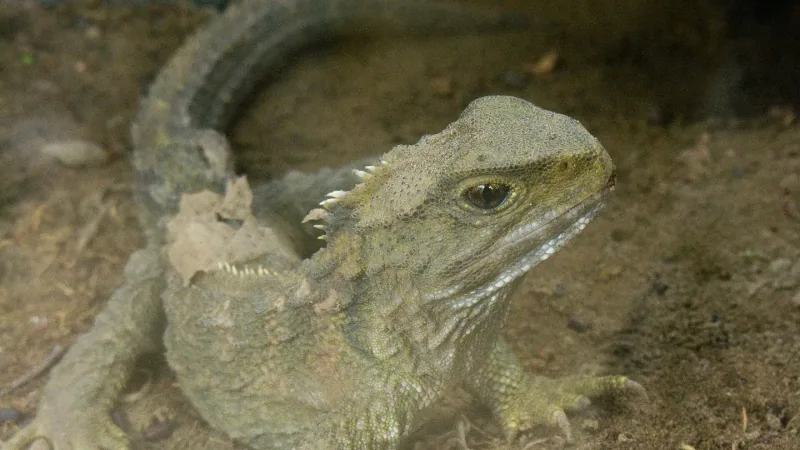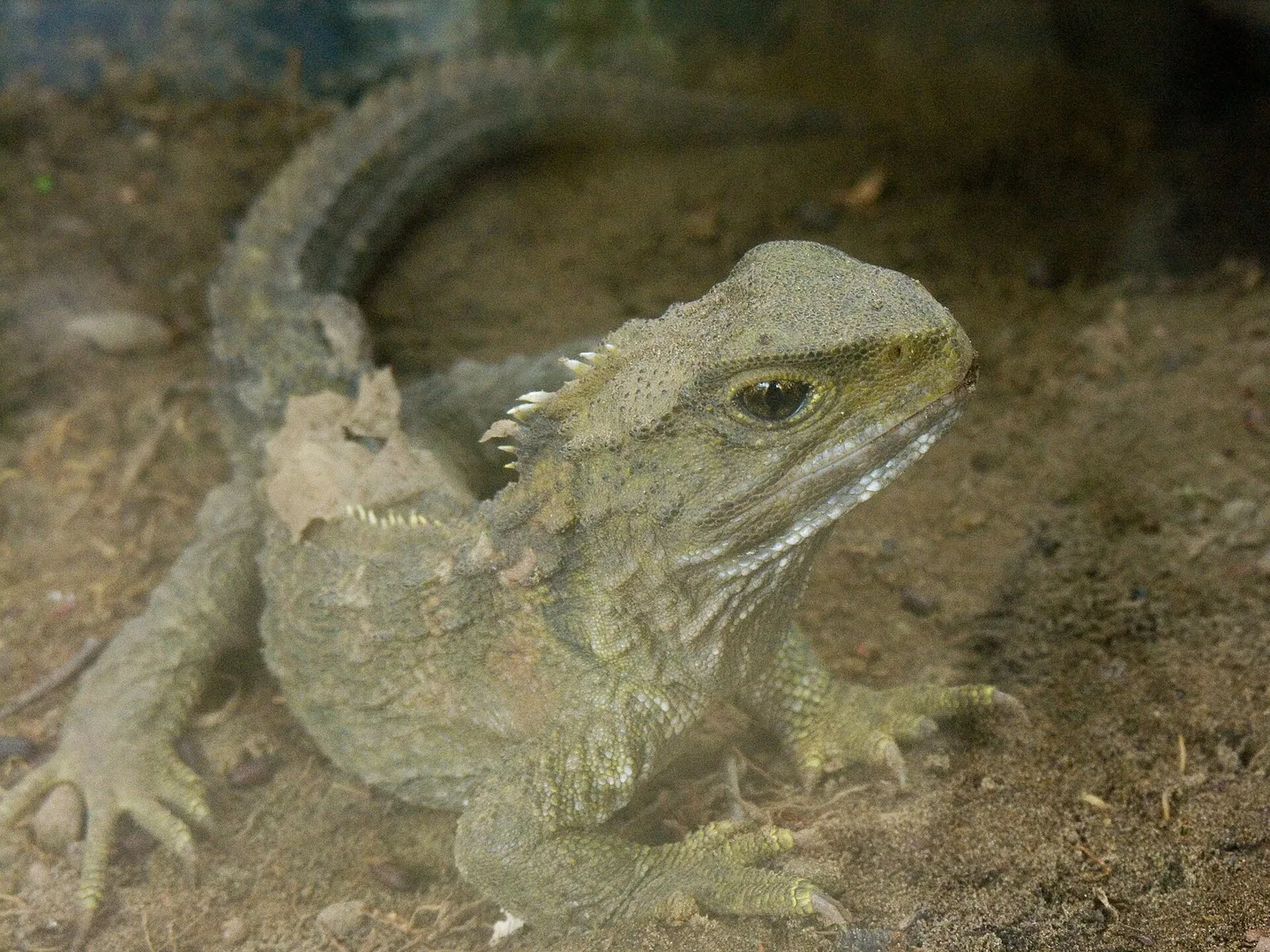
Sphenodon punctatus in Waikanae, New Zealand
Field
notes
On windswept islands off New Zealand lives the Tuatara (Sphenodon punctatus), the only living member of an entire reptile order, Rhynchocephalia. It looks like a lizard, but it is not one: the tuatara lineage split from the branch that led to every living lizard and snake around 250 million years ago. Adult males are about half a metre long and weigh up to 1.5 kilograms when fully grown, with a crest of spines along the neck and down the back that a male can raise to attract females or when fighting other males.
Slow Grower, Long Liver A tuatara keeps growing until it is about 35 years old, and its average life span is about 60 years, though it can live up to 100. In managed care, the San Diego Zoo gives a life span of up to 91 years.
A Living Fossil? Scientists Disagree
Animal Diversity Web puts it bluntly: “The tuatara has been falsely called a living fossil.” The label has often been applied because of the tuatara’s apparent close resemblance to its Mesozoic forebears. But Rhynchocephalia once held a much greater diversity of forms and was widespread across Gondwana, with its last fossils outside New Zealand dating to about 70 million years ago. One study of the group’s fossil skulls concluded the tuatara “is not the product of evolutionary stasis” but the only survivor of a diverse Mesozoic radiation whose decline remains unexplained. A 2017 study that put the label to a formal test came out in its favour: the living tuatara did evolve unusually slowly, and its anatomy sits near the centre of the range of forms seen across all Rhynchocephalia.
An Eye That Doesn’t Actually See
On top of the head, a tuatara has a third eye with a retina, lens and nerve endings. It isn’t used for seeing. In young tuatara it shows through the skin, but within a few months scales and pigment cover it, making it hard to spot. The eye is sensitive to light and may help the tuatara judge the time of day or the season.
Two Rows of Teeth, One Shearing Bite
A tuatara’s upper jaw carries two rows of teeth, and the one row on the lower jaw fits between them when the mouth is closed. After a closing, crushing bite, the lower tooth row slides forward between the upper rows in a propalineal movement, giving a shearing bite that cuts fragments off large prey. Its teeth are fused to the jawbone. Lost or broken teeth are not replaced, and older tuatara have to eat softer food as their teeth wear down. The diet is mostly invertebrates such as beetles, wētā, worms, millipedes and spiders, and the rest is lizards, seabird eggs and chicks.
Hanging On Offshore
In the wild, tuatara now survive on only 32 islands. Rats are considered their most serious threat, and there were probably few, if any, tuatara left on the North and South Islands by the time European settlers arrived. A 2020 genome study put the global population at around 100,000. The Brothers Island tuatara was once treated as a second species, Sphenodon guntheri, but that was dropped in 2009 after a genetic study concluded that tuatara is best described as a single species with distinctive geographic variants.
Published Updated
Traits
Intel
& FAQ
Guess
first
How big is a Tuatara, really? Slide, lock in, and see what the sources say. Every answer is a figure from this page, quoted from where it came from.
Sources
- 01Tuatara. New Zealand Department of Conservation.
- 02Tuatara. San Diego Zoo Wildlife Alliance.
- 03Gemmell et al. (2020). The tuatara genome reveals ancient features of amniote evolution. Nature.
- 04Sphenodon punctatus. Animal Diversity Web, University of Michigan.
- 05Meloro & Jones (2012). Tooth and cranial disparity in the fossil relatives of Sphenodon (Rhynchocephalia) dispute the persistent 'living fossil' label. Journal of Evolutionary Biology.
- 06Herrera-Flores, Stubbs & Benton (2017). Macroevolutionary patterns in Rhynchocephalia: is the tuatara (Sphenodon punctatus) a living fossil? Palaeontology.
- 07Hay et al. (2009). Genetic diversity and taxonomy: a reassessment of species designation in tuatara (Sphenodon: Reptilia). Conservation Genetics.
- 08Gorniak, Rosenberg & Gans (1982). Mastication in the tuatara, Sphenodon punctatus (reptilia: Rhynchocephalia): Structure and activity of the motor system. Journal of Morphology.
- 09Hitchmough (2019). Sphenodon punctatus. The IUCN Red List of Threatened Species 2019: e.T131735762A120191347.
What the sources say: 64 claims checked word for word against these sources →