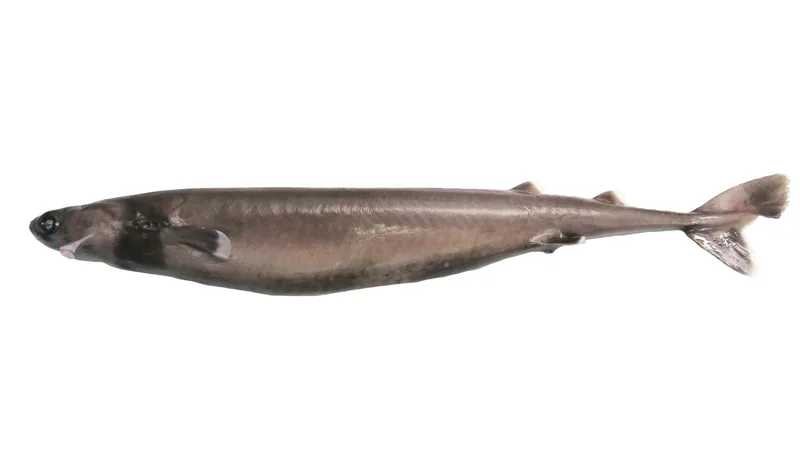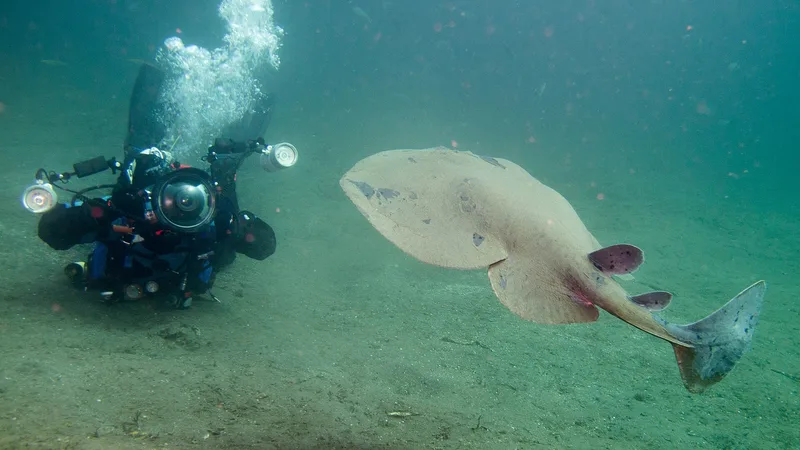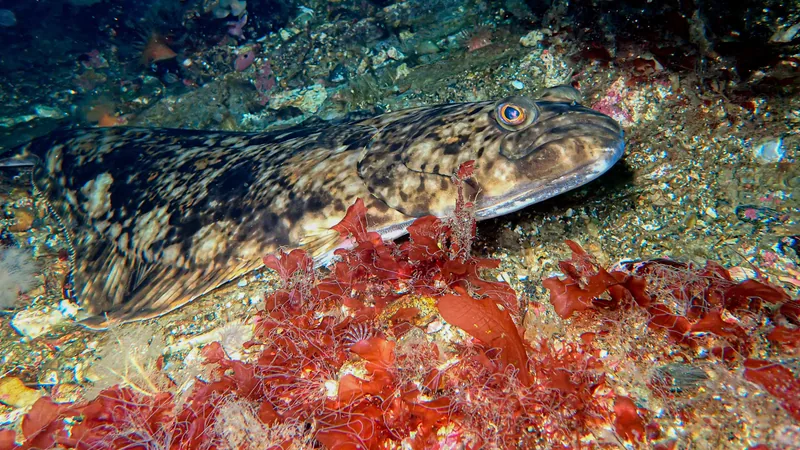
Torpedo nobiliana, now Tetronarce nobiliana, as illustrated by Gervais and Boulart
Field
notes
A Shock Built From a Stack of Batteries
Two kidney-shaped electric organs sit inside the pectoral fins on either side of its head, giving the skin a honeycomb-like appearance. They deliver a shock of 170 to 220 volts. A large adult’s shock is strong enough to disable a person, though it is extremely unlikely to stop a human heart.
Scientists studied the organs in rays brought to the Marine Biological Laboratory in Woods Hole, Massachusetts, in the summers of 1958 and 1959. Their paper describes each organ as 500 to 1,000 columns of flat cells called electroplaques, stacked one above the other. The voltages of the cells in one column add together, which scientists call series summation, like batteries wired in a row. The maximum peak power the team recorded was about 600 watts per organ.
Stacked like a roll of coins Each column of electroplaques runs the full thickness of the fish, and the Woods Hole study says the thickest columns probably hold more than 1,000 cells.
A Heavyweight Ambush Hunter
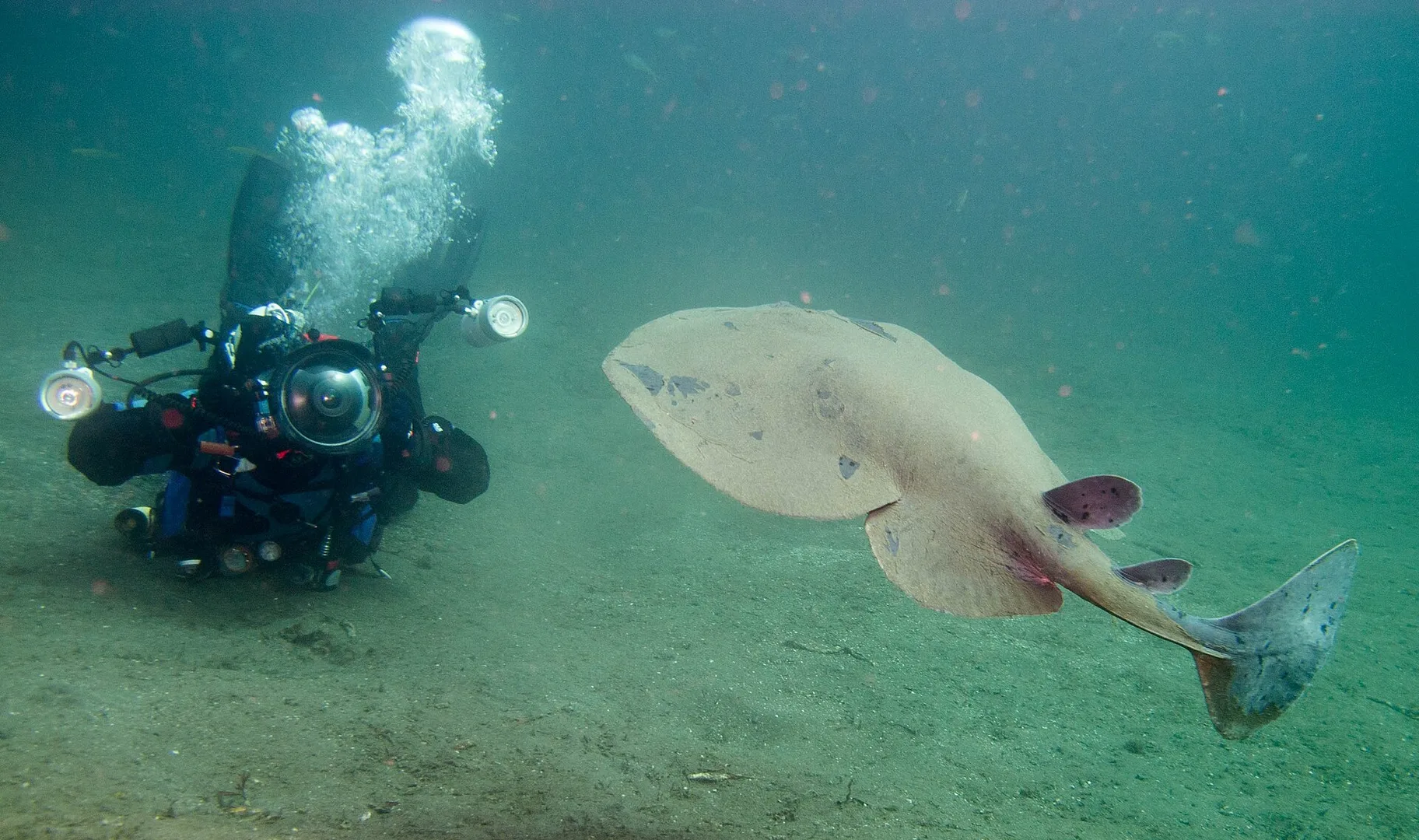
The maximum reported length of a great torpedo ray is 180 cm (70.9 in), and the maximum published weight is 90 kg (198 lb). They are usually 0.6 to 1.5 m long and seem heavy for their size. It prefers soft seabeds or coral reefs, where it can ambush prey. It wraps a fish in its pectoral fins and shocks it, which stuns or kills the fish before the torpedo eats it. Its jaws can distend, or stretch wide, letting it swallow fish bigger than its closed mouth makes seem possible. It eats mostly large bottom-dwelling and open-water fish, including sharks, dogfish, flounder and mullet.
From Scotland to South Africa
This ray lives in the eastern Atlantic and the Mediterranean, from Scotland south to Morocco, though not in the Black Sea. It also lives from Mauritania to the Gulf of Guinea, and from Namibia to South Africa. Adults live up in the water column, from 2 to 800 meters deep. Juveniles live on the bottom, over soft seabeds and coral reefs. The species is reported to migrate long distances. It has few natural predators due to its electric power and large size. Sharks and other large meat-eating fish seldom take on electric rays.
Ancient Medicine and Big Families
In ancient Greek and Roman times, its shock was used to treat gout (a painful joint disease), headaches and other illnesses. A torpedo ray is ovoviviparous, which means its babies grow inside the mother’s body. They feed first on yolk, then on a rich fluid called uterine “milk” enriched with mucus, fat and protein. Pregnancy is thought to last about a year. A female can give birth to as many as 60 pups, each about 20 cm (8 in) long. The IUCN Red List rates the great torpedo ray as a species of Least Concern.
Published Updated
Traits
Intel
& FAQ
Guess
first
How big is a Great Torpedo Ray, really? Slide, lock in, and see what the sources say. Every answer is a figure from this page, quoted from where it came from.
Sources
- 01Atlantic Torpedo. Florida Museum of Natural History.
- 02Bennett, Wurzel & Grundfest (1961). The Electrophysiology of Electric Organs of Marine Electric Fishes. The Journal of General Physiology.
- 03Finucci et al. (2021). Tetronarce nobiliana. The IUCN Red List of Threatened Species 2021: e.T116861529A116861706.
What the sources say: 41 claims checked word for word against these sources →