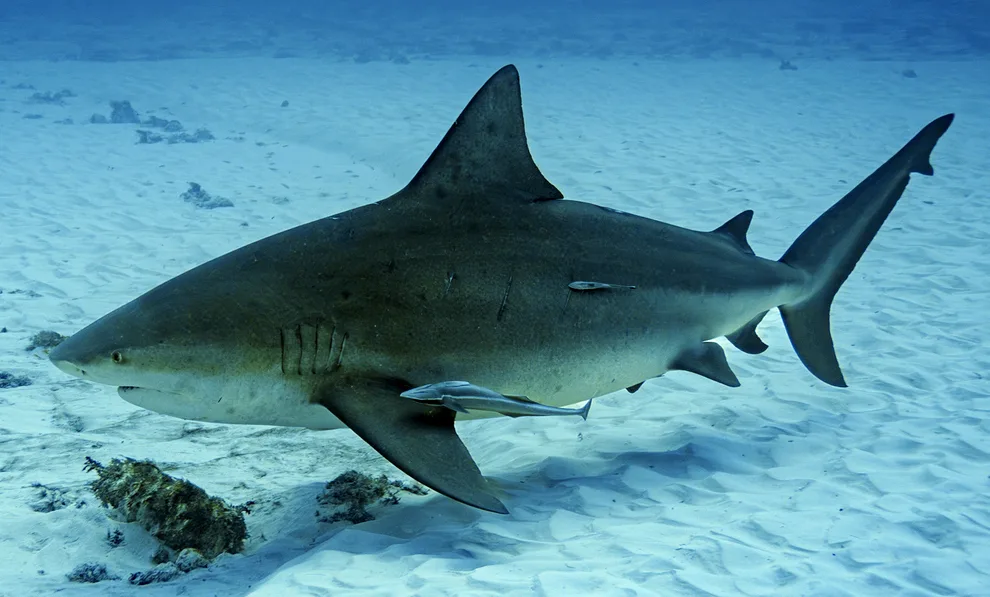
Adult Bull Shark (Carcharhinus leucas) cruising off Playa del Carmen, Mexico
Field
notes
A Shark That Swims Upriver
Bull sharks (Carcharhinus leucas) live in tropical to subtropical coastal waters around the world, preferring shallows less than 30 meters (100 feet) deep. They commonly push into estuaries, bays, harbors, lagoons and river mouths, and they are one of very few sharks that readily move into freshwater. They have been reported 3,700 kilometers (about 2,300 miles) up the Amazon River in Peru and more than 3,000 kilometers (1,800 miles) up the Mississippi, in Illinois. The bull sharks of Lake Nicaragua were once thought to be trapped there, until researchers found they reach the ocean through a system of rivers and estuaries.
Blood That Changes With the Water
Sharks and rays hold on to a chemical called urea, so their body fluids are as concentrated as the seawater around them, or slightly more. A study that caught bull sharks along a gradient from freshwater to seawater found the freshwater sharks carried about half as much urea in their blood: 192 millimoles per liter, against 370 in sharks from the sea. Their sodium and chloride were lower too, yet at every salinity their blood stayed more concentrated than the water outside. Urea rose sharply between 28 and 33 parts per thousand of salt.
In sharks and rays that move between salt and fresh water, the kidneys, rectal gland and liver work together to handle the change. In the gills of bull sharks caught in freshwater, the genes for two sodium-handling transporters were more active than in sharks from saltier water, which may help the gills take up sodium in freshwater.
Fresh, salty and saltier Bull sharks are found in both salt and fresh water, and they can also tolerate hypersaline water, saltier than the sea, as high as 53 parts per thousand.
A Stout Body and a Heavy Bite
The name comes from the shark’s stout build and its reputation for aggressive behavior. Bull sharks are thick-bodied with a blunt, rounded snout, and can grow to about 3.4 meters (11 feet) long; the longest reported measured 4 meters (13 feet). Their eyes are smaller than those of most other requiem sharks, which suggests vision may matter less to a species that often lives in murky water.
Bony fish and small sharks make up the vast majority of the diet, and in inshore nurseries they also eat stingrays and young sharks, including small bull sharks. They look sluggish cruising along the bottom, and have been recorded moving at over 19 km/h (11 mph) in short bursts.
A 2012 study calculated the bite force of bull sharks 73 to 285 centimeters long. At the back of the jaws, the theoretical bite ranged from 170 to 5,914 newtons, about 1,330 pounds of force at the top end. Compared with 12 other cartilaginous fishes, bull sharks had the highest bite force for their body mass, beating the great white and the great hammerhead.
Published Updated
Traits
Intel
& FAQ
Guess
first
How big is a Bull Shark, really? Slide, lock in, and see what the sources say. Every answer is a figure from this page, quoted from where it came from.
Sources
- 01Carcharhinus leucas. Florida Museum of Natural History, Ichthyology.
- 02Habegger et al. (2012). Feeding biomechanics and theoretical calculations of bite force in bull sharks (Carcharhinus leucas) during ontogeny. Zoology.
- 03Pillans & Franklin (2004). Plasma osmolyte concentrations and rectal gland mass of bull sharks Carcharhinus leucas, captured along a salinity gradient. Comparative Biochemistry and Physiology Part A: Molecular & Integrative Physiology.
- 04Reilly et al. (2011). Branchial osmoregulation in the euryhaline bull shark, Carcharhinus leucas: a molecular analysis of ion transporters. Journal of Experimental Biology.
- 05Bull Shark, Carcharhinus leucas Report Card. Shark and Ray Report Card, Fisheries Research and Development Corporation.
- 06Hazon et al. (2003). Urea based osmoregulation and endocrine control in elasmobranch fish with special reference to euryhalinity. Comparative Biochemistry and Physiology Part B: Biochemistry and Molecular Biology.
- 07Species Implicated in Attacks. International Shark Attack File, Florida Museum of Natural History.
What the sources say: 40 claims checked word for word against these sources →