Chlamydoselachus anguineus
Field
notes
An Eel Wearing a Shark’s Head
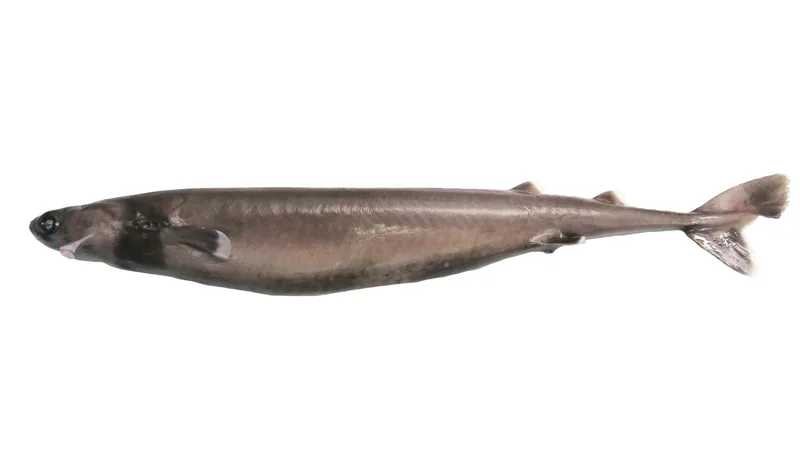
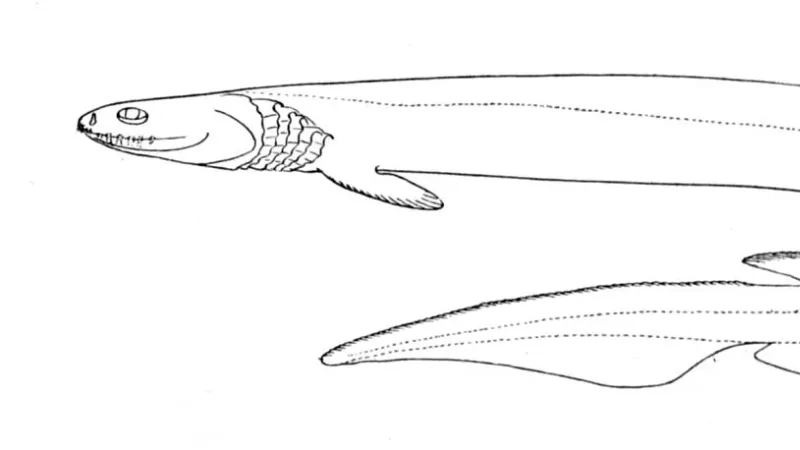
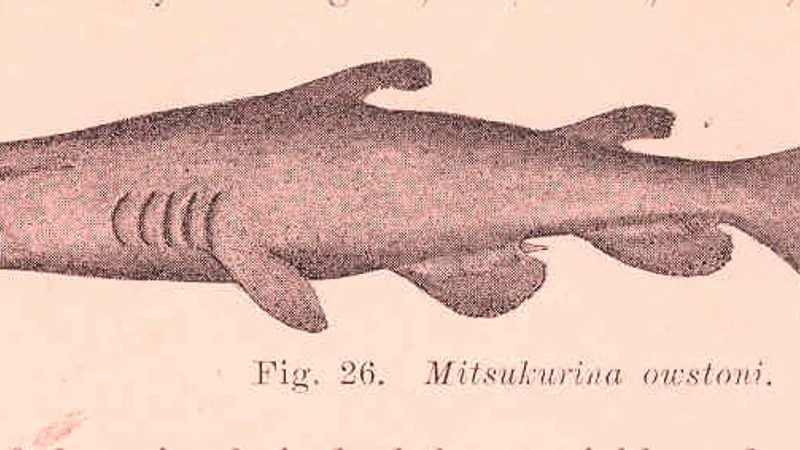
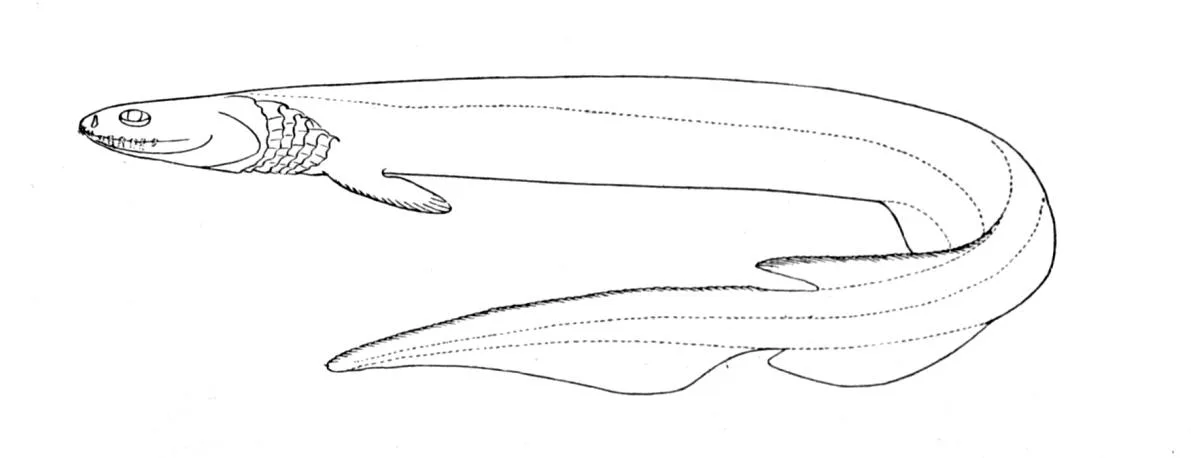
The Frilled Shark (Chlamydoselachus anguineus) looks like it was assembled from spare parts: a long, eel-like body, usually chocolate brown, that grows to an average total length of about 150 cm, with the largest on record at 196 cm. Most sharks breathe through five gill slits. This one has six, each edged with a frilly margin of skin, which is how it got its name. The teeth on both jaws each carry three long, sharp points, a shape scientists call tricuspid.
It’s also in no hurry. The frilled shark is among the slowest of shark species, and usually lives along outer continental shelves and continental slopes.
Pregnant for Years
Frilled sharks give birth to live young rather than laying eggs. Embryos hatch inside the mother’s body at just 5.5 cm long, then keep growing on their own yolk supply until they’re born at 40 to 60 cm, usually in litters of two to 10. One estimate puts the pregnancy at 3.5 years, which a 2020 study calls the longest gestation known for any vertebrate, though other estimates run as low as one to two years.
Older Than It Looks Possible Mitochondrial DNA analysis puts the frilled shark’s own lineage at roughly 82 million years old, a figure that broadly matches the fossil record of its wider group, which goes back about 85 million years.
Rare, Deep, and Split in Two
Frilled sharks are rarely seen, with a wide-ranging but patchy distribution in the Atlantic and Pacific Oceans, usually at depths of 120 to 1,500 metres. They have been recorded as bycatch in trawl and bottom longline fisheries throughout their range.
Sharks from off southern Angola, Namibia and South Africa, long believed to be the same species, turned out in 2009 to differ on the inside: in the structure of the skull and in their vertebra, spiral valve and fin-cartilage counts. They were named a species of their own, Chlamydoselachus africana.
A Squid Eater With an Empty Stomach
Stomach checks on 139 frilled sharks caught in Suruga Bay, Japan, between 1984 and 1988 found squid in most of the stomachs that held any food, and fish in some. Nearly three-quarters of the sharks had empty stomachs, an extremely high rate compared with other deep-water sharks. The 77 females in that sample weighed between 6.2 and 12.1 kg; the 62 males were smaller, between 3.2 and 5.7 kg. Separately, a 1,618 mm frilled shark caught off Choshi, Japan, had eaten a 590 g shark, Apristurus japonicus, reported as the first documented case of a frilled shark preying on another shark.
Published Updated
Traits
Intel
& FAQ
Guess
first
How big is a Frilled Shark, really? Slide, lock in, and see what the sources say. Every answer is a figure from this page, quoted from where it came from.
Sources
- 01Chlamydoselachus anguineus (frill shark). Animal Diversity Web, University of Michigan.
- 02Finucci & Charles (2024). Chlamydoselachus anguineus. The IUCN Red List of Threatened Species 2024: e.T41794A124416882.
- 03López-Romero et al. (2020). Growth trajectories of prenatal embryos of the deep-sea shark Chlamydoselachus anguineus (Chondrichthyes). Journal of Fish Biology.
- 04Tanaka et al. (2013). Evolutionary Relations of Hexanchiformes Deep-Sea Sharks Elucidated by Whole Mitochondrial Genome Sequences. BioMed Research International.
- 05Indurain et al. (2025). New record of Frilled shark Chlamydoselachus anguineus Garman, 1884 (Chondrichthyes: Hexanchiformes) in the South Pacific Ocean. PeerJ.
- 06Kubota, Shiobara & Kubodera (1991). Food habits of the frilled shark Chlamydoselachus anguineus collected from Suruga Bay, central Japan. Nippon Suisan Gakkaishi.
- 07Ebert & Compagno (2009). Chlamydoselachus africana, a new species of frilled shark from southern Africa (Chondrichthyes, Hexanchiformes, Chlamydoselachidae). Zootaxa.
- 08Kobayashi, Tomonaga & Tanaka (1992). Identification of a second immunoglobulin in the most primitive shark, the frill shark, Chlamydoselachus anguineus. Developmental & Comparative Immunology.
- 09Goto & Hashimoto (1976). Studies on the teeth of Chlamydoselachus anguineus, a living archaic fish. Japanese Journal of Oral Biology.
What the sources say: 51 claims checked word for word against these sources →