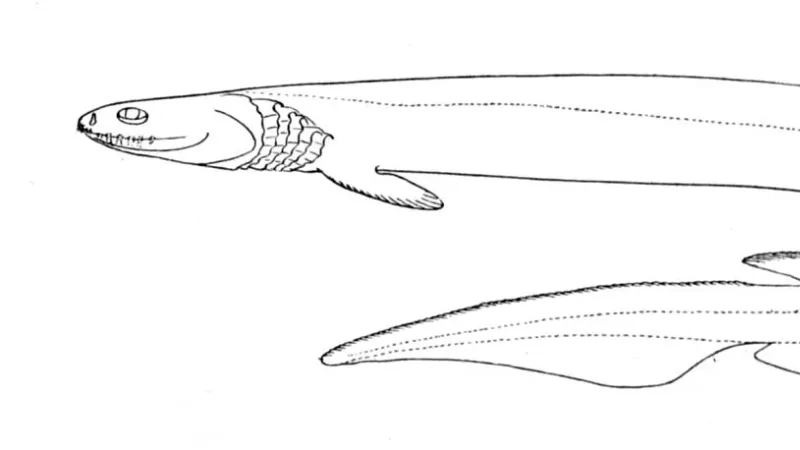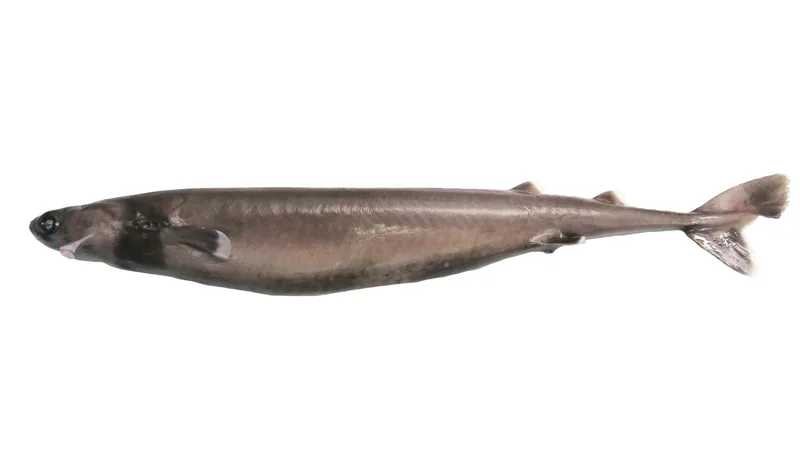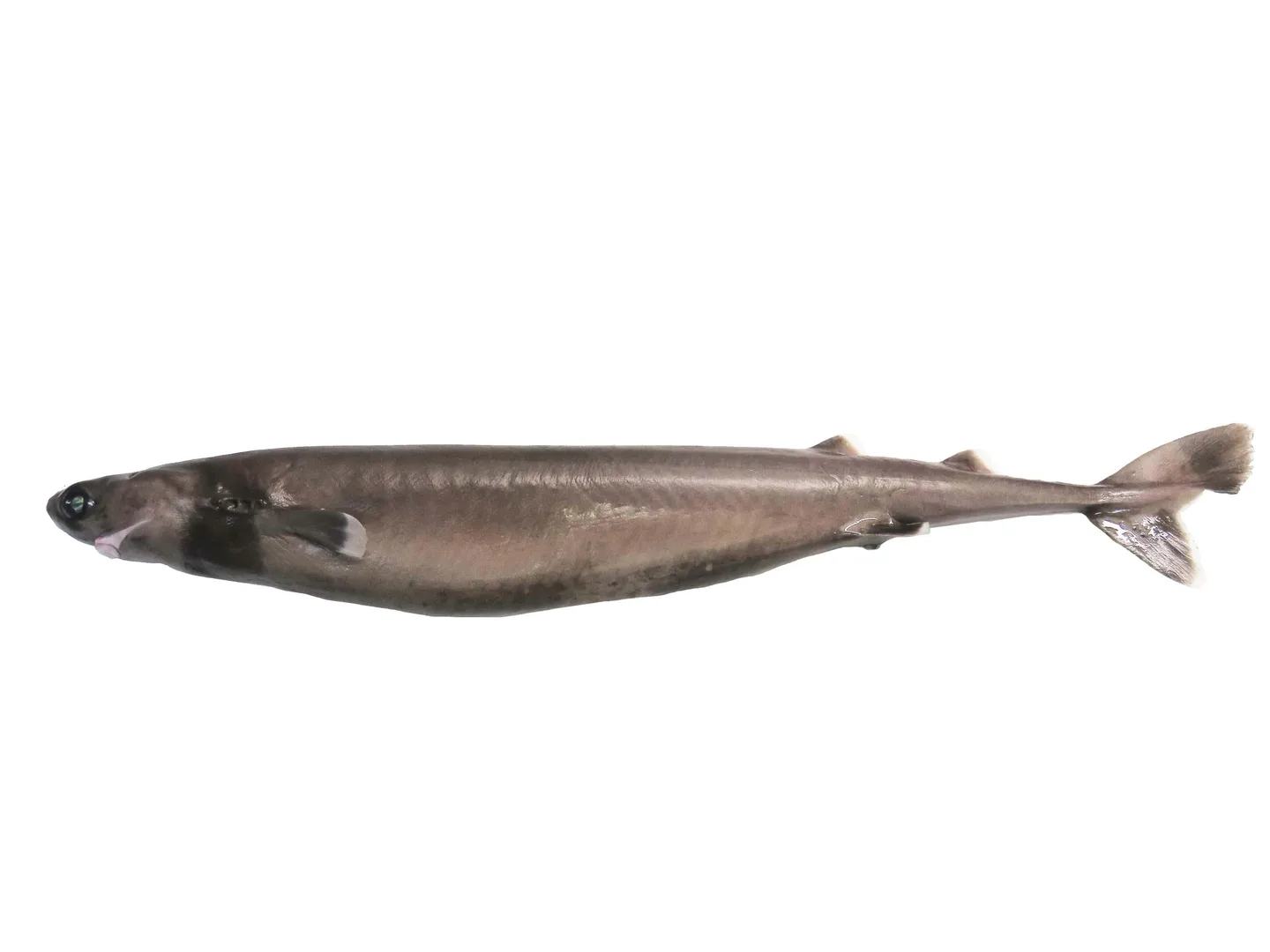
A cookiecutter shark from Réunion on a white background. No freely licensed photo of a live one exists.
Field
notes
Bait with teeth
The cookiecutter shark turns its own belly into a lure. Its underside is covered in photophores, tiny light-producing organs that give off a greenish glow. The only gap on the underside is a dark collar around the gill region. The glow attracts fish, whales and sharks, and it appears similar to a small fish. The shark bites when they come close.
Cookie-shaped hole It grips with sucking lips and upper teeth, then spins its body to cut a cookie-shaped plug out of its prey with its larger lower teeth.
The prey is left with a perfectly round, cookie-cutter-shaped hole in its side.
A small shark with huge targets
Males grow to a maximum of 42 cm and females to 56 cm. Fifteen caught off Hawaii in 2013 weighed 213 g on average. The small, cigar-shaped shark can be called a parasite, because it feeds on larger animals without killing them. The Florida Museum lists marlin, wahoo, tuna, sharks, stingrays, seals, whales and dolphins among its prey. It also eats squid, and many squid remains found in cookiecutter stomachs were estimated to come from squid often as large as the sharks themselves. There are even reports of crater marks on the sonar domes of nuclear submarines.
Up at night, down by day
Cookiecutter sharks live in tropical and subtropical oceans around the world. They are found from the Bahamas to southern Brazil in the western Atlantic, and from Mauritius to New Guinea, New Zealand, Japan and the Hawaiian Islands in the Indo-Pacific. By day they stay below 1,000 m. At night they rise to the surface waters to feed, a daily trip scientists call vertical migration.
Of the six bites by cookiecutter sharks (genus Isistius) on live people in Hawaiian waters, five came with the moon set and after dark. Even so, the Florida Museum considers the shark harmless to humans because of its size and deep-water habits.
Teeth that go down the hatch
The teeth are connected at the base and lost as one complete unit, rather than one at a time like most sharks. It swallows its shed lower teeth, which is thought to help maintain the calcium in its body. A litter holds 6 to 12 live young. The IUCN Red List rates the species Least Concern.
Published Updated
Traits
Intel
& FAQ
Guess
first
How big is a Cookiecutter Shark, really? Slide, lock in, and see what the sources say. Every answer is a figure from this page, quoted from where it came from.
Sources
- 01Kyne (2018). Isistius brasiliensis. The IUCN Red List of Threatened Species 2018: e.T41830A2956761.
- 02Carlisle et al. (2021). Integrating multiple chemical tracers to elucidate the diet and habitat of Cookiecutter Sharks. Scientific Reports.
- 03Minaglia & Liegl (2024). Moonless night sky increases Isistius species (cookiecutter shark) and live human contact. PLOS ONE.
What the sources say: 41 claims checked word for word against these sources →